

CARACTÉRISTIQUES TECHNIQUES
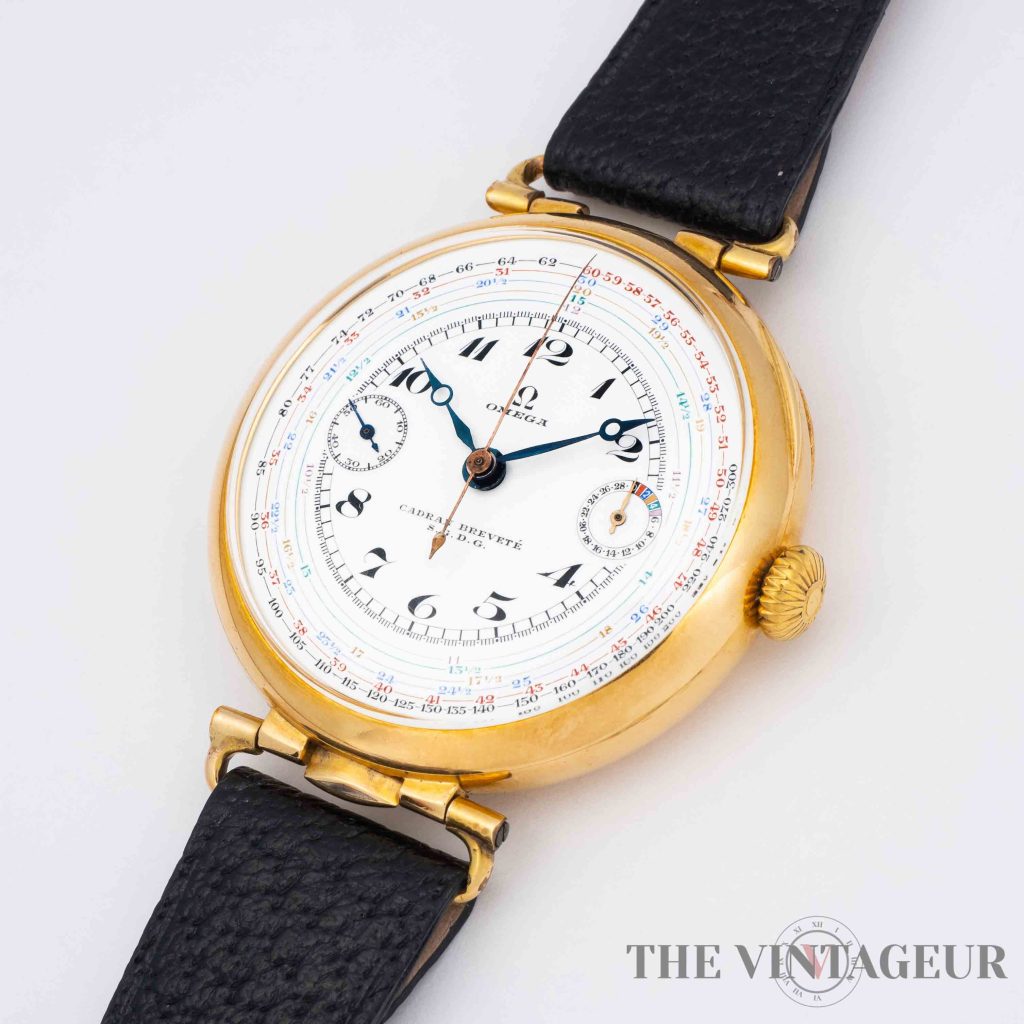
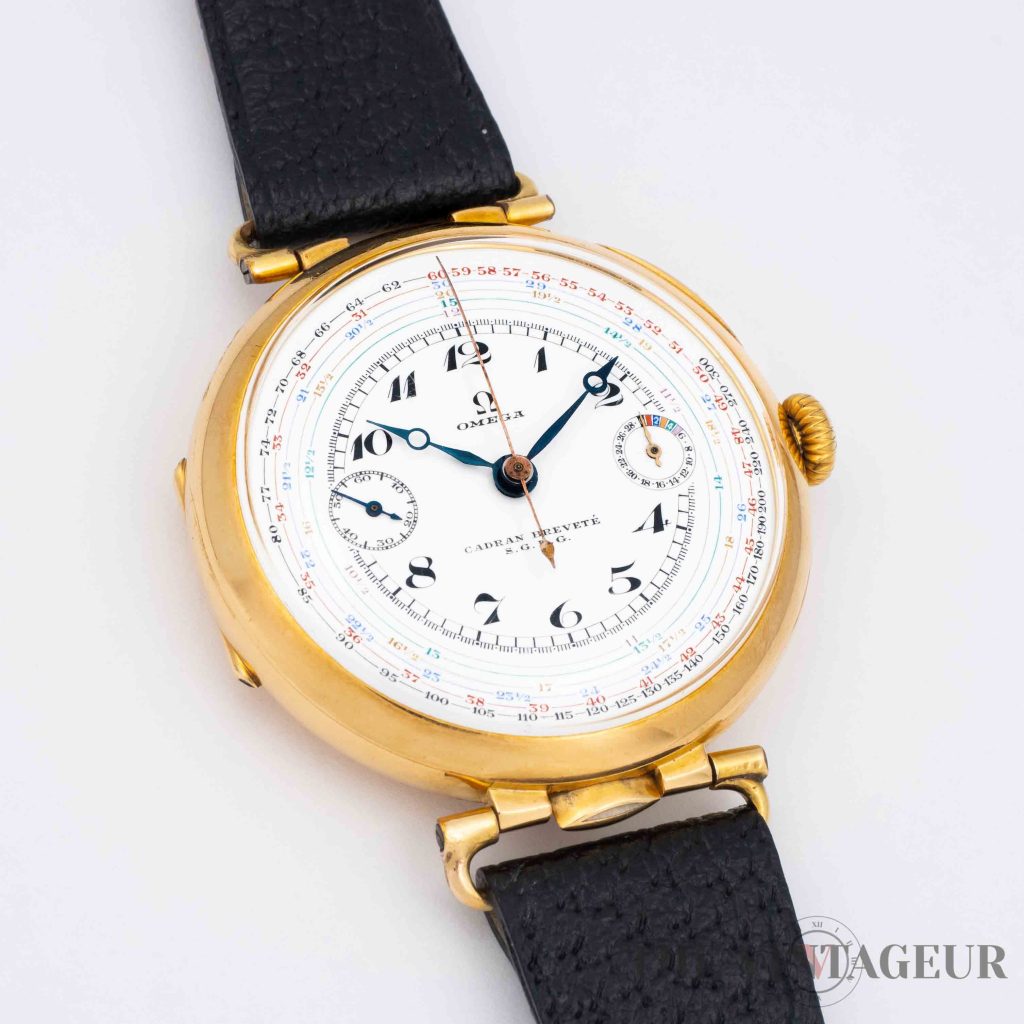
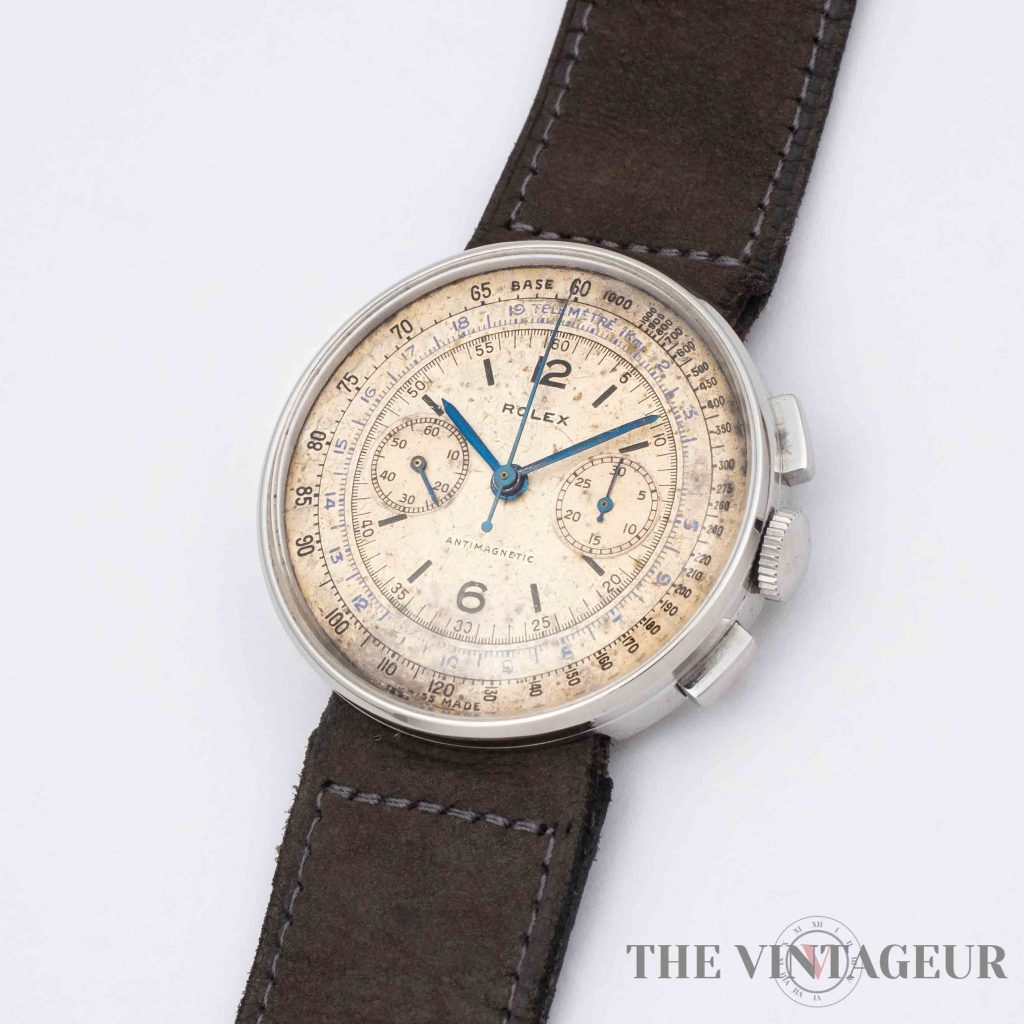
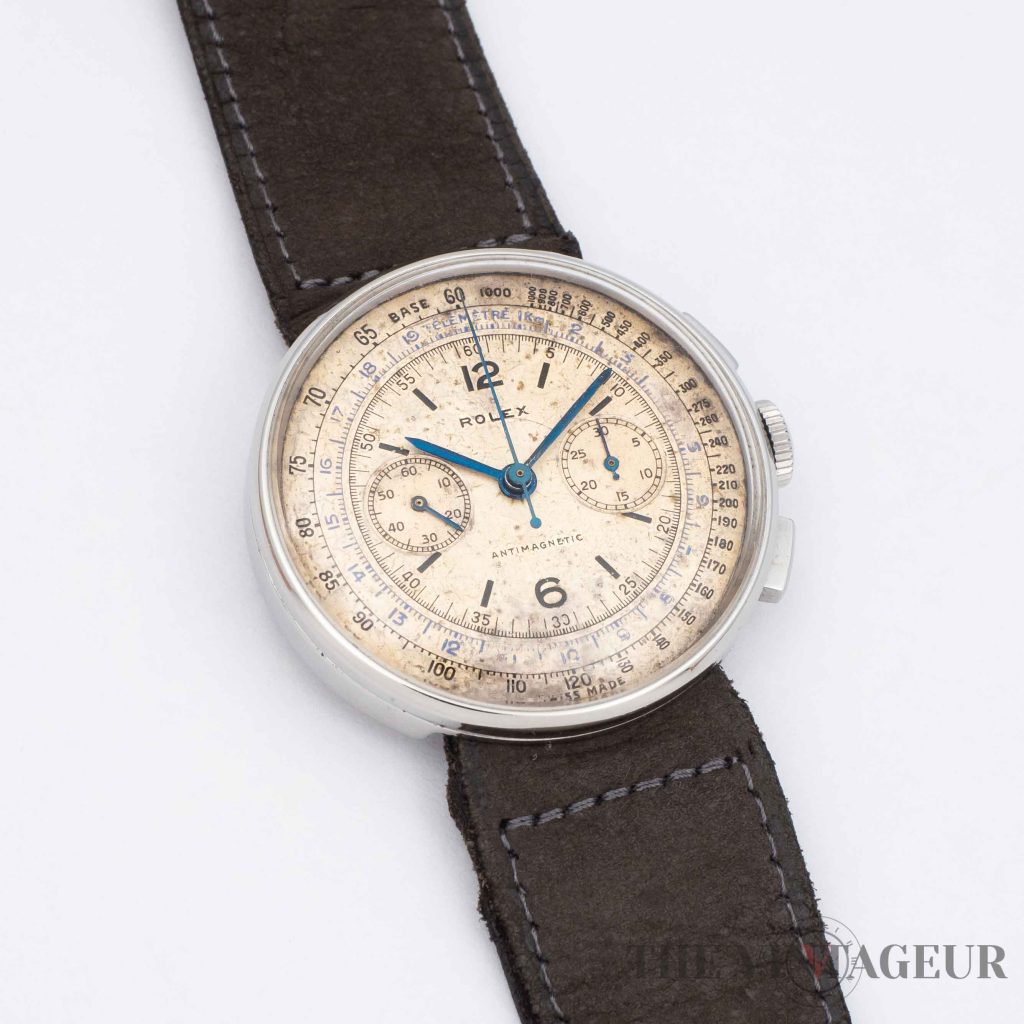
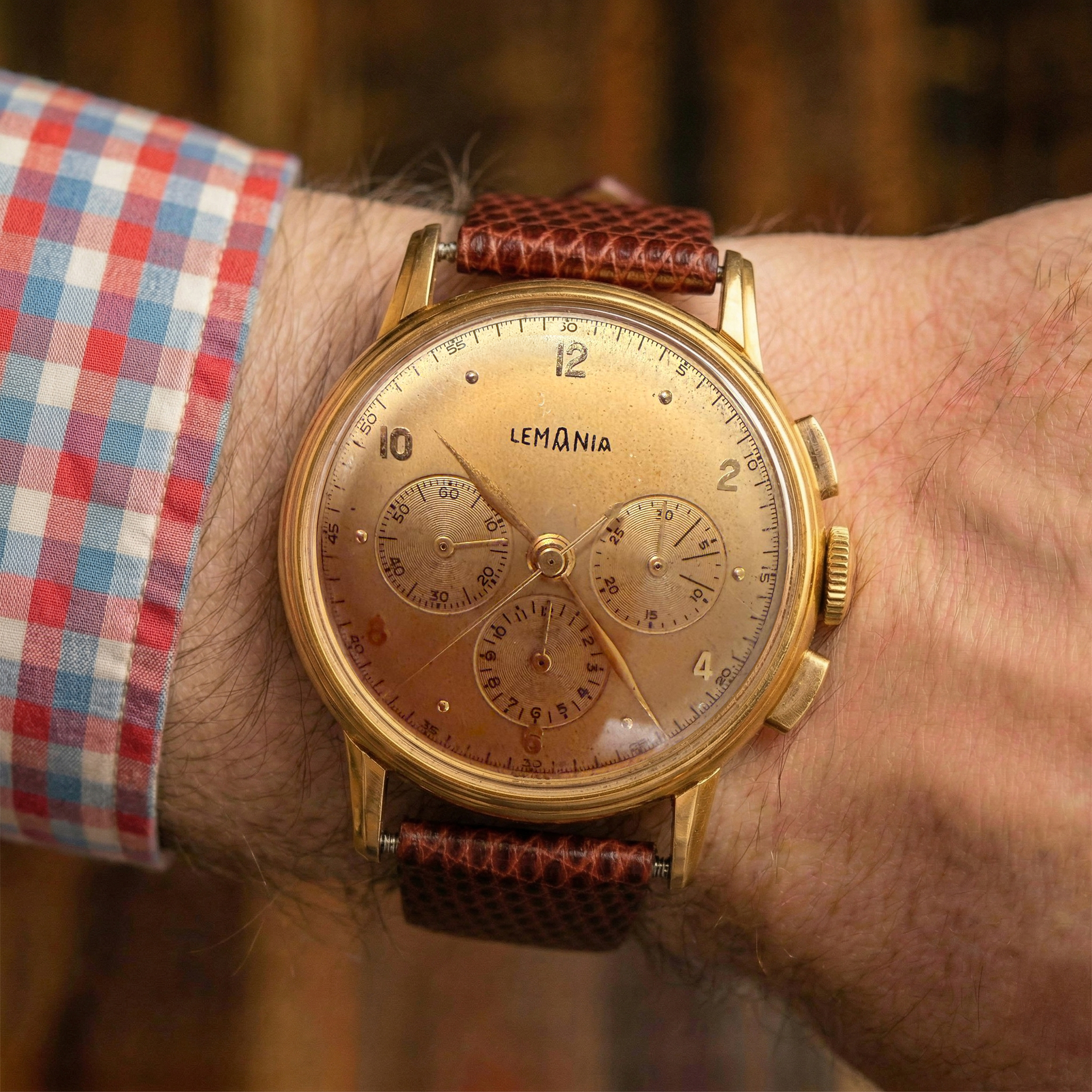
Beautiful Lemania chronograph with a solid 18KT yellow gold case and “fancy lugs,” powered by the in-house Lemania 27 CHRO C12 chronograph movement from the 1950s.
Solid 18Kt yellow gold case measuring 35 mm
Lug-to-lug measuring 42 mm
Applied gold indexes
Original pushers and crown
Lemania 27 CHRO C12 movement inside
ANALYSE
Since its founding in 1884 by Alfred Lugrin under what was then the name of a Lemania sub-brand, the company immediately dedicated itself to the production of complicated watches, particularly chronographs. In 1920, the caliber 12 was one of the first movements to emerge from the Maison’s original headquarters at L’Orient with a chronograph complication operated by a single pusher. Movement No. 12 took technical and architectural cues from the great tradition of in-house chronograph mechanisms for pocket watches (such as the caliber 19), reworked and re-proposed in a smaller size to adapt to wristwatches. The name “Lemania,” although in use as a sub-brand of Lugrin & Cie since 1905, was registered in 1924 as a change of name of the Maison with registration no. 57181. From that day in 1924, Lemania became one of the absolute leaders in the production of chronograph mechanisms. It continued to prosper independently, designing its own watches, but by the 1930s, it was already supplying many other Swiss watchmakers. Almost everything changed at the dawn of the “Great Depression.” The economic crisis pushed Lemania to merge with the Omega-Tissot duo, founding the “Société Suisse pour l’Industrie Horlogère” (SSIH) on 24 February 1930. The years immediately following saw the birth of two very important chronograph movements for the three sister companies, all of which came out of the Lemania factory: the calibre 13 CH monopush (1932) and the calibre 15 TL bi-push (1933). Both lacked the chronograph hour adder, which was introduced in 1942 under the general direction of Marius Meylan and the technical guidance of Albert Piguet and Jacques Reymond: the calibre 27 CHRO C12 was born (where “C12” indicates a 12-hour counter). This movement quickly became a household name in watchmaking, becoming legendary as it powered the Omega Moonwatch, known as the “321.” Production of the 27 CHRO C12 ended around 1968, when new, more economical calibers (the Lemania 1873, known by Omega as the 861) were launched. These replaced the column-wheel mechanism with a simpler and less refined lever mechanism.
This introduction to the history of this splendid watch’s movement serves to properly frame the intrinsic value of the object.
The dial produced by Stern is essential and clean; it eschews any peripheral scales to leave room for the surface, which appears to expand from the center outward, making the watch appear larger on the wrist. In addition to the black pad-printed minute track, alternating Arabic numerals and small gold dots mark the hours. The hour and minute hands are leaf-shaped, while the small hands of the three subdials are narrow baton-shaped. The beautiful and distinctive Lemania signature stands out at 12 o’clock.
The solid 18K yellow gold case was produced by the sons of Jules Blum, a casemaker active in La Chaux-de-Fonda from 1934 to 1974 (Hammerhead Hallmark no. 105). It features three sections, with a beautiful bezel constructed from two overlapping domed rings; the case band terminates in beautiful double-stepped lugs curved almost to an extreme 90°; and a domed snap-on case back with a circular-grained inner surface.
Inside this marvel we find the aforementioned Lemania 27 CHRO C12 hand-wound chronograph movement. This caliber was composed of 189 components, had a frequency of 18,000 A/h and a power reserve of 41 hours.