

SPEZIFIKATIONEN
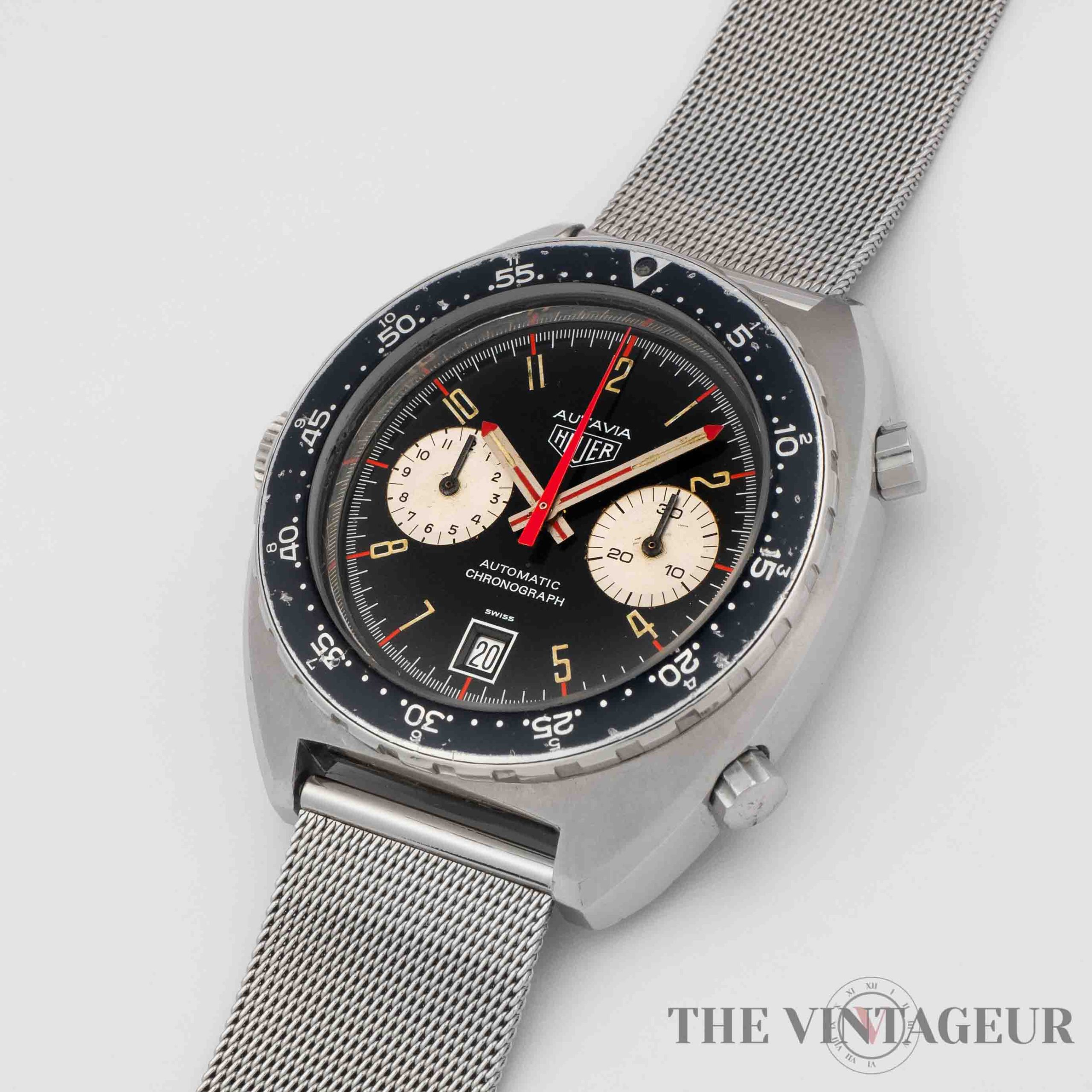
Very rare Heuer Autavia military chronograph Ref. 11630 KAF “Kenyan Air Force”, steel case, Heuer/Buren 12 self-winding movement, from 1970s.
Steel case measuring 42mm
Screw-down case back
Original Lünette
Original Kristall
Original Krone und Drücker
Heuer/Buren 12 self-winding movement
ANALYSE
Edouard Heuer founded the company that bears his name in 1860, focusing from the beginning on the production of high-precision instruments. Even then, in Saint-Imier, Heuer chronometers were renowned for their highly reliable timekeeping. Soon, with the advent and spread of automobiles and airplanes, Heuer specialized in the production of onboard instruments in the early 1900s. One of the first publications featuring a nascent Heuer wrist chronograph with a 30-minute counter at 6 o’clock dates back to 1916. It was a period of great exploration into the possibilities of micromechanics, and the race for the wrist chronograph was an exciting adventure, involving not only Heuer and its subsidiary Rose, but also Breitling and Ralco (sub-brands of Movado). After the rush for the manually wound wrist chronograph of the early 1910s, more than 50 years later, a long march began again that led to the idea of the wrist chronograph powered by a self-winding caliber. In 1969, three rivals faced off: Zenith with its El Primero, Seiko with its caliber 6139, and the Heuer-Breitling-Buren-Dubois-Depraz-Hamilton consortium with its modular caliber No. 11 (and 12). It was an epic tale of intense battles and rivalries, with the three contenders celebrating themselves as the first to present the world with the first hand-wound chronograph caliber.
Against this backdrop, in 1962, Heuer launched its famous “Autavia” model (with a hand-wound caliber and three and two counters). This name had been used by Ed Heuer since 1933 (registration no. 80370) to sign onboard instruments for cars (“AUT-“) and airplanes (“-AVIA”). The name was renewed again on June 2, 1953, with the number 146590, by Ed Heuer & CO. S.A. and was preparing to be forever remembered as one of the most iconic names in watchmaking history. From 1962 to the present, the Autavia has been a symbol of motor racing but also of flight, with its special military applications.
It is in this context that this extremely rare Heuer Autavia assigned “KAF” (Kenyan Air Force) ref. 11630 fits in. Along with the reference 73663 – which featured the manually wound Valjoux 7736 chronograph caliber with minute summing – the reference 11630 is the only automatic Caliber 12 to have been assigned to the “KAF.”
This military assignment is extremely rare, as it is believed that Heuer produced a batch of approximately 250 pieces for the Kenyan Air Force in the mid-1970s. The Kenya Air Force was officially established in June 1964 and had been controlled since 1940 by the British Royal Air Force, which supplied the KAF with military trainers, transport aircraft, and fighter-bombers. From 1964 onward, the KAF became increasingly autonomous and received reinforcements from many countries between the 1960s and 1980s, including France, Romania, Canada, and, above all, Great Britain and the United States. The Kenya Air Force’s operational parameters positioned it by the early 1980s as the leading air force in the sub-Saharan region, integrating a triple aircraft capability (combat and training), which constituted its distinctive pillars in terms of effectiveness. This consolidated economic and military preeminence was complemented by the order for military watches for pilots.
To make the dials easier for pilots to read in flight, Heuerproduced a layout that featured, instead of the baton indices typical of its Autavia model, Arabic numerals filled with tritium. The dial of this spectacular and rare chronograph adopts this precious and rare configuration (along with the ref. 73663 and ref. 741.603). The white minute track stands out against the black surface of the dial and connects chromatically with the two subdials. The date window is positioned at 6 o’clock, while the Heuer signature and the Autavia name are at 12 o’clock. The hands are broad pencil-shaped with a red tip and filled with luminous material; the chronograph seconds hand is bright red and triangular in shape. The dial is framed by a rotating aluminum bezel with a black insert that displays the hours and minutes.
The steel case is tonneau-shaped, typical of the roaring ’70s. Its upper surface is finely satin-finished to leave room for a polished bevel on the outer edges. The crown is on the left; on the right are the push buttons for activating the chronograph mechanism. This case is very thick because it had to seal the movement inside with a screw-down case back and special gaskets to secure the chronograph pusher holes.
Inside the case is the legendary caliber modulae 12, a self-winding chronograph movement that operates via a micro-rotor hidden from view by the levers as it is grafted directly onto the base plate of the Buren time-only movement. It complements the caliber 11, launched in 1969 by the Heuer-Breitling-Buren-Dubois-Depraz-Hamilton consortium. It is 31mm in diameter and just 7.7mm thick, oscillates at 21,600 A/h and has a 42-hour power reserve.