


EINFÜHRUNG
The first-series Patek Philippe Nautilus Ref. 3700/1 from 1976/1977 is not simply a rare and beautiful watch. It is the materialization of a moment of intellectual courage in which a centuries-old maison decided to reinvent itself without renouncing its founding values; it is proof that design can be both functional and immortal; it is a demonstration that manufacturing excellence – in the movement, in the case finishing, in the quality of the bracelet, in the care devoted to every component – outlives fashions and market cycles. Fifty years after its launch, the Nautilus Jumbo continues to set the aesthetic and technical benchmark against which all luxury sports watches are measured.
In this watch, countless details and facts come together that, even in our present day, radiate a deep, almost mysterious fascination, trapping all enthusiasts in the dream of the myth.

(Patek Philippe Nautilus ref. 3700/1. Detail. Credit by The Vintageur.com)
PART I – AN EPIC ENCLOSED IN A NAME
Jules Verne, born in Nantes, France, in 1828, aspired to travel and adventure from a very young age. At 11, he ran away from home to try to reach the Indies by sea, stowing away on a merchant ship about to set sail. His reckless enterprise failed because his father retrieved him at Paimboeuf, a port suburb located along the Loire River about 70 km northwest of Nantes. This event already says much about the adventurous spirit and curiosity of the man who would become one of the greatest writers and novelists of the 19th century.
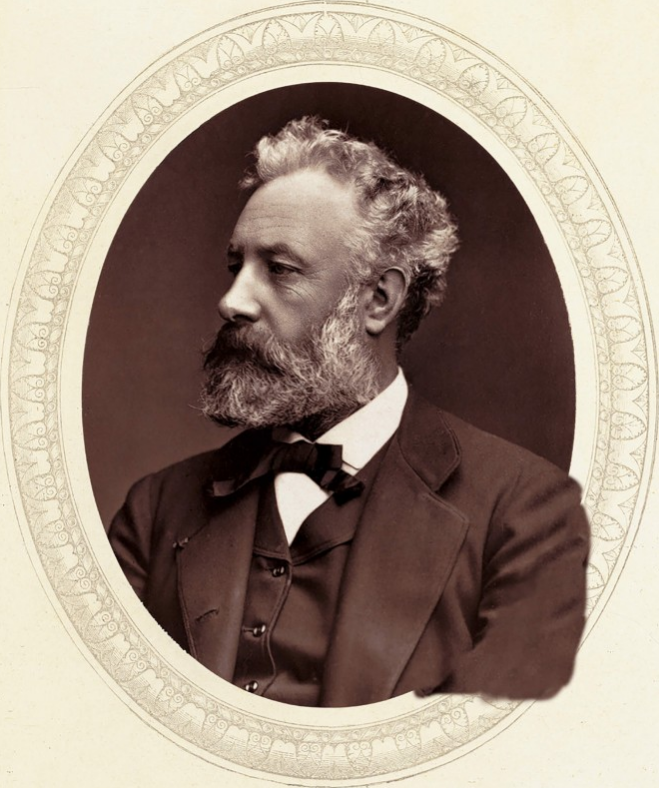
(Jules Verne, portrait. Credit: Pacmusse.qc.ca)
In adulthood, Verne – after reluctantly studying law in Paris – discovered his passion for research and study in the field of natural sciences, with particular attention to zoology and botany. His voracious intellectual curiosity pushed him to also delve into chemistry, physics, and geography. In short, he was a cultured man, fueled by an insatiable desire to understand the world and the laws that govern it. Consequently, he loved science, technique, and technology as humanity’s response to explain, control, or interact with events and the manifold manifestations of nature. Alongside this incredible propensity for research and study, the fire of the writer soon ignited within him. He immediately proved capable of converting his studies into foundational elements for the plots of his famous tales and adventure novels.
Inspired by the scientific and technological progress of the 19th century, Jules Verne conceived machines and devices that anticipated innovations destined to change the face of the modern world, skillfully weaving them into his extraordinary adventure narratives: a vessel capable of plowing the abyss, diving equipment, state-of-the-art instruments in the hands of courageous explorers and navigators: these are tangible proofs of a visionary intellect able to see far beyond his time.
This context includes works such as “Journey to the Center of the Earth” from 1864, “From the Earth to the Moon” from 1865 (which inspired one of the very first science fiction films, “A Trip to the Moon” by George Méliès, from 1909), and “Twenty Thousand Leagues Under the Sea” from 1869.
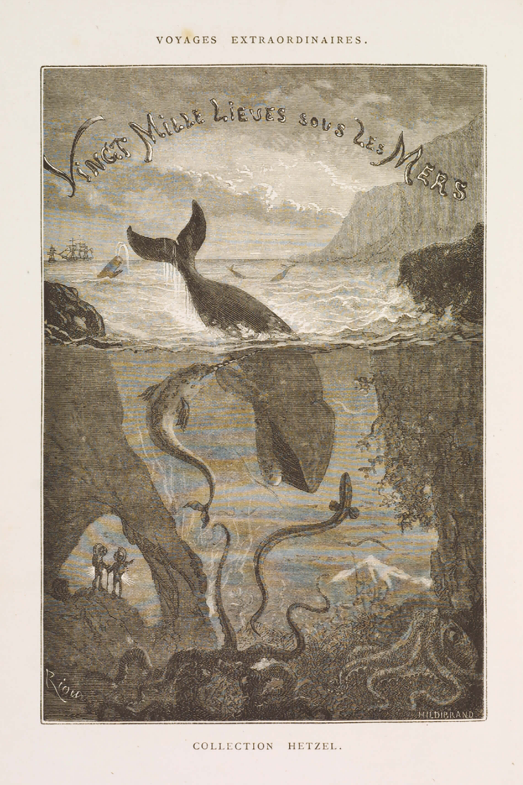
(“Twenty Thousand Leagues Under the Sea”, title page. Credit by Wikipedia.org)
In this last novel, Verne recounts an adventurous, science-fiction voyage centered on Captain Nemo, who commands a futuristic, hyper-technological submarine called the “Nautilus.”
Inside and outside the belly of this incredible submarine, the protagonists’ adventures unfold, amidst unknown underwater tunnels, giant pearls, monstrous squids, vast underwater forests, and approximately 80,000 km of navigation to the South Pole and beyond.

(Model of the Nautilus reconstructed for the exhibition “Jules Verne, Writing the Sea”, Pointe-à-Callière, Montreal Museum of Archaeology and History, Canada, 2006. Credit by Pacmusee.qc.ca)
The name “Nautilus” given to the iconic submarine is a legacy of Verne’s naturalistic studies. The Nautilus is, in fact, the name of a mollusk (specifically, of the genus of tetrabranched cephalopods) with a large shell (which can measure up to 20 cm in diameter) with a smooth outer surface and internally divided into approximately 34-36 spaces or hollow sections called “septa.” This structure allows the mollusk to reach enormous depths (over 500 meters) while remaining immune to the enormous force of pressure. Today, it is considered a living fossil because until 1829, it was known only from fossil finds from the Paleozoic era; the first living specimen was only sighted in 1929.
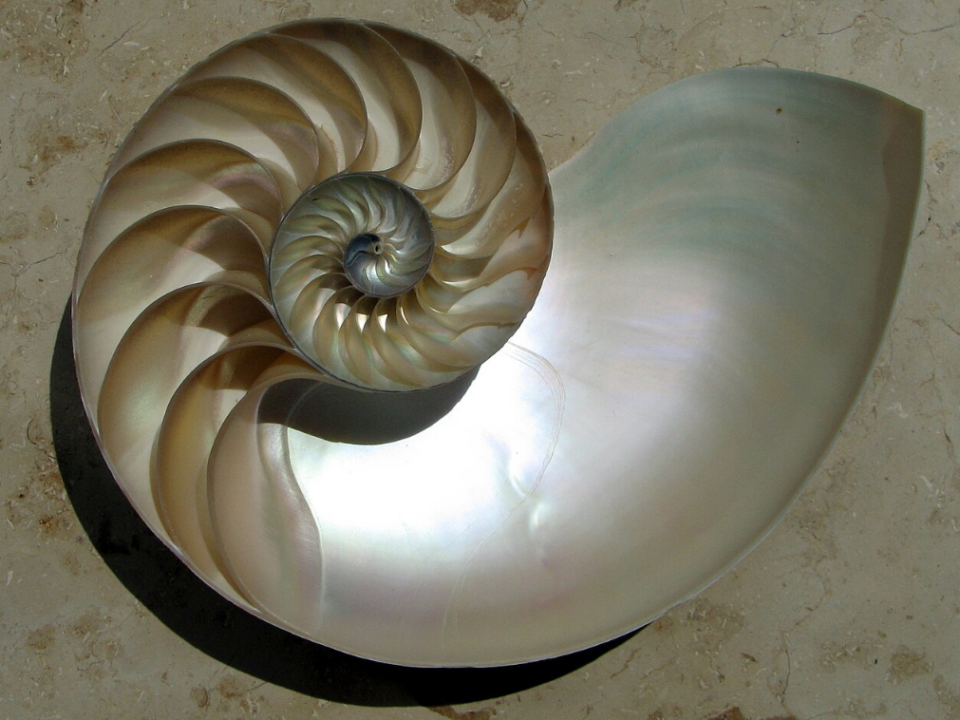
(Nautilus, section. Credit by Wikipedia.org)
The properties of water resistance and structural integrity under the pressure of depth are the basis for Patek Philippe’s choice of the name “Nautilus” for its infamous steel sports watch. But that’s not all. The submarine imagined by Verne had the science-fiction properties of autonomy and silence. It represented technological progress and the dream of autonomy and freedom. Stretching these strictly literary themes, however, it is possible to find many similarities with the philosophy – and not only its construction – of the Geneva-based company’s Nautilus.
PART II – THE “NAUTILUS” BY JUVENIA
In the watchmaking world, the first manufacturer to revive and use the name “Nautilus” was not Patek Philippe, but Juvenia. The company, founded by a branch of the Didisheim family in La Chaux-de-Fonds in 1882, was the first to adopt this name for its sub-brand, as early as the 1910s.
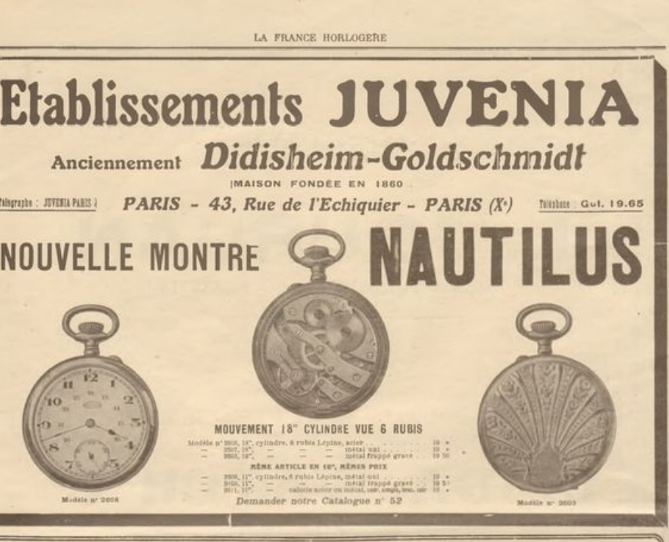
(Juvenia “Nautilus”, poster from 1910. Credit by Niccoloy on IG)
The Nautilus sub-brand, along with others, was registered by Juvenia in February 1910 under the number 26958.
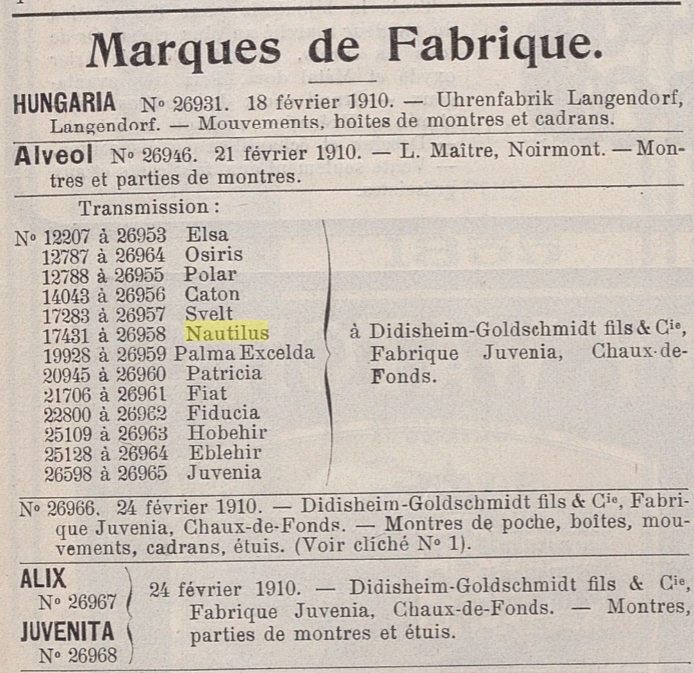
(Swiss Trademark Registration Form from 1910. Credit by Watchlibrary.org)
Essentially, therefore, at least in this initial phase, the name Nautilus does not appear to be closely linked to the hermetic and water-resistant properties that would be inherent in the model Patek Philippe would launch 66 years later.
As is well known, in Switzerland, patents and trademarks (watch model names, brand names, company names, etc.) were first filed, then published in a special official gazette, and from that point on were protected for 20 years against improper use by third parties. Intellectual property was therefore guaranteed for twenty years, after which the patent or trademark holder could renew it or not, subject to fees paid to the legal entity acting as guarantor.
Juvenia, therefore, renewed the registration of the name “Nautilus” 20 years later, in 1930, including it under registration number 71750.
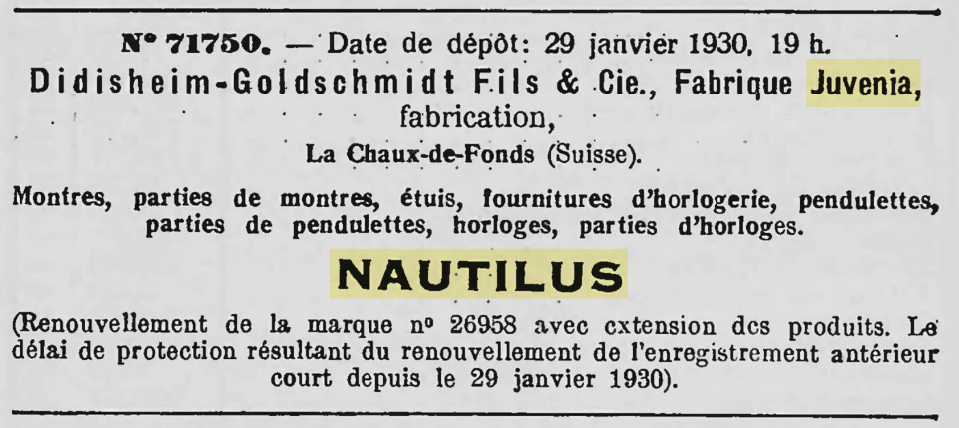
(Renewal of the Nautilus trademark by Juvenia, 1930. Credit by E-periodica.ch)
After another 20 years, Juvenia renewed the trademark again with registration number 132245 (formerly 71750) in February 1950.

(Renewal of the Nautilus trademark by Juvenia, 1950. Credit by Watchlibrary.org)
Here is the same renewal, No. 132245, from another contemporary documentary source.
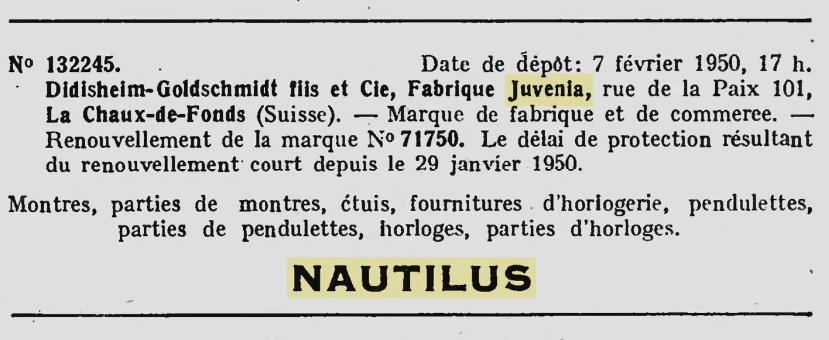
(Renewal of the Nautilus brand by Juvenia, 1950. Credit by E-periodica.ch)
Despite the repeated registration of the name, no watches bearing the Nautilus signature were known to have been produced by Juvenia from the 1910s to the 1950s. The great La Chaux-de-Fonds Maison left a physical trace of the use of this name only in the late 1950s and early 1960s, when it developed and launched a very rare watch featuring a capillary depth gauge.
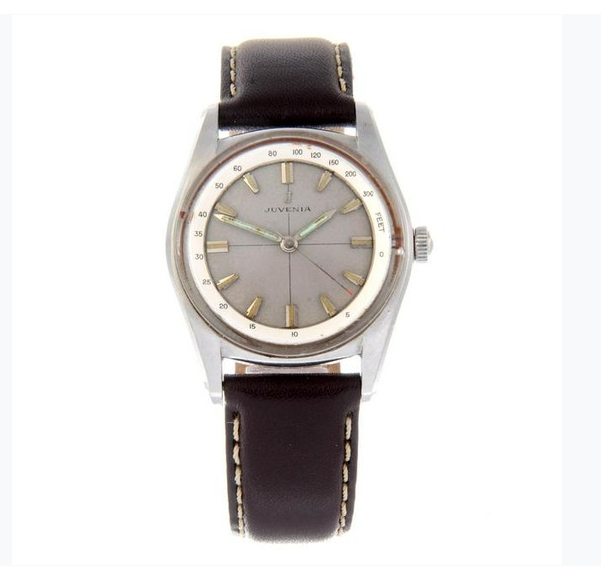
(Juvenia Nautilus, early 1960s. Credit by lot-art.com)
The Juvenia Nautilus uses a mechanical depth gauge system that exploits the physical principle of the interaction between air and water with respect to depth.
A circular channel with a microscopic diameter of approximately 0.3 millimeters runs along the entire perimeter of the dial, sealed and filled with a small amount of air. A tiny opening in the glass, usually at three o’clock, allows water to enter the channel during a dive. As the depth increases, external pressure compresses the air trapped inside the duct, causing the water to advance. The position reached by the water-air separation front along the capillary path thus indicates, directly and without electronic components, the depth on a special graduated scale arranged around the dial. From an optical perspective, the portion of the tube still occupied by air appears clear or reflective, while the section invaded by water becomes transparent, revealing a dark background underneath, ensuring immediate and effective reading even in conditions of poor underwater visibility.
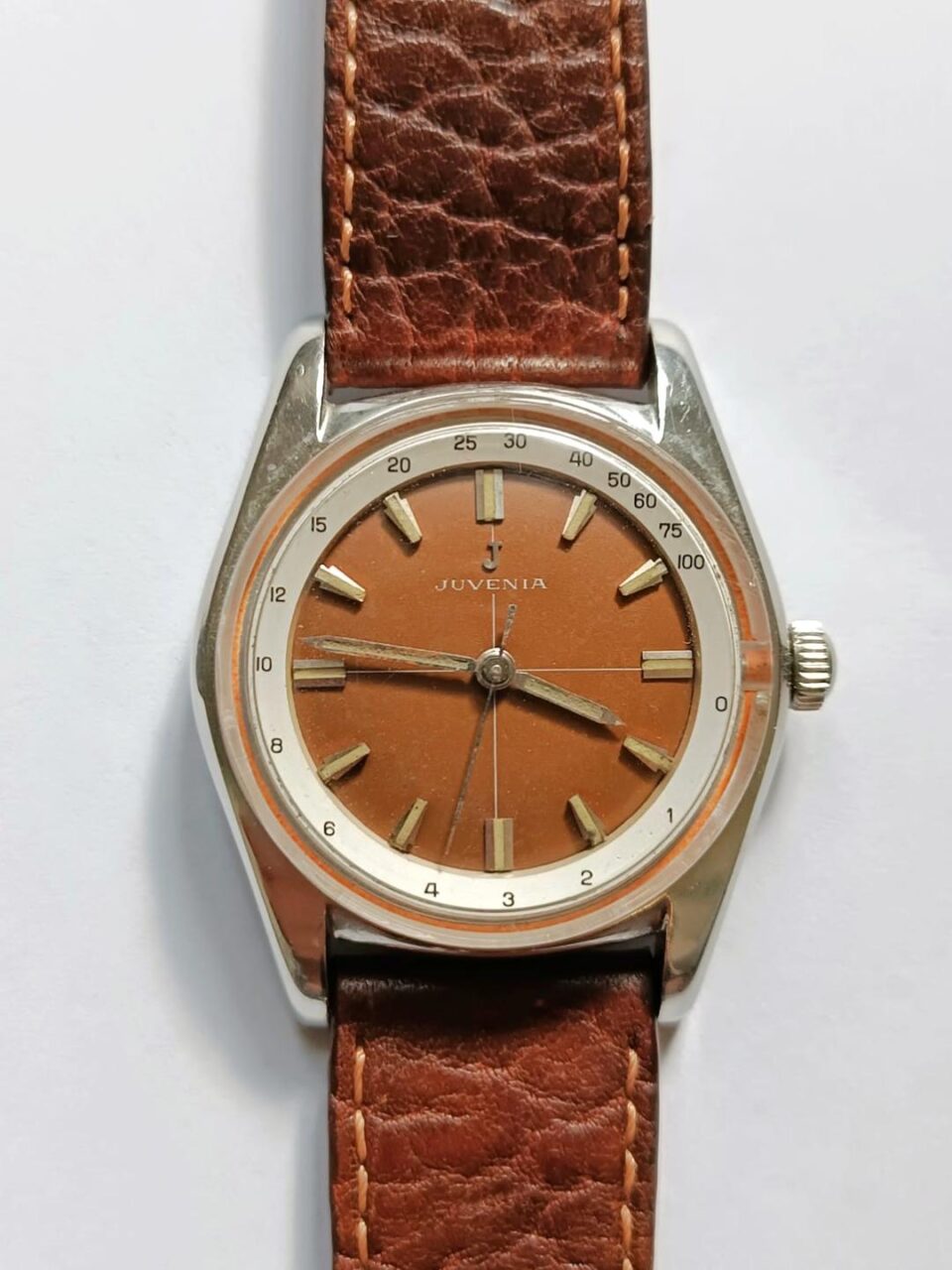
(Juvenia Nautilus, early 1960s. Credit by Snachwatch on IG)
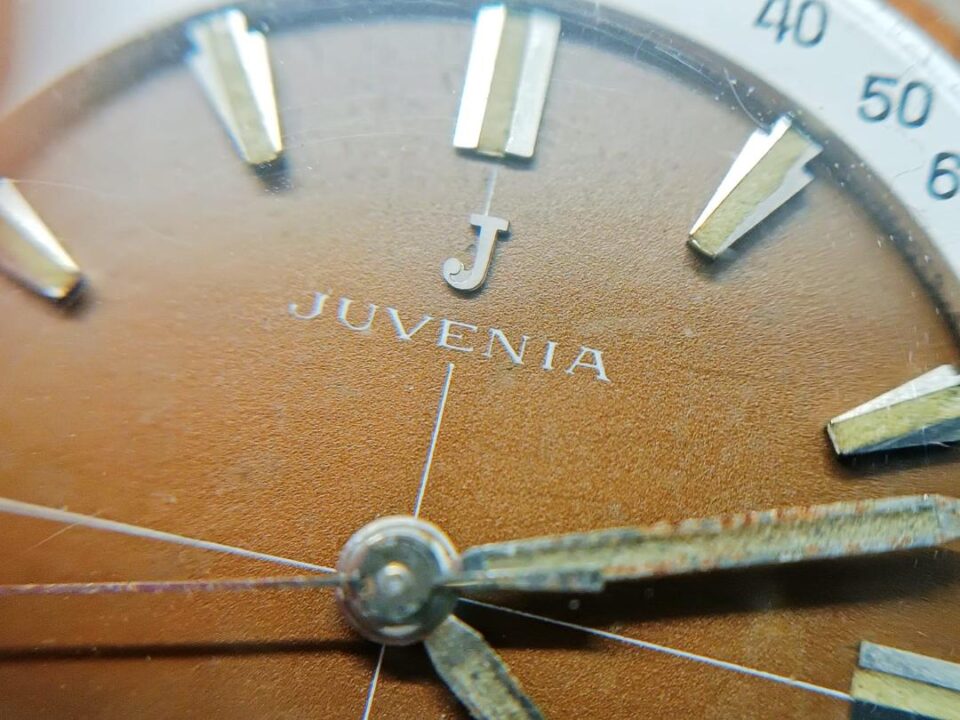
(Juvenia Nautilus, detail, early 1960s. Credit by Snachwatch on IG)
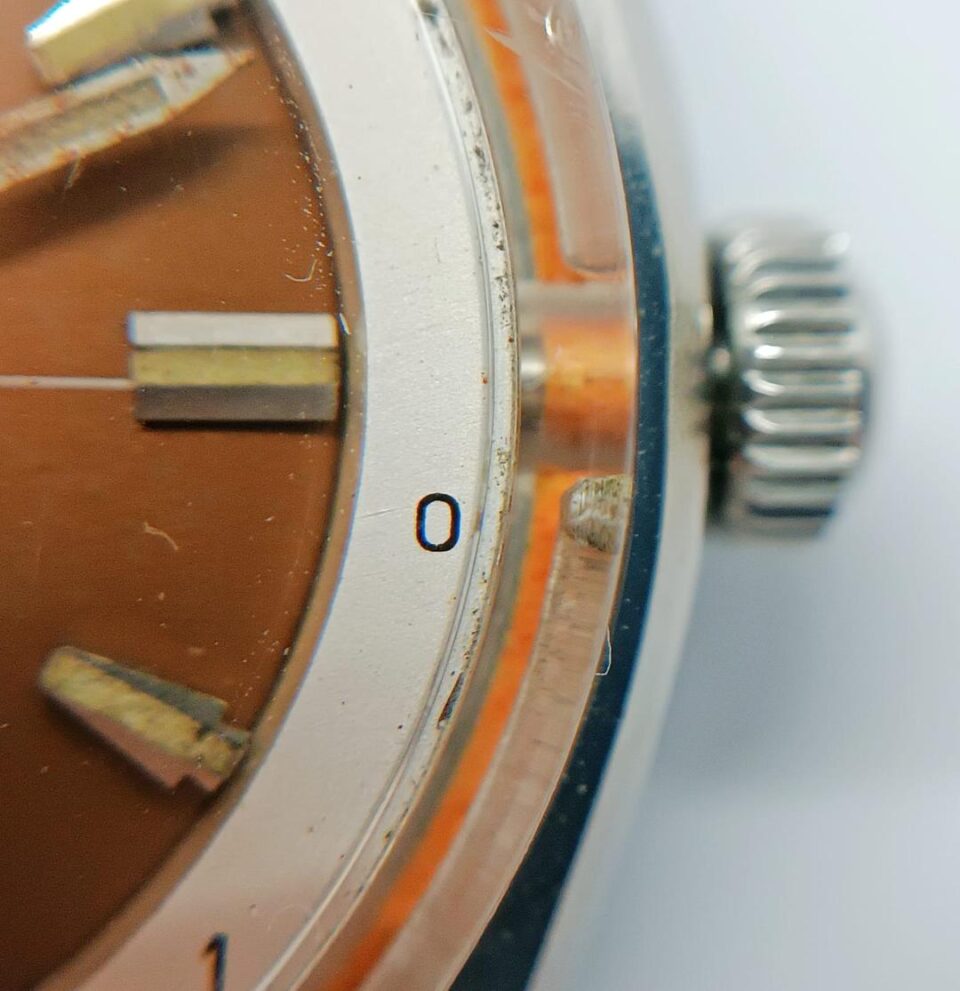
(Juvenia Nautilus, detail, early 1960s. Credit by Snachwatch on IG)

(Juvenia Nautilus, early 1960s. Credit by Snachwatch on IG)
This rare timepiece model reveals, through the engravings on the outer caseback, its direct and explicit connection to the USS Nautilus (SN-571).
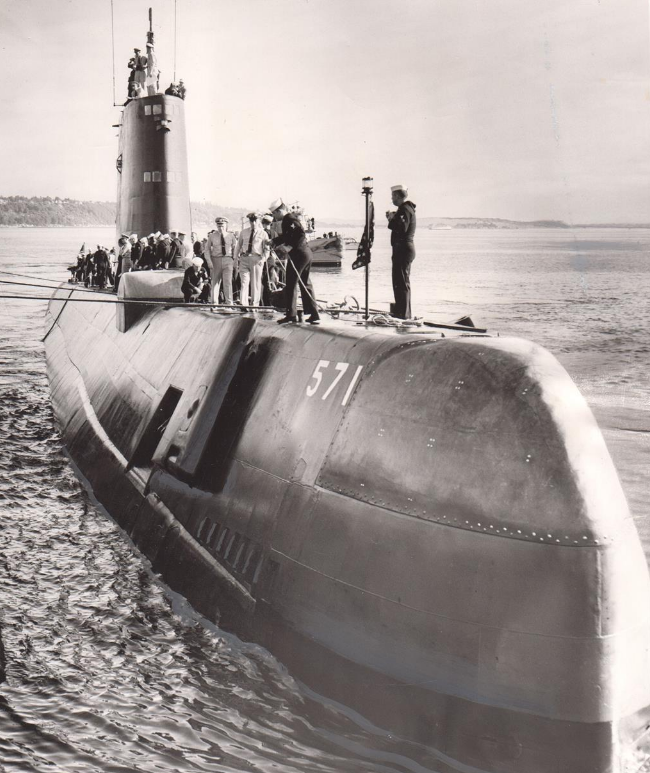
(USS Nautilus, Pier 91, Seattle, 1957. Credit by Historylink.org)
USS Nautilus was the first operational nuclear-powered submarine in history, and it was precisely because of these unique and cutting-edge properties that it was named “Nautilus,” in honor of the science fiction submarine imagined by Jules Verne. It was conceived and commissioned by the United States Navy in 1951 and officially entered active service in 1955, completing the first-ever 2,000-kilometer cruise submerged at sustained speed. Significantly larger than previous diesel-electric submarines, Nautilus was over 97 meters (319 feet) long and displaced 3,180 tons. Its ability to remain submerged for almost indefinite periods was due to its uranium nuclear reactor, which required no air and consumed very small amounts of fuel, generating steam for the propulsion turbines and allowing speeds in excess of 20 knots.
After breaking numerous submerged-duration records, in 1958, under direct orders from US President Eisenhower and at the height of the Cold War, the Nautilus, departing Honolulu on July 23, made the first voyage beneath the geographic North Pole, reaching it on August 3 at 11:15 PM.
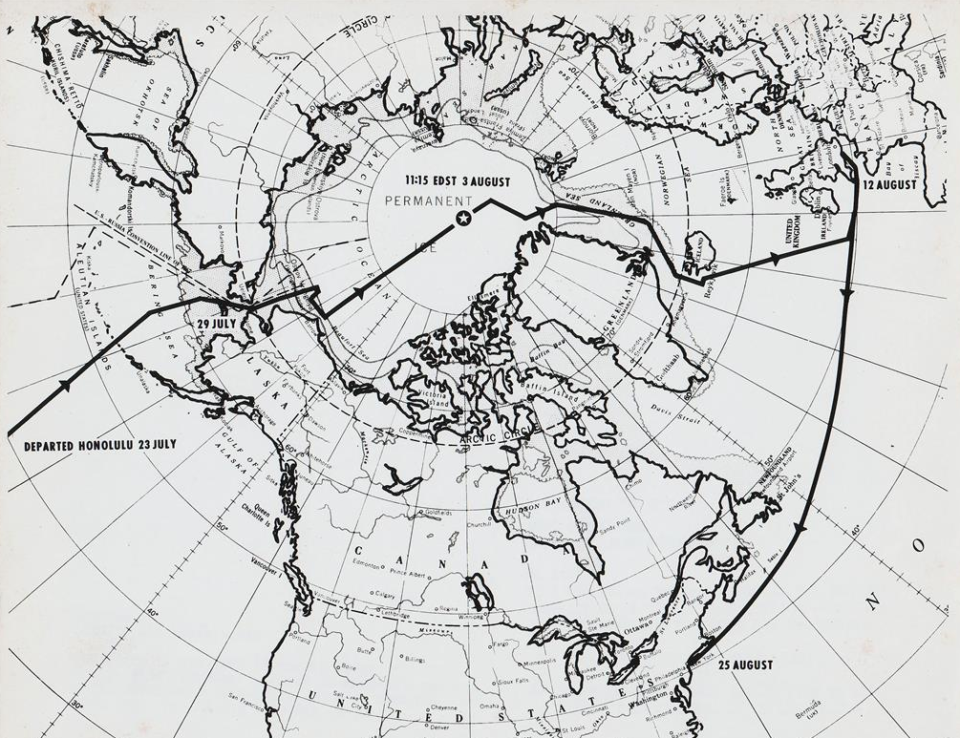
(Navigation map marking the North Pole route of the USS Nautilus, 1958. Credit: Historylink.org)
This important historical and scientific event is linked to another event. The year 1957-1958 was designated the International Geophysical Year. Sixty-seven nations engaged in observations and research dedicated to Earth science: from seismology to electromagnetism, from radioactivity to glaciology, marking one of the largest scientific cooperation programs of the twentieth century.
It was in this context that another significant watch was born: the Jaeger-LeCoultre “Geophysic”.

(Jaeger-LeCoultre Geophysic, 1958 publication. Credit by Watchlibrary.org)
To promote the model, which resisted magnetic fields up to 600 Gauss, the company provided a batch to the military officers of the USS Nautilus crew preparing for the historic crossing of the North Pole.
PART III – THE PATEK PHILIPPE “NAUTILUS”
Patek Philippe is therefore the second watchmaker to use the “Nautilus” name. And it was able to do so because Juvenia, having held the name’s patent for 20 years, decided not to renew it. As noted above, the last registration dates back to 1950 and was due to expire in 1970. In that year, the name “Nautilus,” registered by Juvenia under no. 132245, lapsed (in technical-administrative jargon, this is called “deregistration” / “radiations”).
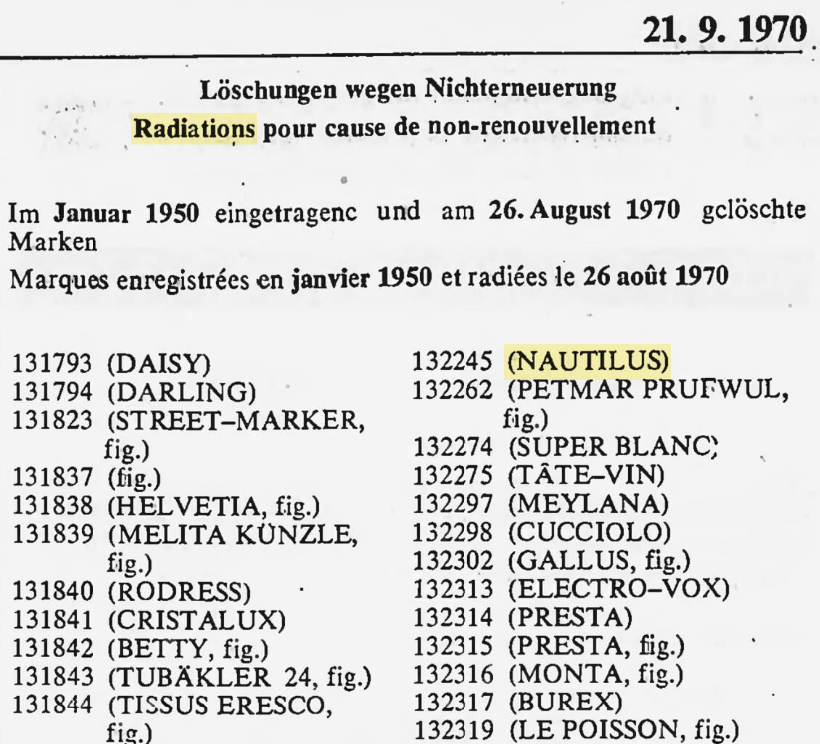
(Revocation of the Nautilus name for failure to renew, 1970. Credit by E-periodica.ch)
Patek Philippe acquired intellectual property rights to the “Nautilus” name in the year its iconic watch was launched, 1976, on June 25th at 6:00 PM, with registration number 283951.
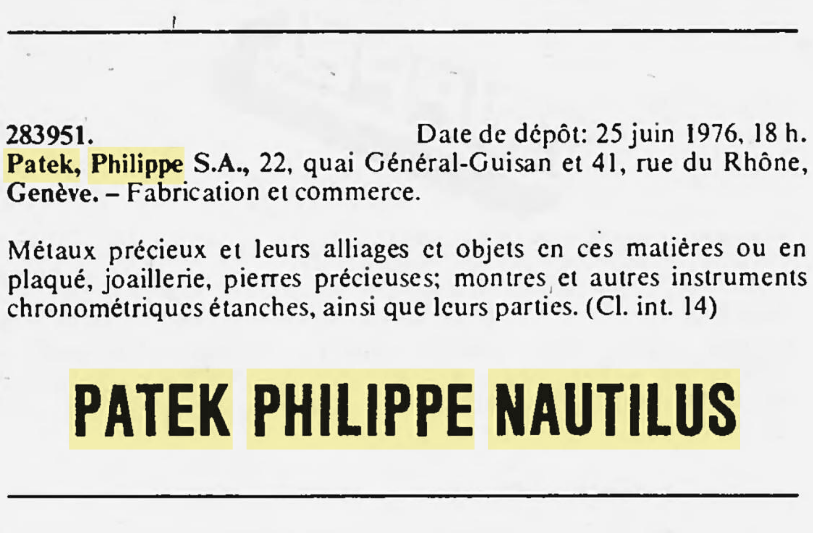
(Registration of the “Nautilus” name by Patek Philippe, 1976. Credit by E-periodica.ch)
At the time, Henry Stern, along with his son Philippe, was leading the great Maison. Philippe was asked to take over an ambitious project to produce a completely new, modern watch that would break away from the Maison’s classic offerings. Philippe Stern at the time was a young 38-year-old with a passion for sports, especially sailing. This new watch was intended to possess the typical elegance of Patek Philippe products, yet with a casual and sporty feel, allowing its owner to use it every day and in any conditions, even during a regatta on Lake Geneva. Thus was born the Nautilus reference 3700/1, launched with the slogan: “one of the most expensive watches made of steel”.

(Patek Philippe Nautilus, affiche, 1976. Credit by Reddit.com)
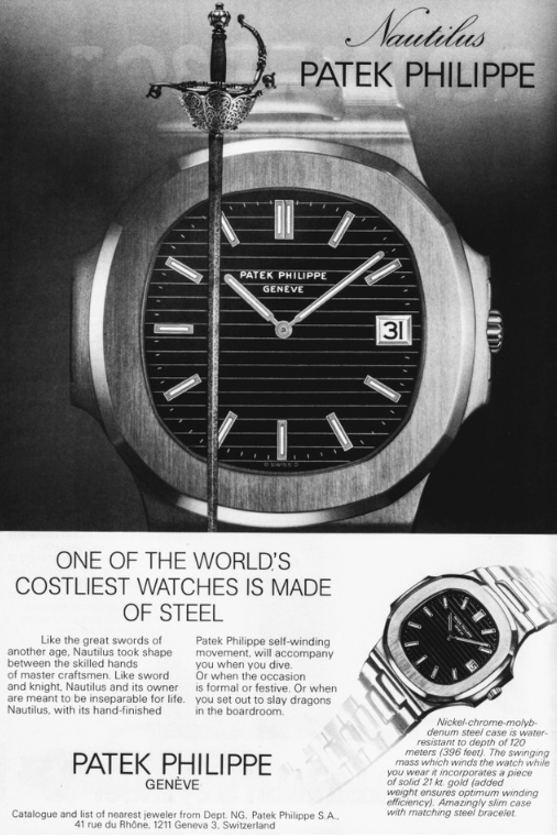
(Patek Philippe Nautilus, affiche, 1977. Credit by Steemit.com)
Although Patek Philippe assumed intellectual ownership of the “Nautilus” name in 1976, in the years that followed, other smaller manufacturers, capitalizing on the fame of the great Genevan Maison, misappropriated the name to market watches and accessories dubbed, precisely, “Nautilus.” For this reason, Patek Philippe was forced to publicly denounce the misappropriations with special “warning” notices.

(Notice of protection of the name “Nautilus,” 1984. Credit by Watchlibrary.org)
This demonstrates the evocative power of that name. A name born in natural science, reworked in literature, and becoming legendary in the world of watchmaking.
PART IIII – NAUTILUS JUMBO REF. 3700/1 “FIRST SERIES”: INTRODUCTION
To fully understand the significance of the Patek Philippe Nautilus Ref. 3700/1, it is necessary to place it in the precise historical moment in which it was born. 1976 was a year of profound change for Swiss watchmaking: the quartz crisis was shaking the foundations of an industry that for over a century had built its supremacy on precision mechanics. Consumers were turning to electronic movements, which were cheaper and more accurate in measuring time, and the major traditional brands were forced to rethink their identity.
This dichotomy is evident in the catalogs of those years: in 1977, the Nautilus appeared alongside mid- to low-end quartz watches.

(1977 catalog. Credits by Watchlibrary.org)

(1977 catalog, detail. Credits by Watchlibrary.org)
The model was presented at the 1976 Baselworld, which took place between April and May. In this climate of uncertainty, Patek Philippe made a bold and ultimately visionary decision: to complement its established production of precious metal timepieces with a stainless steel sports watch.
It was a break with a century and a half of stylistic protocol that had identified the Genevan maison exclusively with dress watches in gold, platinum, and high-complication watches, and no one could have predicted the mythological proportions the Nautilus would attain in the decades to come.
In the ground-floor pavilion of the Baselworld, at booth 1308, next to IWC and opposite Zenith, the Nautilus was thus presented to the world for the first time.
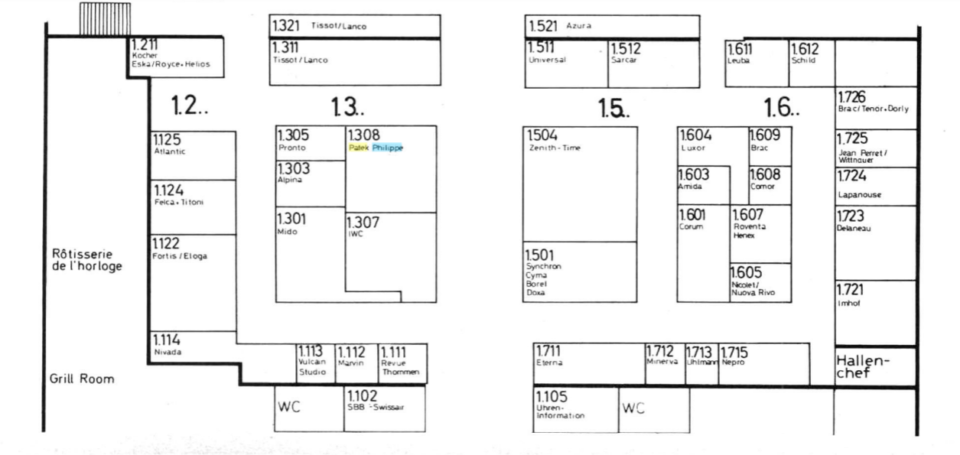
(Plan of the 1976 Basel Fair pavilion, which featured Patek Philippe at booth 1308. Credit: Watchlibrary.org)
PART V – NAUTILUS JUMBO REF. 3700/1 “FIRST SERIES”: THE CASE
The stylistic design of the new watch was entrusted, as previously mentioned, to Gérald Genta, who had already designed the Royal Oak for Audemars Piguet in 1972 and is considered the most visionary watch designer of his generation. Genta developed a formal language for the Nautilus distinct from its predecessor, while sharing its underlying philosophy: the Royal Oak’s bezel was a pure octagon, rigid and angular; the Nautilus’s bezel reinterpreted the octagonal geometry, softening it into rounded, organic forms, clearly inspired by the porthole of a transatlantic liner, with its locking hinges transformed into the characteristic lateral “ears” that protect the crown and serve as a second, symmetrical anchor point on the opposite side.
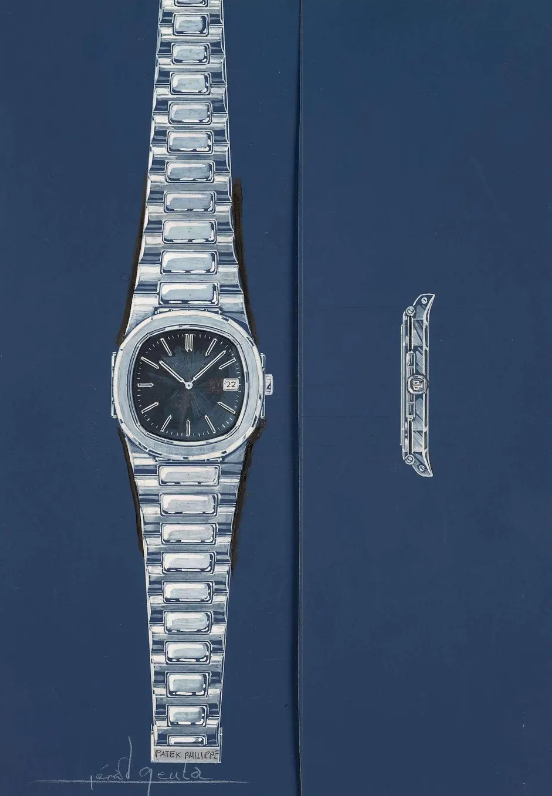
(Original drawing of the Nautilus by Gérald Genta, 1976. Credit by Fobes.com)

(Drawing of the case structure with front view. Credit by Oracleoftime.com)
The case patented by Patek Philippe on April 23, 1976, as reference 3700/1, was constructed in just two pieces: the case back and the case middle formed a single monoblock structure, while the bezel was fixed and compressed onto the case middle by a system of four tightening screws arranged horizontally on the side lugs.

(Patent for the Nautilus ref. 3700/1 case. Credit by Monochrome-watches.com)

(Exploded view of the Nautilus case)
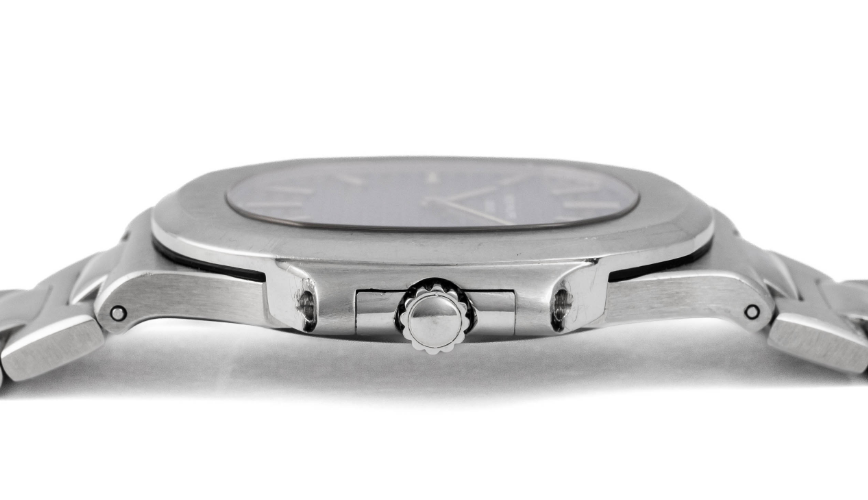
(Crown-side profile of the Nautilus Jumbo ref. 3700/1. Credit by The Vintageur.com)
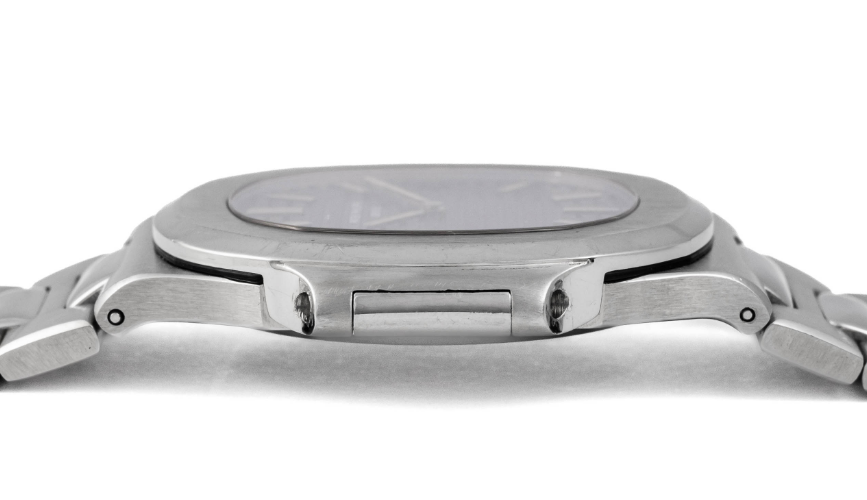
(Profile of the Nautilus Jumbo ref. 3700/1. Credit by The Vintageur.com)
The result was a monolithic, clean profile, devoid of any visible screws on the front. This locking system guaranteed the piece certified water resistance to a depth of 120 meters, a remarkable feat for a dress watch of the era. The case middle was turned with absolute precision to house the movement and receive the oval waterproof gasket.

(Exploded view of the lower case section with a detail of the gasket)
The oval-shaped rubber gasket also appears to be designed as an aesthetic element. Indeed, it remains clearly visible to the eye, compressed between the two sections of the case.

(Profile of the Nautilus Jumbo ref. 3700/1. Credit by The Vintageur.com)
With this architecture, even the slightest flaw in the workmanship of the case components would have compromised its water resistance. The screw-down crown completed the sealing system. It typically has 12 very pronounced teeth interspersed with 12 deep, pronounced grooves. Its top surface is smooth, slightly convex, and in this first series, it features no logo. The crown is therefore designed to allow for comfortable use in water while providing a pronounced grip.
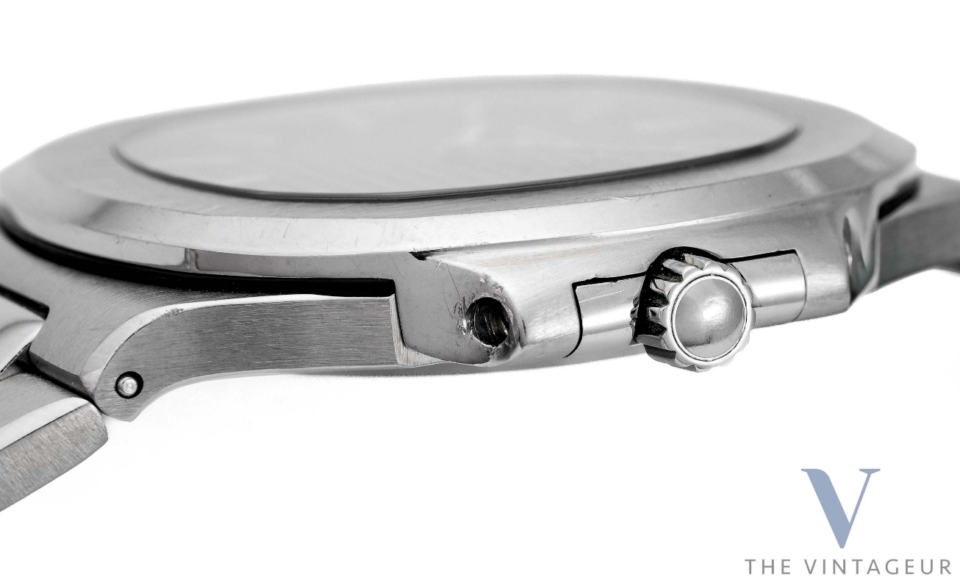
(Profile of the crown side of the Nautilus Jumbo ref. 3700/1. Credit by The Vintageur.com)
The case diameter measured 42 millimeters along the axis from 10 to 4 o’clock – the conventional measurement for this geometry – with an overall thickness of just 7.6 millimeters. These were generous dimensions for the time, when the average men’s watch did not exceed 37 millimetres, and it was precisely this characteristic that earned the Nautilus 3700/1 the affectionate nickname of “Jumbo”.
PART VI – NAUTILUS JUMBO REF. 3700/1 “FIRST SERIES”: THE BRACELET
The integrated bracelet, produced by Gay Frères to Patek Philippe specifications, featured the so-called “wide link” configuration in the first 3700/1 series, with a final width of 16 millimeters at the clasp. Its integration into the case was conceived by Genta as a soft yet compact extension of the bezel.
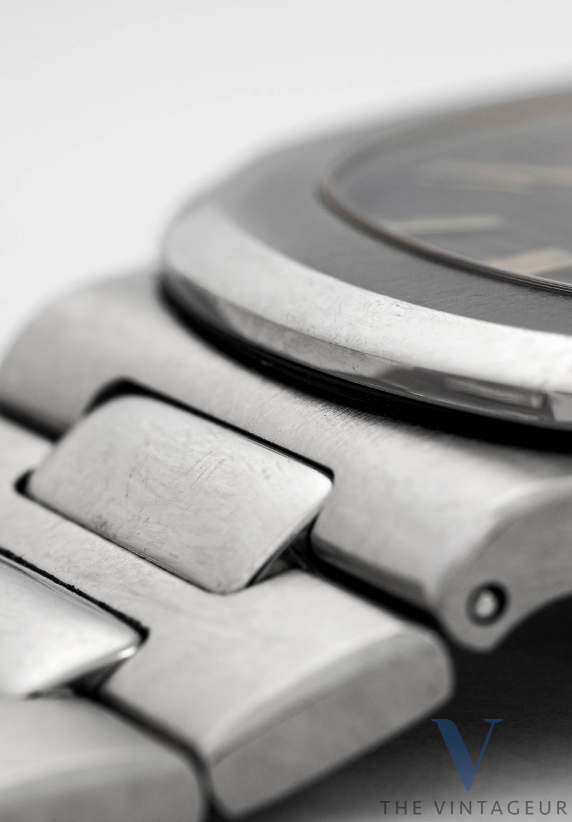
(Nautilus ref. 3700/1, detail. Credit by TheVintageur.com)
The bracelet’s design and structure is composed of rows of satin-finished “H”-shaped links connected by a mirror-polished central link. A gentle chamfering on the edges of the outer links connects with the chamfering on the lug profile in an interplay of finishes that amplified the aesthetic tension between sportiness and elegance.
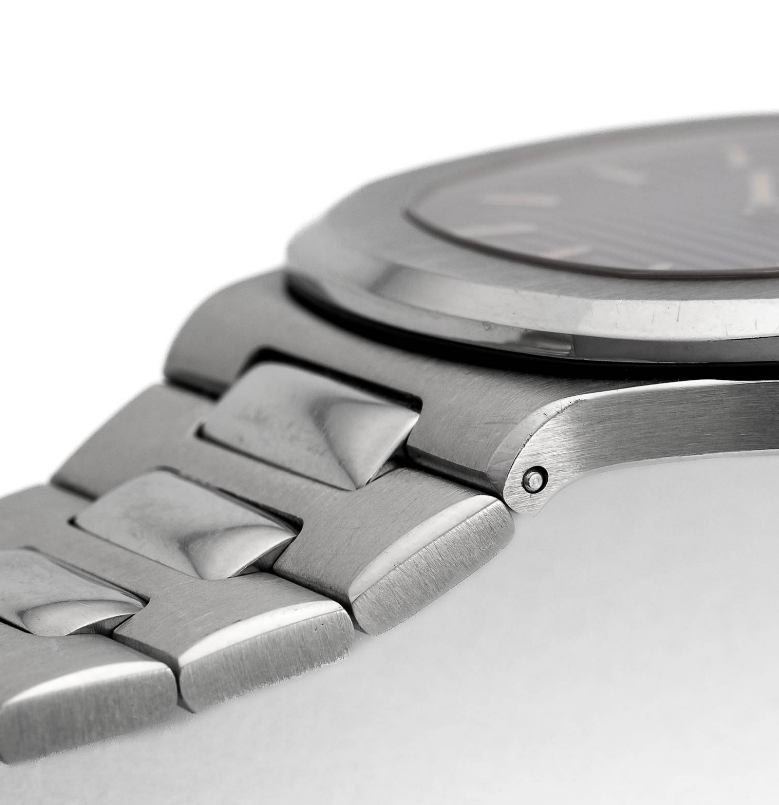
(Nautilus ref. 3700/1, detail. Credit by The Vintageur.com)
The distinction between the first series 3700/1 and the second series 3700/11 lies primarily in the width of the bracelet—16 millimeters for the first, 14 millimeters for the second—and in the assembly, which was transferred around 1981 to the Atelier Réunis, Patek Philippe’s satellite workshop responsible for producing the second generation. The first series, assembled in the main workshops in Geneva, thus retains a historic record and its original purity.
The patented clasp of this iconic bracelet features a hollow terminal link that snaps shut at the opposite end. The Calatrava Cross logo is embossed on it.
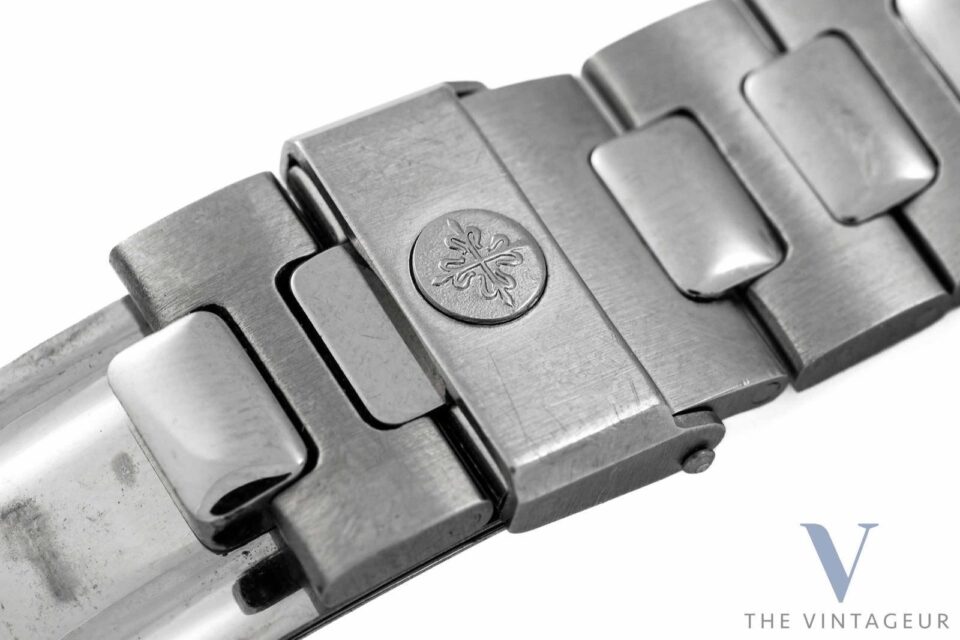
(Nautilus ref. 3700/1, detail. Credit by TheVintageur.com)
A historic symbol of Patek Philippe, the Calatrava Cross – which harks back to a monastic-military order founded in medieval Castile – is more than a distinctive mark on the Nautilus: it is the symbolic link between the aesthetic break that this watch represented in the late 1970s and an explicit desire for historical continuity: this symbol inextricably links the luxury sports watch to the Maison’s aristocratic tradition.
PART VII – NAUTILUS JUMBO REF. 3700/1 “FIRST SERIES”: THE DIAL
The dial of the Nautilus 3700/1 represents one of the most influential aesthetic solutions in the history of contemporary watchmaking. The surface is embossed with a horizontal pattern of parallel grooves – known in technical literature as a “tramline” or “ligné” finish – which lends a deep texture that varies depending on the angle of the light, creating a highly refined two-tone effect: under certain light sources, the dial appears almost black; under others, it reveals a palette of deep blues and grays.
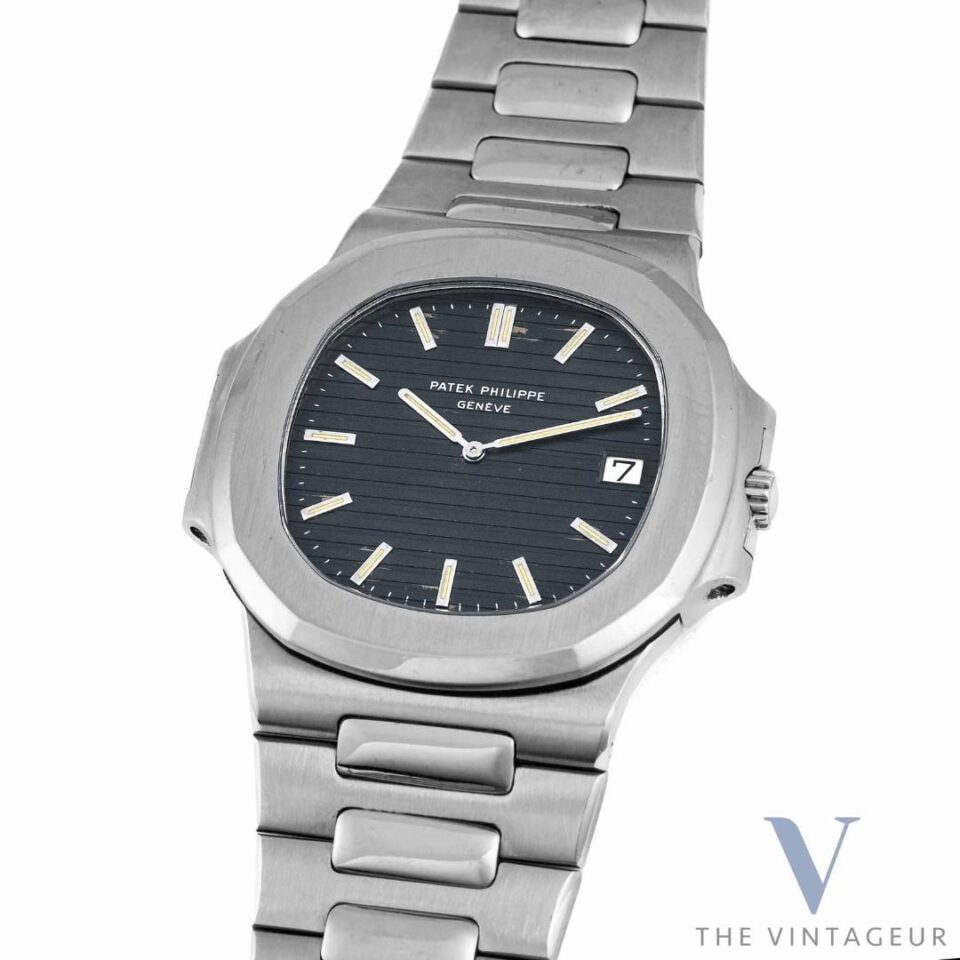
(Patek Philippe Nautilus ref. 3700/1. Credit by The Vintageur.com)
Beneath the thick sapphire crystal, the dial – produced and handcrafted by the specialized craftsmen at Stern Frères – features a semi-instantaneous jump date window at 3 o’clock, which is well hidden and concealed on the surface: it is frameless, has a white disc and black numerals, and was designed to be legible without compromising the formal cleanliness of the dial’s overall design.
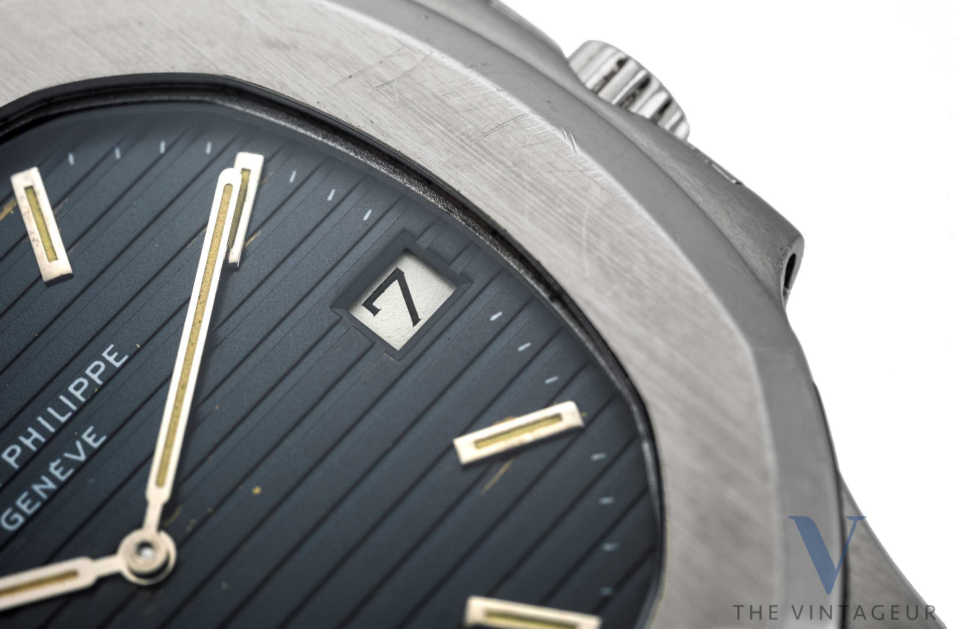
(Patek Philippe Nautilus ref. 3700/1, detail. Credit by The Vintageur.com)
At the center, below 12 o’clock, is the inscription “Patek Philippe Genève”. The “first series” dials of the 3700/1 have a primary characteristic in this area: the fonts differ from those of the immediate, later production models, as the letters here appear less slender. Most notably, the “Genève” inscription does not completely fill the dial’s embossed band, as it does on dials from a few months later.
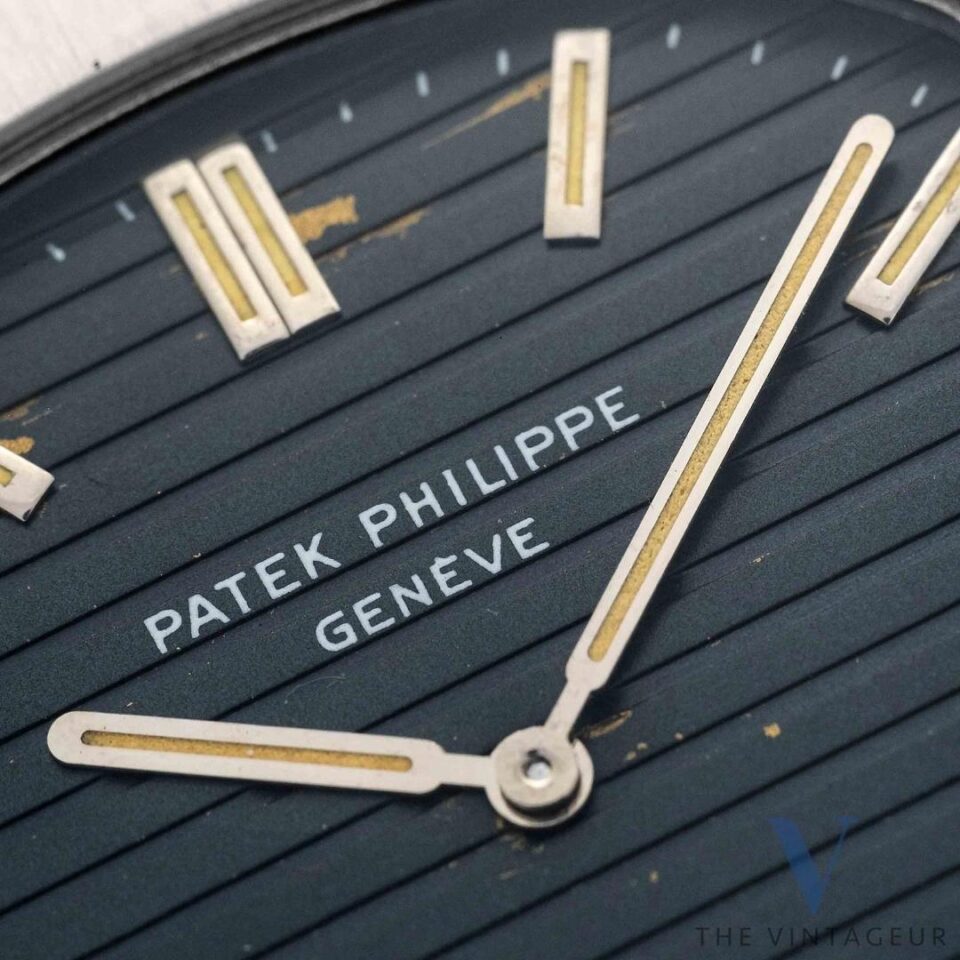
(Patek Philippe Nautilus ref. 3700/1, 1977, detail. Credit by TheVintageur.com)

(Patek Philippe Nautilus ref. 3700/1, 1981, detail. Credit by Antiquorum.com)
In the first series models, produced between 1976 and approximately 1981, the dials are called “sigma dials”, indicating the use of solid gold applied hour markers. At 6 o’clock, the inscription “Swiss” appears between the Sigma symbols. This characteristic, typical of Swiss haute horlogerie production in the late 1970s, is considered an indicator of high-end pedigree. The applied baton indexes are therefore made of white gold, as are the hour and minute hands, which feature a luminescent tritium insert for nighttime readability. There is no seconds hand: a technical choice dictated by the movement’s extraordinarily thin design, but one that contributes to the dial’s sober composition, leaving plenty of room for the relief motif.

(Patek Philippe Nautilus ref. 3700/1, 1977, detail. Credit by TheVintageur.com)
The first production Patek Philippe 3700/1 features another unique and unmistakable detail: the minute track is pad-printed in white with lines/baton marks, rather than the typical dots.
This initial series was produced in an extremely limited number of examples, of which only about 50 are known. This dial type – called the “MK0” due to its rarity – was used from the watch’s launch at the Baselworld in April-May 1976 until November 1977, when the classic circular dot minute track became the preferred choice. According to sources, it is likely that the two dial types – the “MK0” with a line/baton minute track and the “MK1” with a dot minute track – coexisted in the second half of 1977.

(Nautilus ref. 3700/1, “MK0” dial, 1977, detail. Credit by TheVintageur.com)
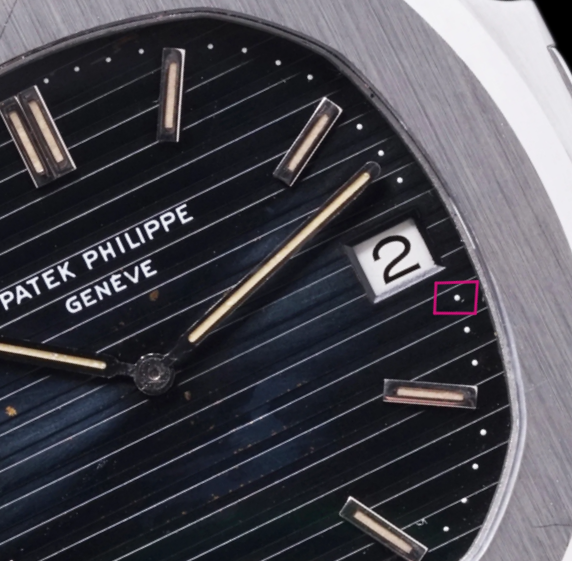
(Nautilus ref. 3700/1, “MK1” dial, 1977, detail. Credit by Craftandtailored.com)
PART VIII – NAUTILUS JUMBO REF. 3700/1 “FIRST SERIES”: THE MOVEMENT
The mechanical heart of the Nautilus 3700/1 is the automatic caliber 28-255 C, one of the finest movements ever mounted on a sports watch. Its lineage is complex and fascinating: it is a version adapted by Patek Philippe from the Jaeger-LeCoultre 920 ebauche.

(Spare parts list for the JLC 920 movement. Credit by Ebay.com)
This ultra-thin movement was developed as a joint venture between three major watchmakers – Jaeger-LeCoultre, Audemars Piguet, and Patek Philippe itself – with shared ownership. The same basic caliber was used by Audemars Piguet in the Royal Oak as caliber 2121, and by Jaeger-LeCoultre in its Memovox and Master Ultra Thin models, in versions slightly different in diameter and overall thickness.
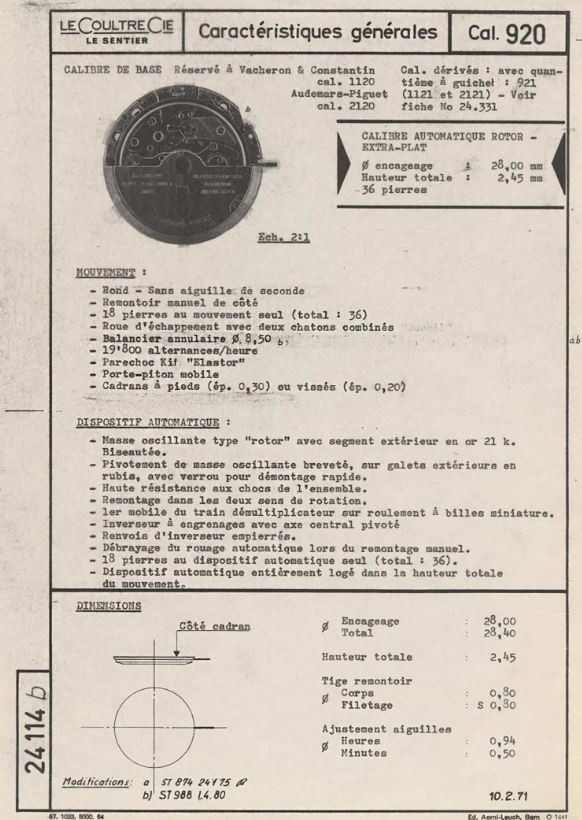
(Technical data sheet for the JLC 920 movement. Credit by Calibercorner.com)
In the Patek Philippe version, designated caliber 28-255 C, the movement was just 3.15 millimeters thick, contributing significantly to the remarkably thin profile of the entire watch. The bidirectional winding rotor was equipped with a peripheral semi-ring in 21-karat gold, a highly elegant mechanical and aesthetic solution. A specific system managed the bidirectional winding via an additional wheel that engaged when the rotor swung counterclockwise, ensuring a 40-hour power reserve when fully wound.
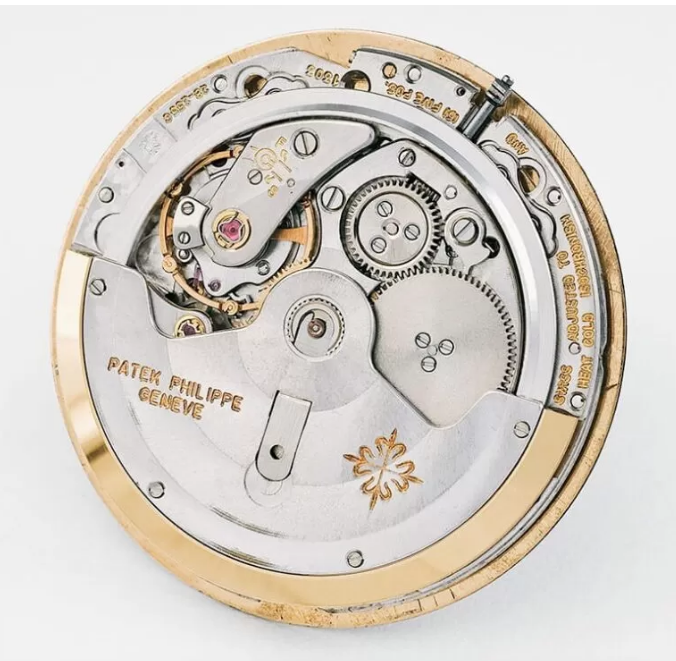
(Patek Philippe 28-255 C movement. Credit by Horbiter.com)
The Gyromax balance wheel – a historic Patek Philippe patent since 1949, featuring micro-regulating screws arranged perpendicular to the oscillating weight – vibrated at a unique frequency of 19,800 A/h and was combined with a free-spring balance spring with a Kif-Ultraflex shock absorber.

(Detail of the Gyromax balance wheel with Kif shock absorber. Credit by Revolutionwatches.com)
The caliber boasted 36 jewels and was finished to the standards of the Geneva Seal, with bridges and plates decorated with Cotes de Genève, hand-crafted chamfering, and mirror-finished surfaces on the steel components. A jumping date completed the functions of a movement that, in its essential time-only nature, constituted – and still constitutes – an absolute benchmark for self-winding mechanical watchmaking.
PART IX – NAUTILUS JUMBO REF. 3700/1 “FIRST SERIES”: THE BOX
No discussion of the Nautilus 3700/1 would be complete without a mention of its original box, which has itself become a cult object in the world of watch collecting.
Patek Philippe chose a cork chipboard box for the first Nautilus, an unusual and bold material for a luxury timepiece, evidently chosen to coherently evoke the marine theme and the aquatic environment echoed in the watch’s design.

(Patek Philippe Nautilus ref. 3700/1, box, 1977. Credit by The Vintageur.com)

(Patek Philippe Nautilus ref. 3700/1, box, 1977. Credit by The Vintageur.com)
The cork box has become one of the icons of 1970s Italian-Swiss design applied to luxury accessories: its unmistakable appearance, with the porous, brown surface of natural cork, contrasts beautifully with the cold, metallic character of the watch it houses.
For the 50th anniversary of the Nautilus, celebrated in 2026, Patek Philippe has chosen to honor this tradition by delivering the new commemorative editions in cork boxes inspired by the 1976 original, confirming the iconographic value of this detail in the model’s mythology.
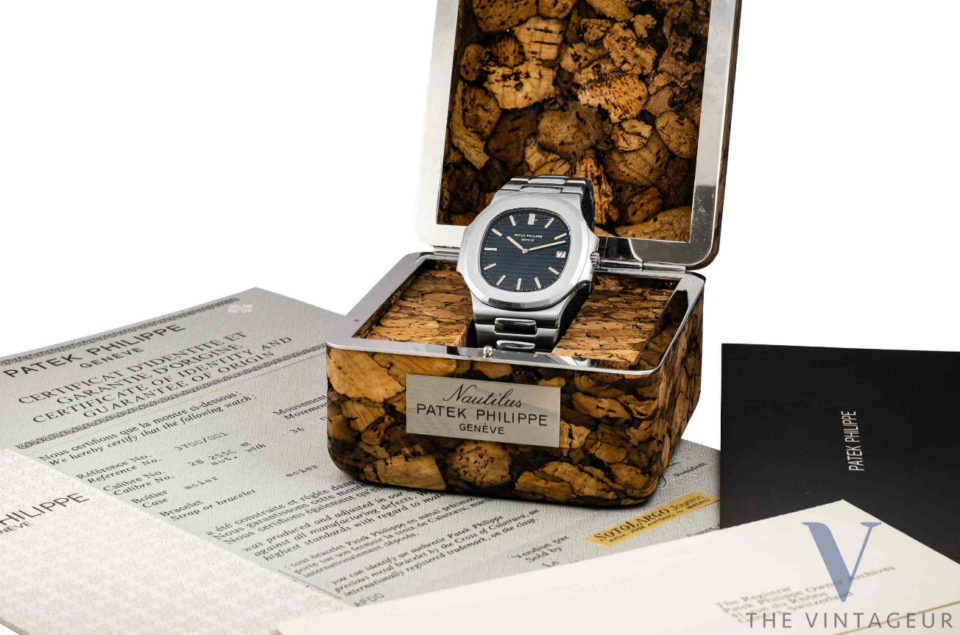
(Patek Philippe Nautilus ref. 3700/1, full set, 1977. Credit by TheVintageur.com)
PART X – NAUTILUS JUMBO REF. 3700/1 “FIRST SERIES”: CONCLUSION
The Patek Philippe Nautilus Ref. 3700/1 is today considered by critics, auction houses, and collectors around the world to be one of the five or six most important watches of the twentieth century. Its influence on contemporary watch design is pervasive: the concept of the luxury sports watch – a robust, waterproof timepiece with an integrated bracelet and an overtly industrial aesthetic, yet powered by a top-tier manufacture movement and offered at haute horlogerie prices – has become the most significant commercial category in luxury watchmaking over the last thirty years.
Today, the form of this immortal watch has the immediate recognition of a work of art, effectively becoming a pop icon unlike any other watch in history.
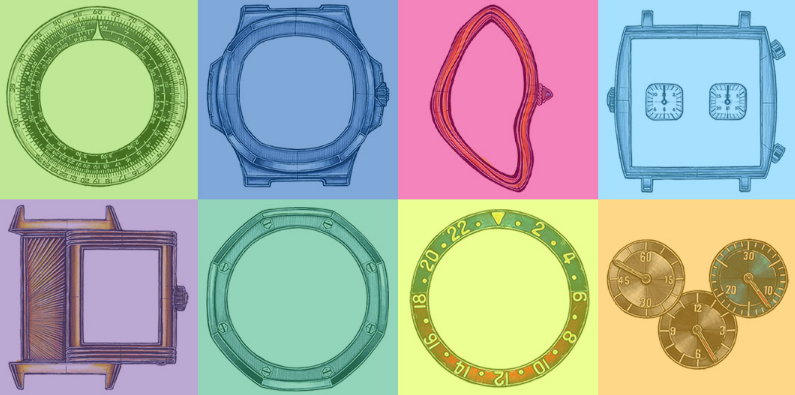
(Artistic composition. Credit by Oracleoftime.com)
The overall production of the reference 3700, in its two main variants, 3700/1 and 3700/11, spanned from 1976 to 1990, with an estimated total that makes this watch one of the rarest high-end timepieces of the twentieth century. But a first-series example with the “MK0” dial, complete with all its original components, along with its cork box, documents, and archive extract, today represents not only a significant collector’s investment, but a living testimony to an unrepeatable moment in the history of design and global watchmaking.