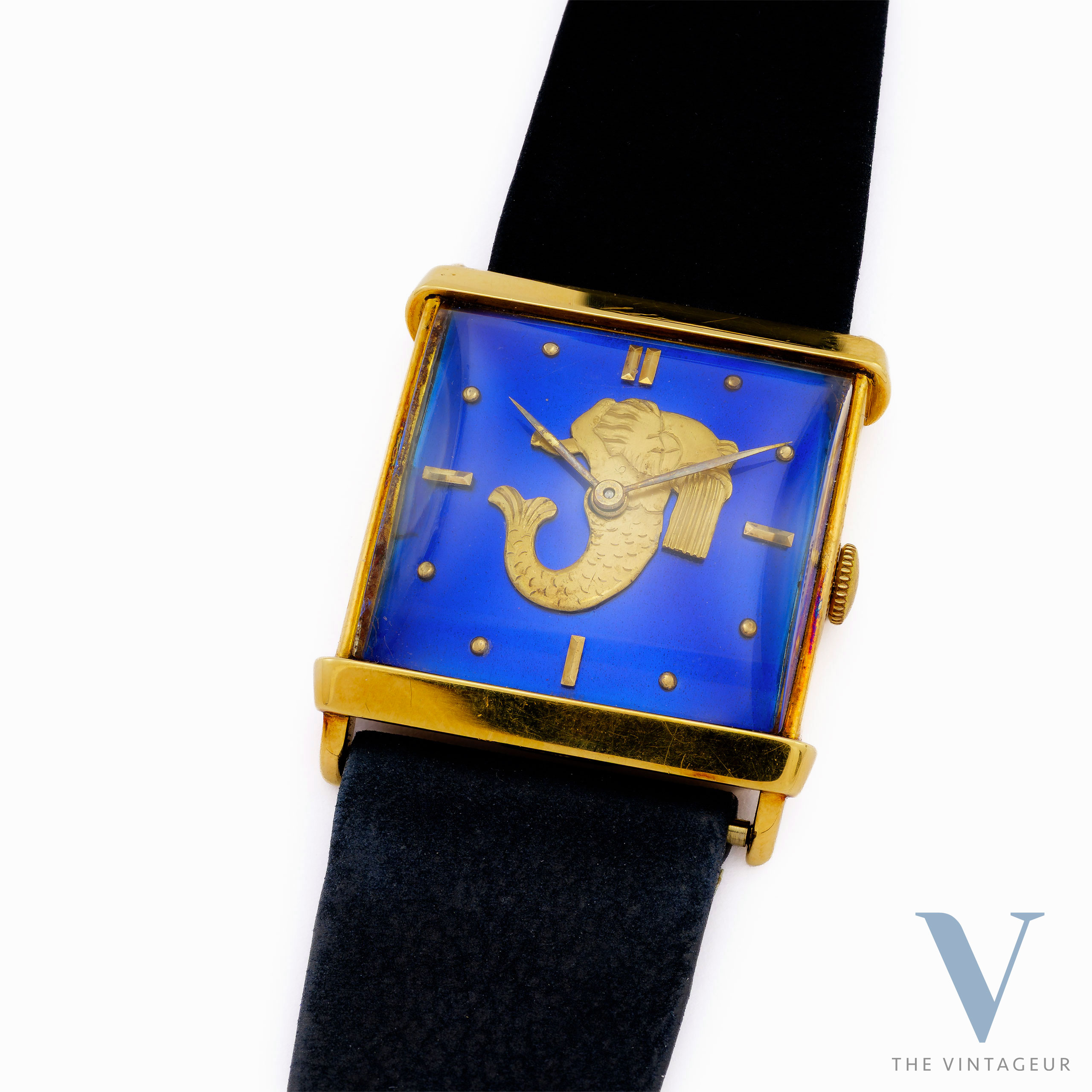
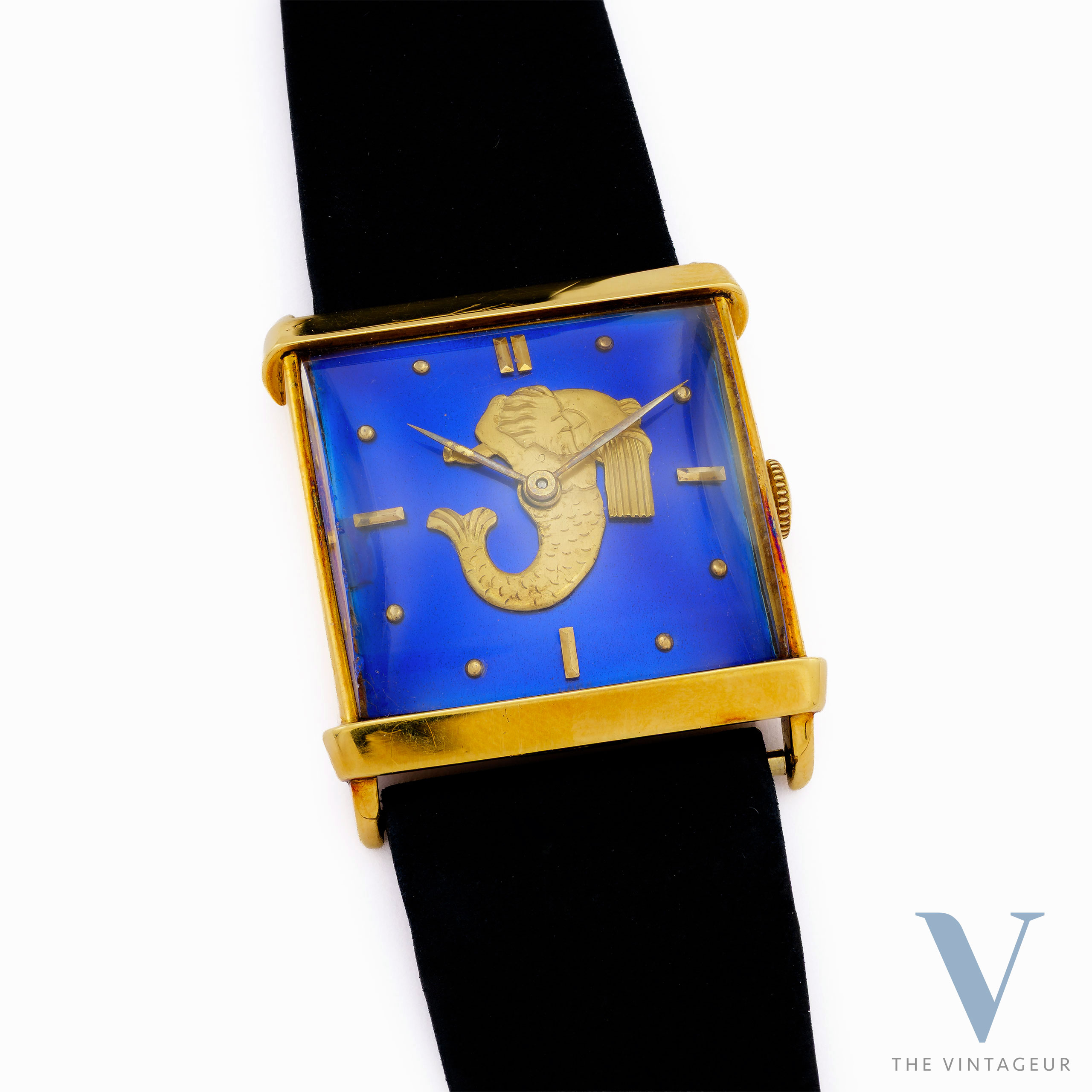
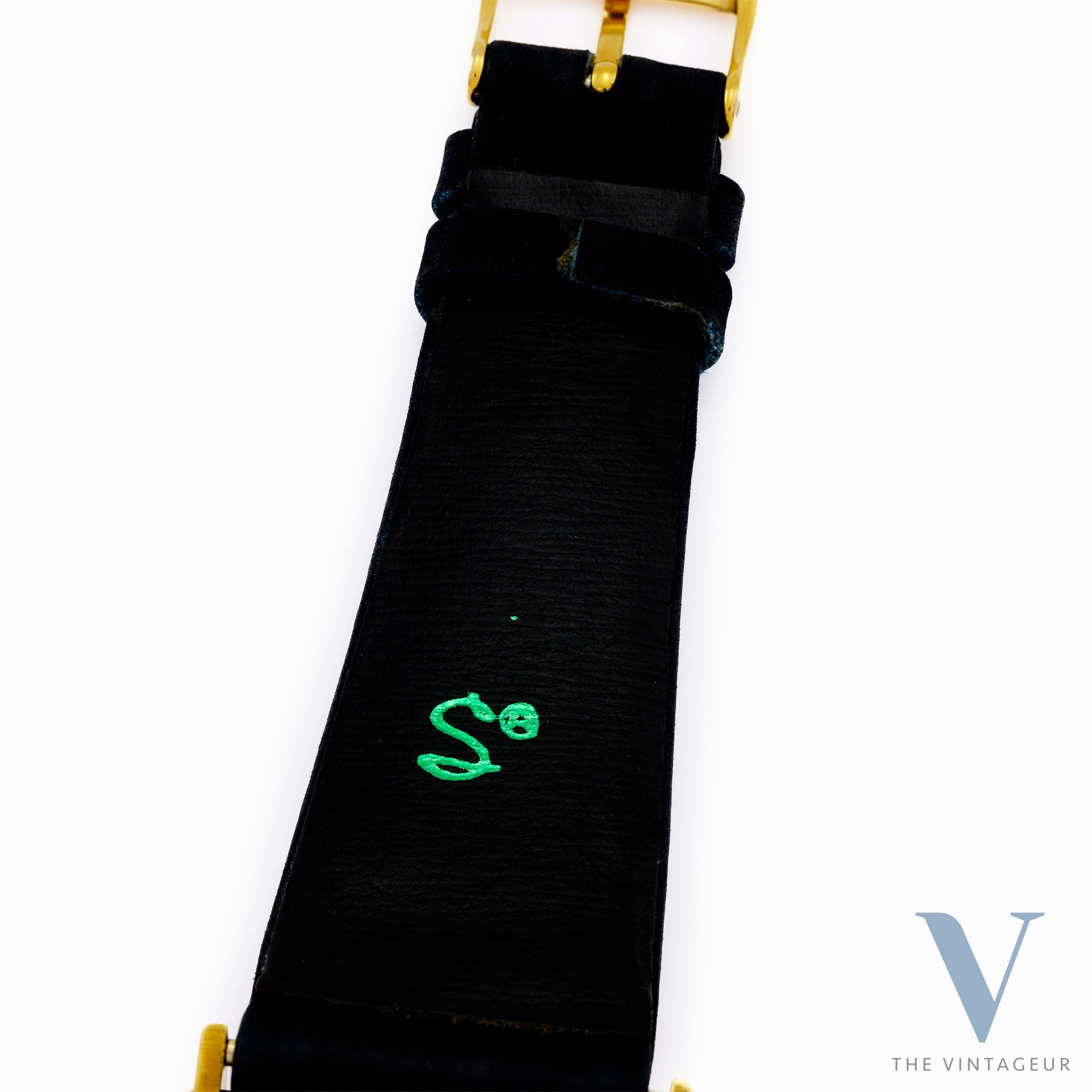
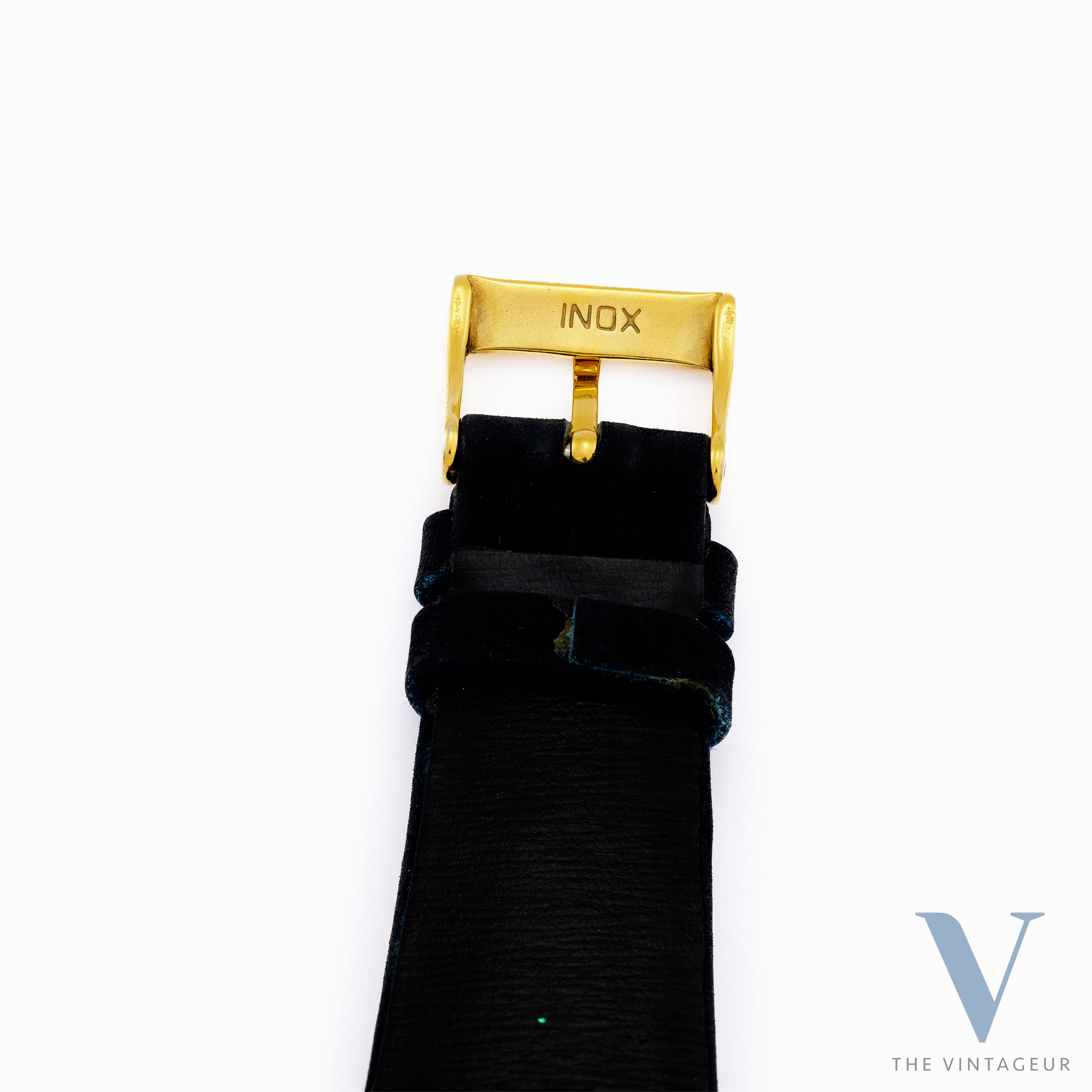
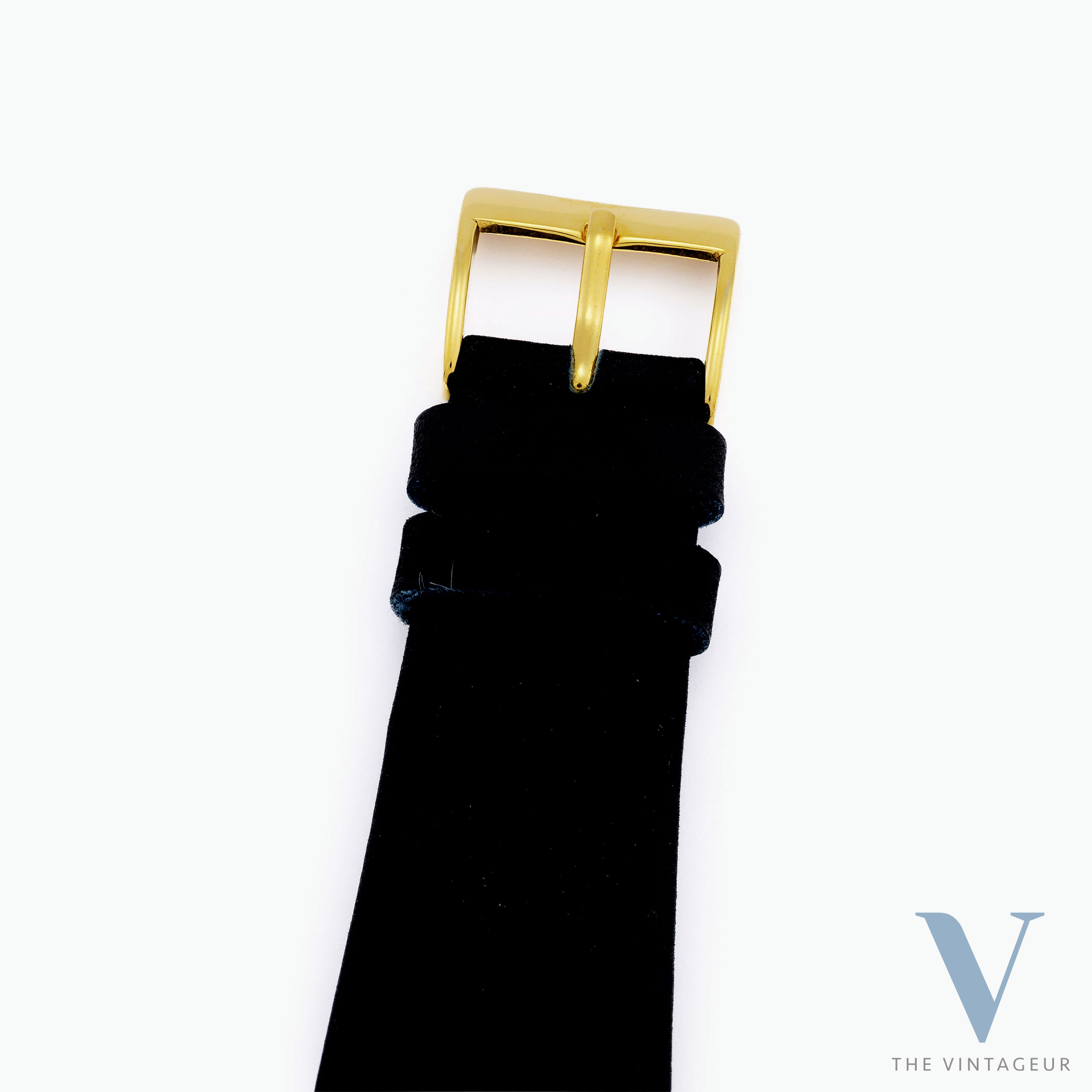
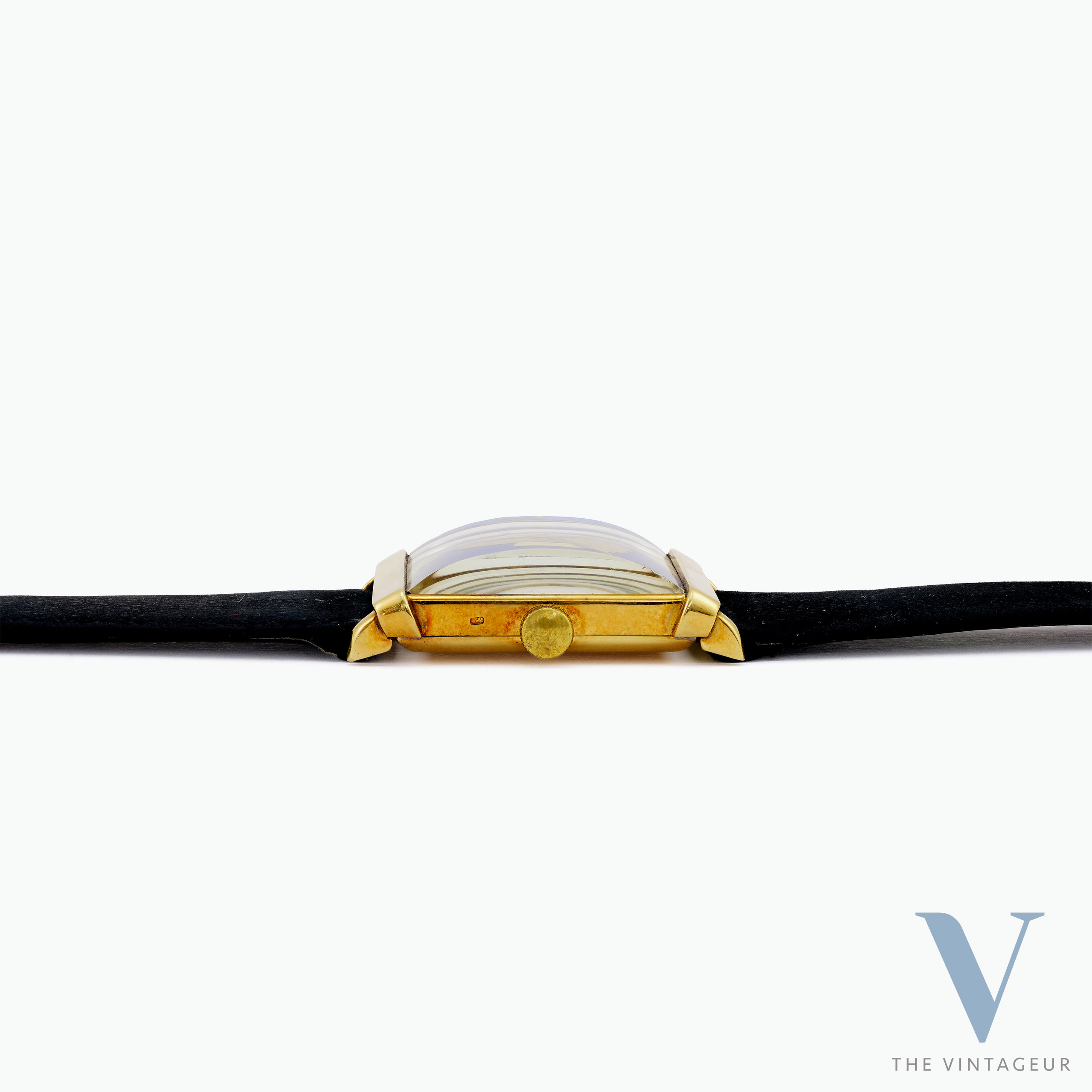
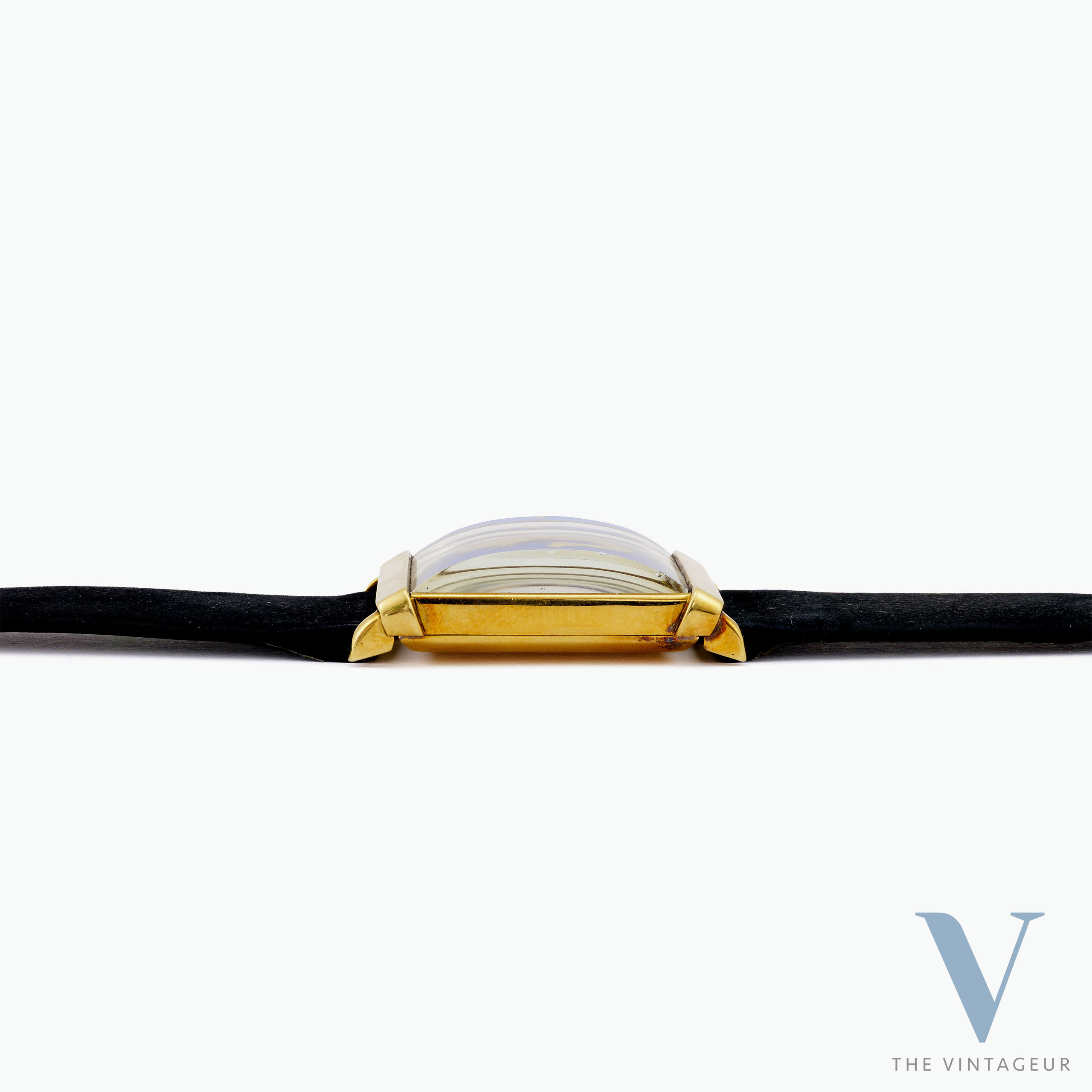
Unique Universal Genève “Triton” with blue enamel dial featuring an embossed yellow gold miniature of Triton, square-shaped 18Kt yellow gold case, in-house 264 manual-winding movement, from the 1940s.
CARACTÉRISTIQUES TECHNIQUES
18Kt yellow gold case measuring 29mm x 30mm
Original domed mineral crystal
Snap-on case back
Couronne originale
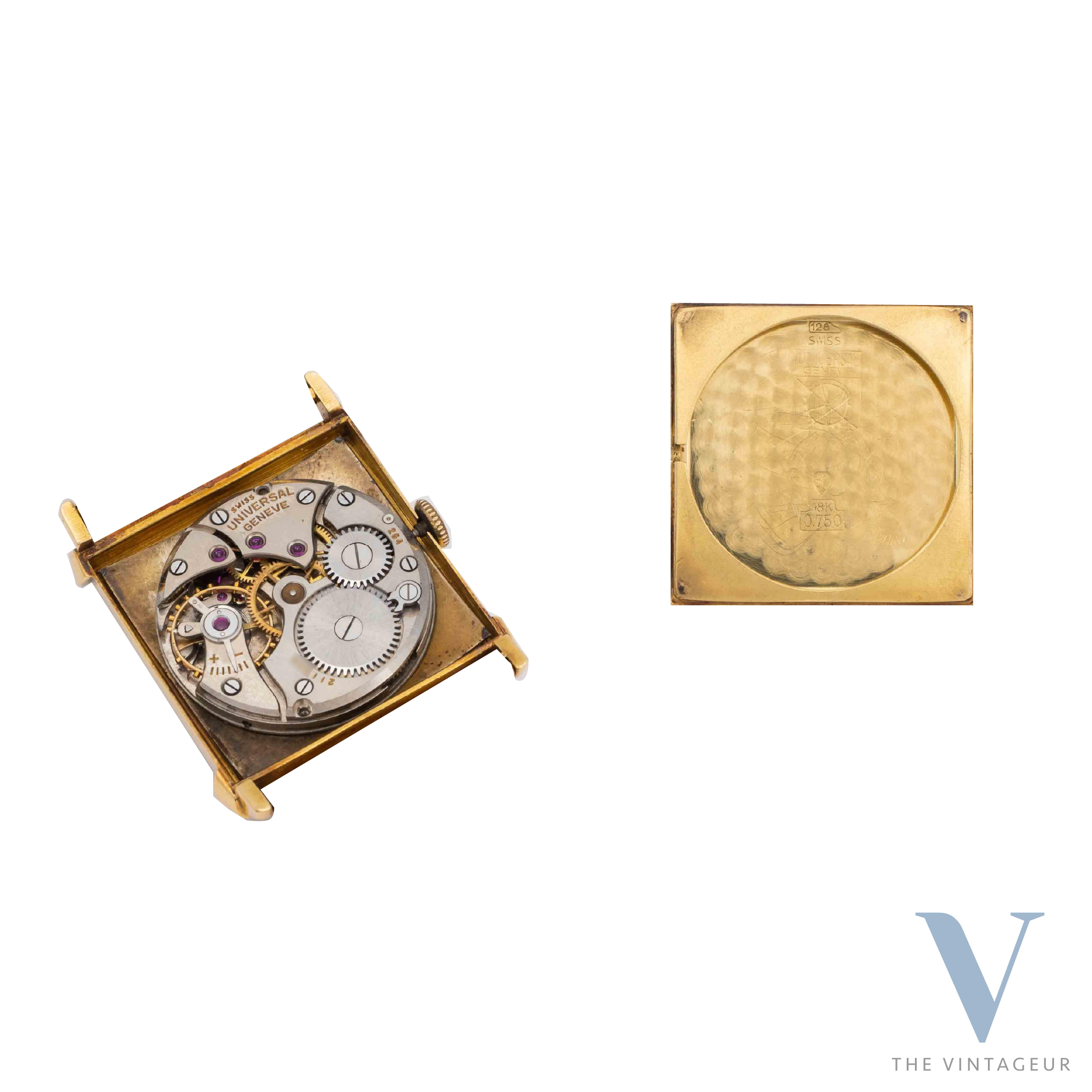
Hand-wound UG 264 movement inside
ANALYSE
This is a truly unique and special watch. Throughout its long and memorable history, Universal Genève has produced timepieces featuring extraordinary enamel dials, but in very limited numbers. This production, according to sources, was reserved for special orders, meaning it was made in extremely limited numbers and only at the request of special clients. This watch, with its stunning blue dial, is one of these exclusive examples.
The dial is crafted using the enamel technique, which involves a scientific series of firing steps at pre-set temperatures. It has acquired a blue hue reminiscent of lapis lazuli or ancient Egyptian glass paste (also known as “faience turquoise”). The faceted parallelepiped hour markers at the quarter hours are applied to the dial’s periphery, interspersed with circular dots. At the center of the composition is the figure of a character typical of ancient Greek mythology, Triton. He appears emerging from the depths of the sea in the middle of the dial, making it unique. The miniature is embossed in chased yellow gold and is meticulously crafted, revealing all the characteristics of this ancestral deity.
The name Triton has its roots in ancient Greece (although its primary origin is likely Phoenician), where myth held him to be the son of Poseidon, lord of the deep. This legendary figure, with his long mustache and prominent beard, appeared in his features and in his iconography as half man, half fish. He wielded a sonorous conch shell with which he tamed the waves or unleashed them in furious storms, embodying the ocean’s dual soul: indomitable strength and wild beauty. Over the centuries, his figure has spanned eras and cultures, appearing on painted amphorae, temple bas-reliefs, and lost frescoes, almost as if to remind mankind of the subtle boundary between the human and the divine in the face of the vastness of the sea. Even today, Triton remains the seal of an ancestral pact with the sea, a bridge between myth and the human thirst for knowledge of the unknowable.
The marvelous dial appears to be embedded in its mineral glass. Both components aim to evoke a sense of marine depth, as if water were actually flowing over the surface of the dial. The glass is very thick and domed; it tends to thicken at the edges, especially the corners, and seems to give the dial a fading effect of the blue color, which becomes increasingly intense and deep toward the center.
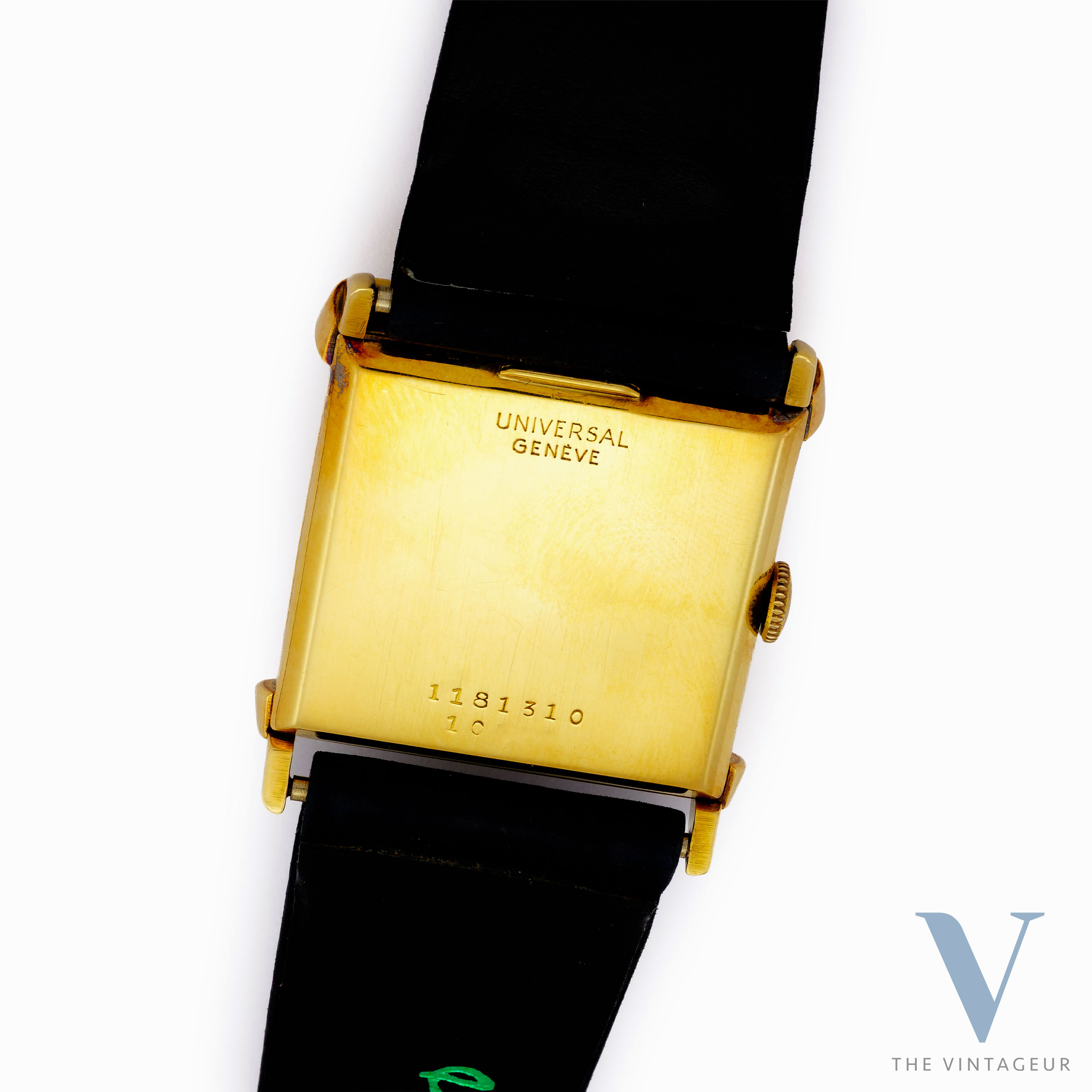
This combination of elements is set in a splendid 18K yellow gold case that forms the backdrop to the overall composition. It is square in shape with two sloping bezels that extend into the middle case and almost hide the lugs from a high-frontal view. The “Universal Genève” signature is placed on the outer caseback, along with the serial number and reference number.
Beneath this heavy caseback lies the manually wound caliber UG 264, a movement used from the 1940s to the 1950s, featuring 15 jewels and a screw-compensated balance wheel. It runs at 18,000 A/h and had an approximately 40-hour power reserve.
This stunning watch also emerged from an original archive photo, which depicts this unique piece next to its reference 10912. A small black and white photo – as we are accustomed to seeing with many examples of archived UG models – but very moving.
A second emotional aspect is the connection this watch has with a very fascinating figure, the Maharaja of Rajpipla, Vijaysinhji Chhatrasinhji. He lived from 1890 to 1951 and reigned from 1915 until the constitutional abolition of the monarchy in India in 1948. From 1948 until his death in 1951, he retained his title at an honorary level and was thus the last Maharaja of Rajpipla, a princely state in the Indian subcontinent. He was a highly charismatic figure, who was able to modernize his country with a cutting-edge school system, with the supervision of major public works in road and railway communication, as well as major administrative revolutions related to agriculture such as the implementation of the first state cadastral system.
Vijaysinhji also modernized the figure of the maharaja itself. He was a very elegant man, who loved the West, and especially the Old Continent. He spent long summers in England, where he had the opportunity to study and practice local sports, such as cricket and football. As a passionate sportsman, his name remains closely linked to the world of professional equestrianism. He had one of the finest stables of racehorses in India, which led him to win the Indian Derby in 1919, the Irish Derby in 1926, and the Belgian Grand Prix in 1927. His most famous achievement, however, was winning the Epsom Derby in England in 1934 with his fabulous horse, Windsor Lad.
According to some Indian sources, also attested by a relative of the Maharaja, this watch was his property. It is very likely that Vijaysinhji ordered it or received it as a gift during one of his long stays and travels around Europe a few years before his death. The depiction of the Triton on the dial is said to be a representation of his “Western” zodiac sign, Aquarius (he was born on January 30, 1890). Furthermore, the color associated with his reign was blue. Even today it is possible to admire pencil cases, brooches, storage boxes of various shapes and beauty cases, decorated with blue enamels (on which the letter “V” of her name is often imprinted in gold).