


CARACTÉRISTIQUES TECHNIQUES
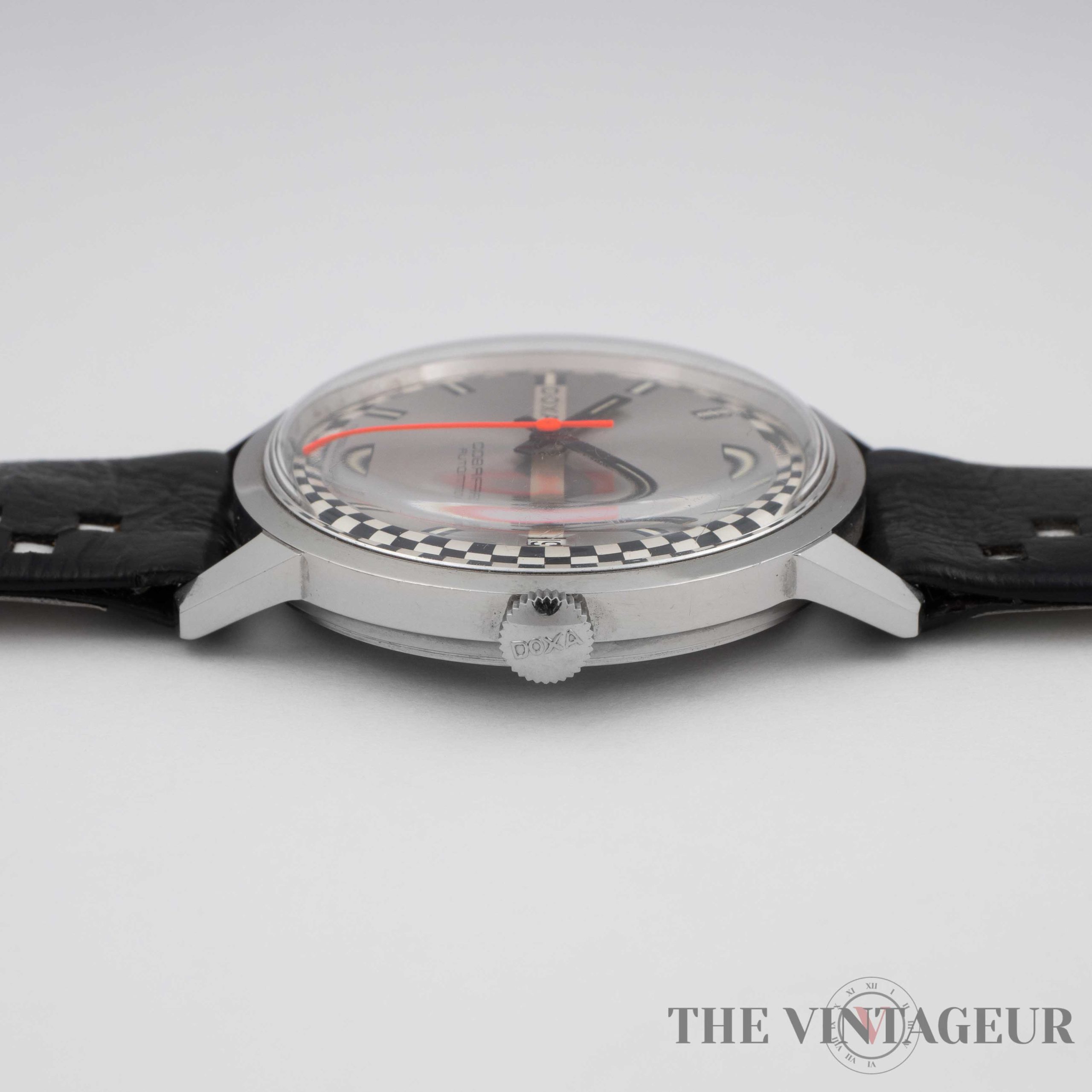
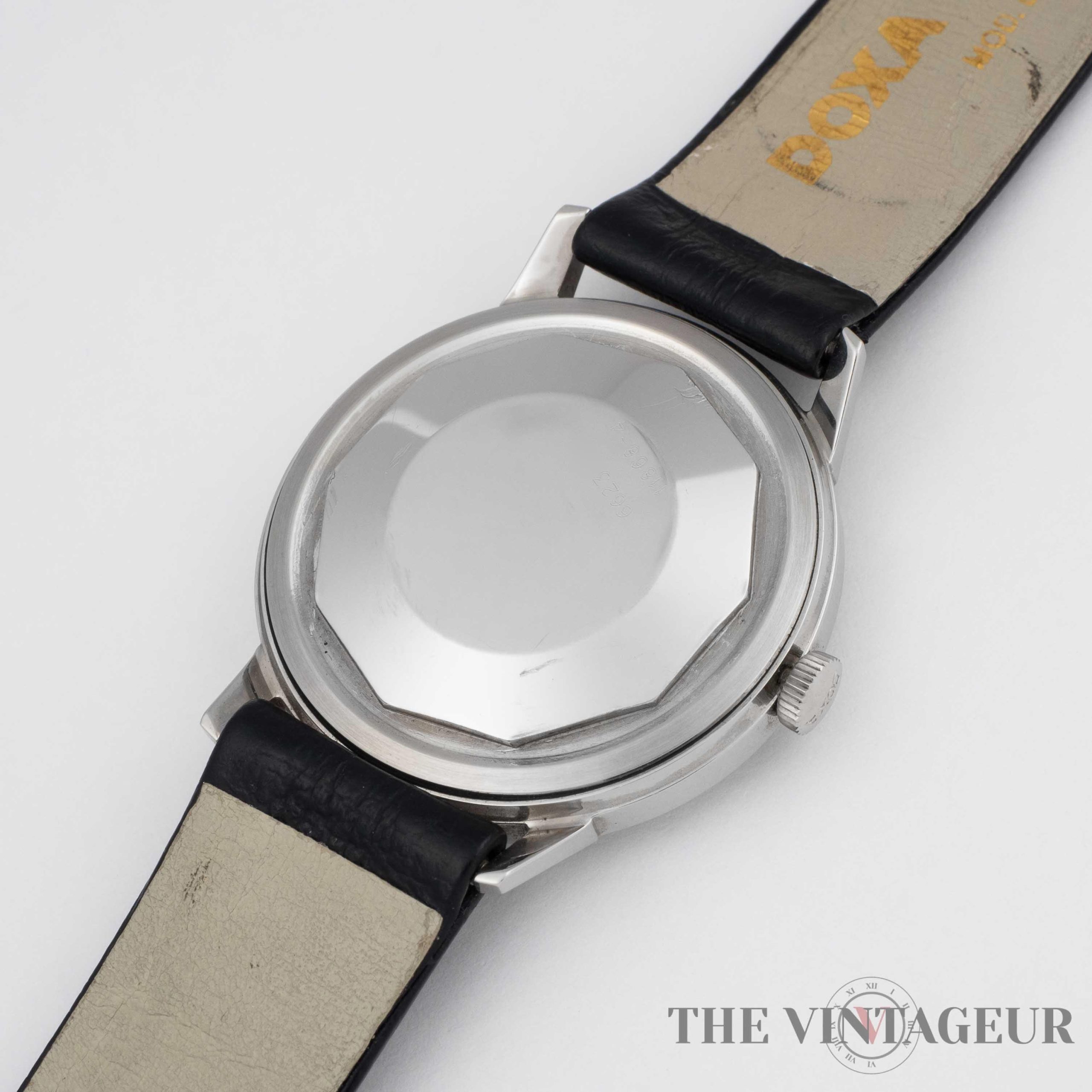
NOS Doxa Cobart F1 with waterproof steel case, automatic Doxa 118 movement (ETA 2472), from 1968.
35mm steel case
Cristal en plastique original
Couronne originale
Original strap and buckle
Automatic Doxa 118 movement (ETA 2472)
ANALYSE
The idea of a twelve-year-old boy from a large family in French-speaking Switzerland starting to tinker with the gears in a small watchmaking workshop would be alarming today. However, this was commonplace in the mid-19th century, and this is precisely the beginning of the story of Georges Ducommun, born in Le Locle in 1868. Coming from humble beginnings, with thirteen brothers and sisters, his passion for pocket watches led him, at the tender age of twenty, to open his own workshop. It didn’t take long for his skill to be noticed: his watches became so renowned that he won major awards, including in Liège and Milan in the early 20th century. In 1908, he even patented a movement with an eight-day power reserve, a true innovation for the time.
The first references to the name Doxa date back to the early 1900s, and are always associated with the term “Automobile” (registration no. 16331 of September 3, 1903). It was only in 1910 that Georges decided to give a clear identity to his watchmaking art, registering the Doxa trademark (on March 5, 1910, registration no. 27118). This name, derived from Ancient Greek, embodies, in its evolution, the very essence of the scientific ideal: the search for absolute and universal knowledge, distinct from and superior to the mere sphere of opinion. Subsequently, with the introduction of the New Testament term, the meaning of the term changes to glory and honor, to which is added the meaning of splendor and magnificence, and it is destined to become, in this latter sense, legendary in the world of watchmaking.
Ducommun wasn’t content with personal watches: his brilliant mind began designing chronometers for ships, airplanes, and automobiles (his “8-day” movement, chosen to equip the luxurious Bugattis of the time, is famous). By the 1920s, the Doxa catalog had expanded dramatically: alongside professional instruments, there were wristwatches, alarm clocks, and jewelry watches mounted on rings and bracelets. Upon his death in 1936, his brother-in-law, Jacques Nardin, great-grandson of the famous Ulysse Nardin, took up this tradition of excellence, ensuring that Ducommun’s pioneering spirit lives on to this day. It was between the 1960s and 1970s that Doxa achieved its greatest commercial success by entering the world of diver’s watches. In the early 1960s, with diving evolving from a specialized activity to a hobby, the market for mass-produced “diver’s” watches was still nonexistent, remaining the exclusive territory of a few manufacturers of professional instruments. Doxa filled this need with a line of diving watches that culminated with the market launch of the Sub-300 in 1967.
That same year, the trade magazine Europa Star published the first advertisement for the Doxa “Cobart F1” model. This watch stood out for its eclectic and extremely sporty spirit, inspired by motor racing. It was produced in three versions: manual winding and waterproof case; manual winding, date display and waterproof case; and automatic winding, date display and waterproof case.
This piece belongs to the last of these three categories/sub-models.
Its silver-toned dial with a sunburst finish features a black and white checkerboard band, reminiscent of the finish line and the checkered flag marking the end of a car race. Adjacent to this band, which runs along the entire exterior, are the applied baton-shaped indexes filled with tritium. A white band runs along the central axis of the dial, framing the Doxa signature on the left and the date window on the right, beneath which is the model name Cobart F1 Automatic. The hands are black baton-shaped with luminescent material; the seconds hand is a bright orange, further accentuating the racing spirit of this extravagant watch.
The black and white checkerboard motif is echoed in the original strap: it is black leather and features square openings on the right side, revealing the white textured interior. The strap closes with the original Doxa buckle and is completed with its original tag.
The waterproof steel case features a screw-down case back. Otherwise, the structure and design of the entire case remain fairly classic and clean, further accentuating the imaginative, sporty dial.
This stunning watch, which embodies all the hallmarks of the late 1960s and early 1970s, is powered by the self-winding Doxa 118 caliber. It is based on the ETA 2472 caliber with a bidirectional winding rotor and was produced starting in 1965. It has 21 jewels, a 42-hour power reserve, and runs at 18,000 A/h.