

CARACTÉRISTIQUES TECHNIQUES
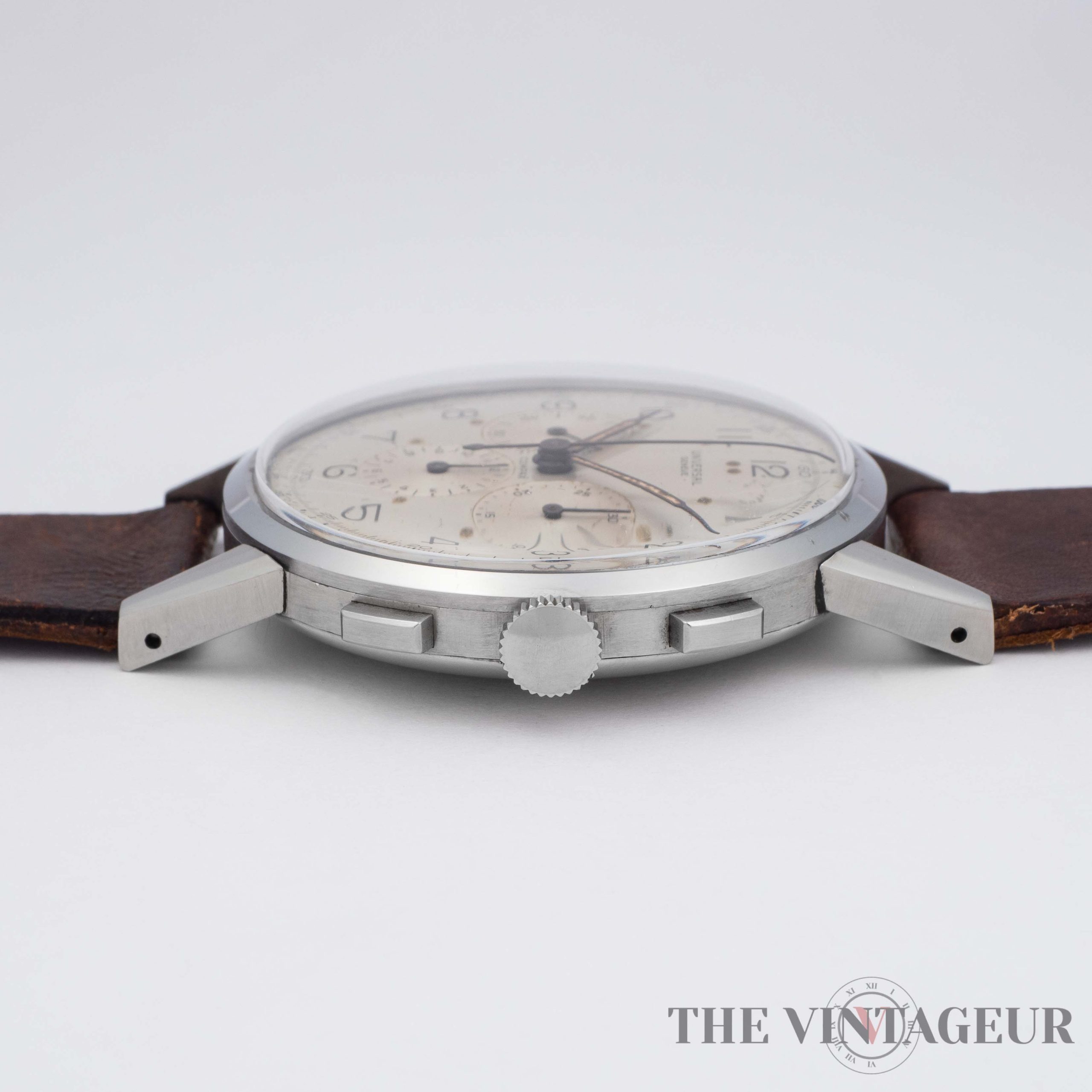
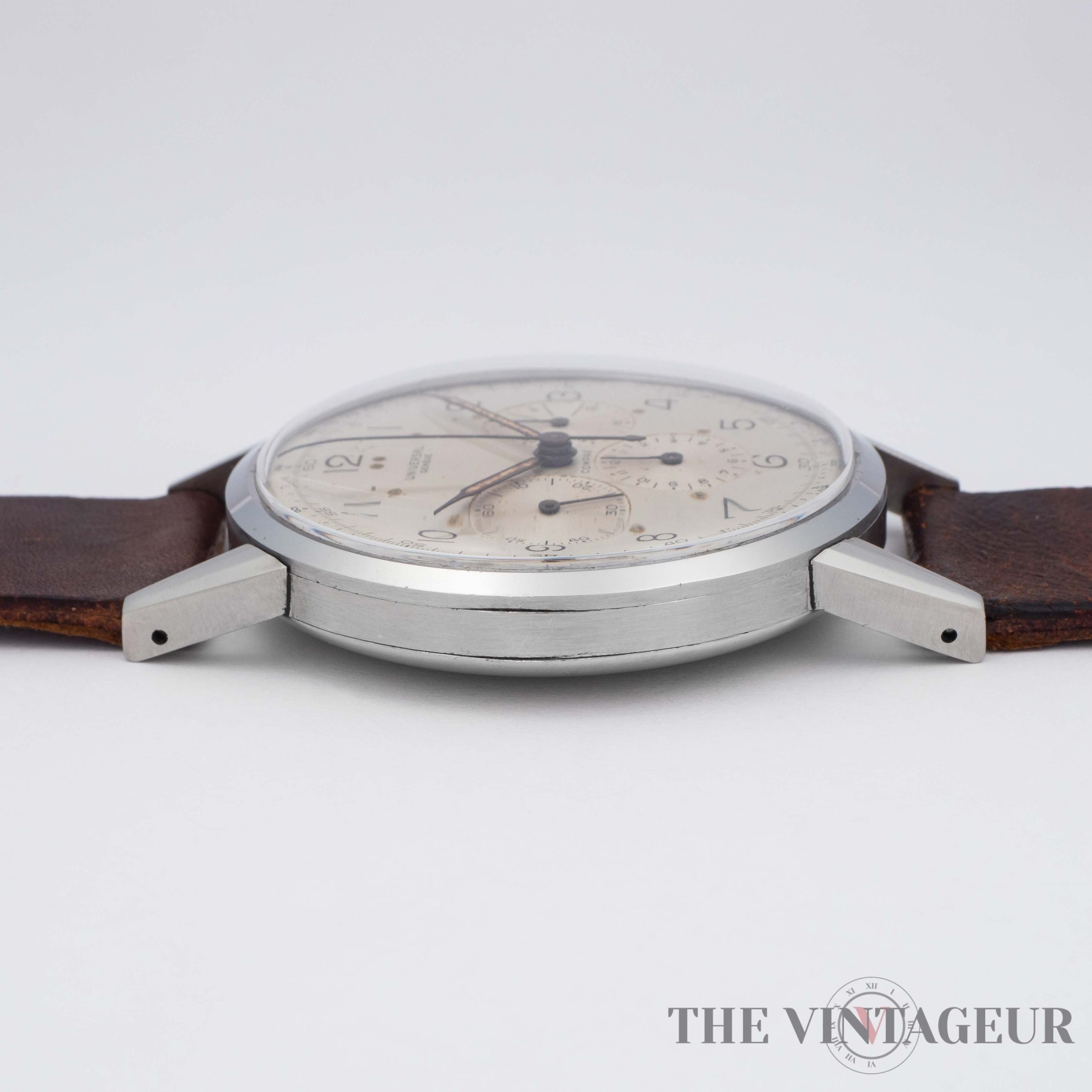
Incredible and rare Universal Genève Compax ref. 22430, known as the “Universalone” or “Compaxone,” with an extra-large 46mm steel case and a manually wound UG 292 chronograph movement from 1945.
Steel case measuring 45mm
Radium dial
Original radium hands
Original rectangular pushers
Cristal en plastique
UG 292 chronograph movement inside
ANALYSE
The history of Universal Genève is extremely long and complex, but one thing has always been very clear, both now and today: its chronographs are among the most popular watches among buyers from the 1940s to the present day. In the hand, a Compax, designed in 1936, has the same effect, evokes the same emotion, that they must have felt exactly 90 years ago. The Compax was among the most innovative watches of the late 1930s, adding a chronograph hour counter to the Compur and then the Uni-Compax models. It wasn’t just a technical and practical evolution: Universal Genève created the canonical configuration of the ideal chronograph dial, with three subdials positioned at 3, 6, and 9 o’clock. It’s no coincidence that even today, the name “Compax” is used (inappropriately) to indicate any subdial on any watch, even a three-hand watch. This is the legacy of that significant aesthetic innovation.
Universal Genève has produced many versions of the Compax throughout its history, but there are some references that, due to their rarity and beauty, are among the most sought-after chronographs by collectors. The “Compaxone” or “Universalone” – as Italian collectors like to call this model (Italians, as is well known, give nicknames to everything, and in the watchmaking world they’ve always been the first and last to do so) – is one of the finest examples of what “rarity” means.
Along with just a couple of other references (including the ref. 22531), the Compax ref. 22430 with its ultra-large 45mm steel case is one of a kind. This watch was produced in the first half of the 1940s to meet the needs of airline pilots, who needed an easily legible watch with easy-to-use chronograph functions, often worn over their flight jacket. For this reason, Universal Genève produced very few examples of this gigantic Compax, which today are highly sought-after, especially by collectors of the brand.
The dial is light with a warm patina of time, which has turned it a very luminous ivory color. The periphery of the dial features a 1000-based tachometric scale, which is pad-printed in a bright blue. The hour numerals are Arabic and feature a combination of radium dots centered toward the inside of the dial. The word “Universal Genève” appears at 12 o’clock; at 6 o’clock, just above the chronograph counter, the word “Compax” appears in its typical position. The hands have a flame-blued frame and contain the original luminescent paste.
The case appears enormous at 45 mm in circumference, yet it still feels slender on the wrist due to its thinness. The four faceted lugs are attached to the circular body of the case. This is a typical construction of oversized cases of the period, which is also found at Minerva, for example, in its cal. 17.29 and cal. 19.9 (which, much like the UG, are affectionately called “Minervone” by Italian collectors). The case back snaps shut, leaving the case profile flat.
This exceptional chronograph is powered by the caliber (derived from Martel) UG 292. This time-tested chronograph movement has the classic chronograph architecture with a lateral clutch and column wheel. It measures 35.20 mm and is only 6.05 mm thick. It oscillates at 18,000 A/h, has 17 jewels, and is rhodium-plated.