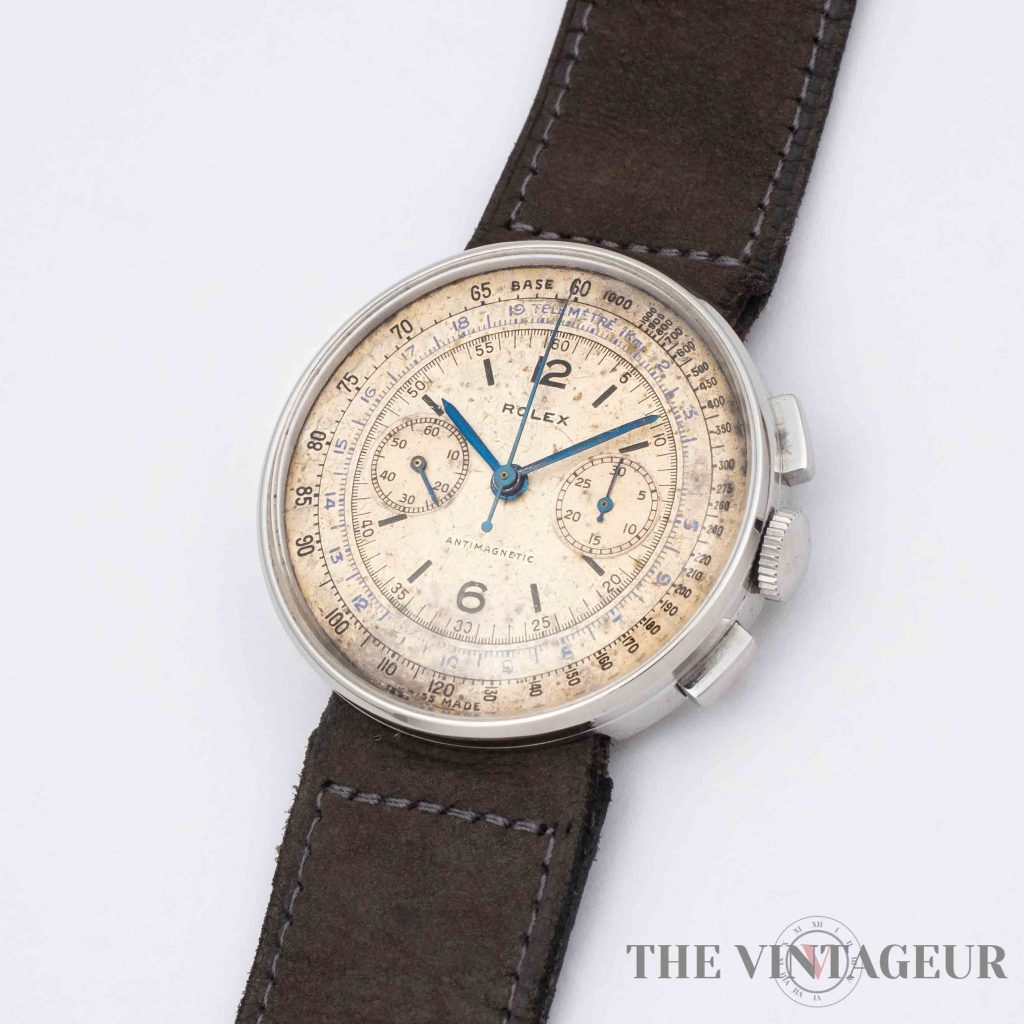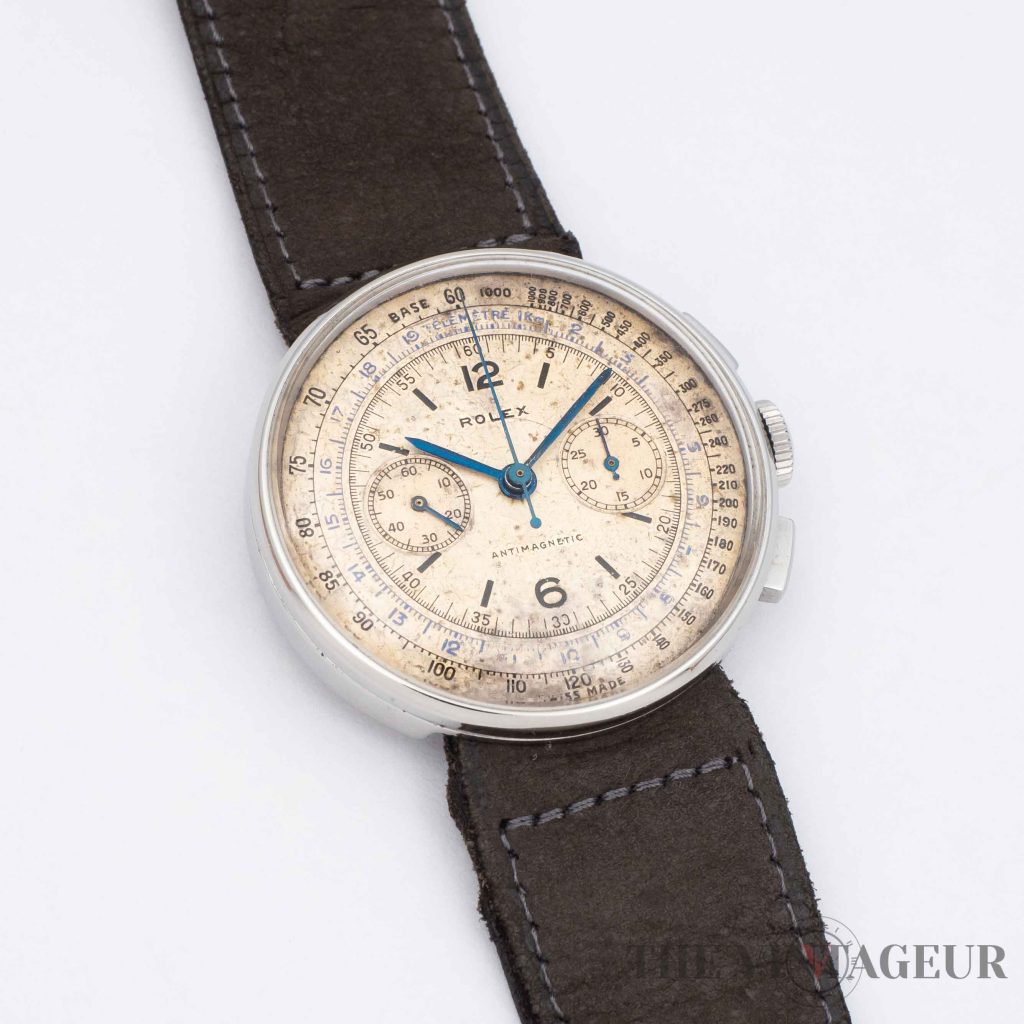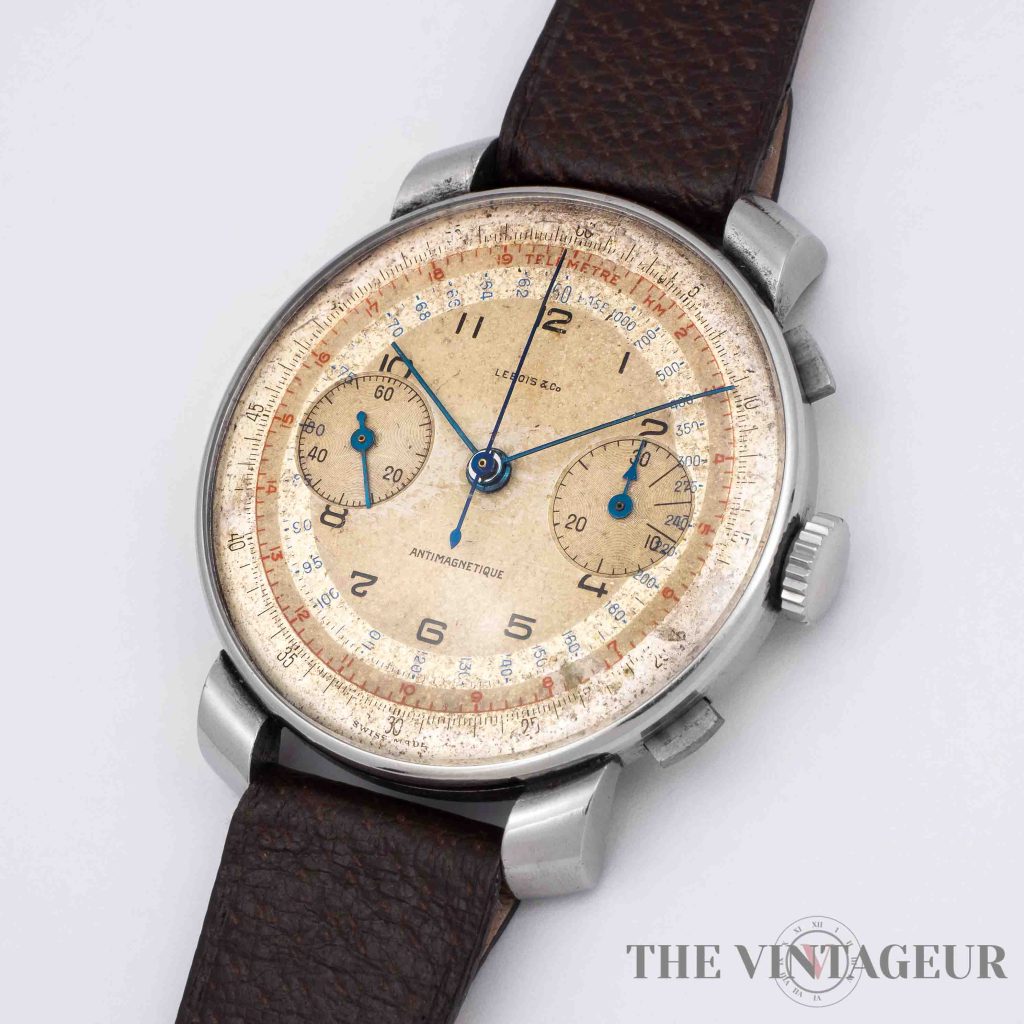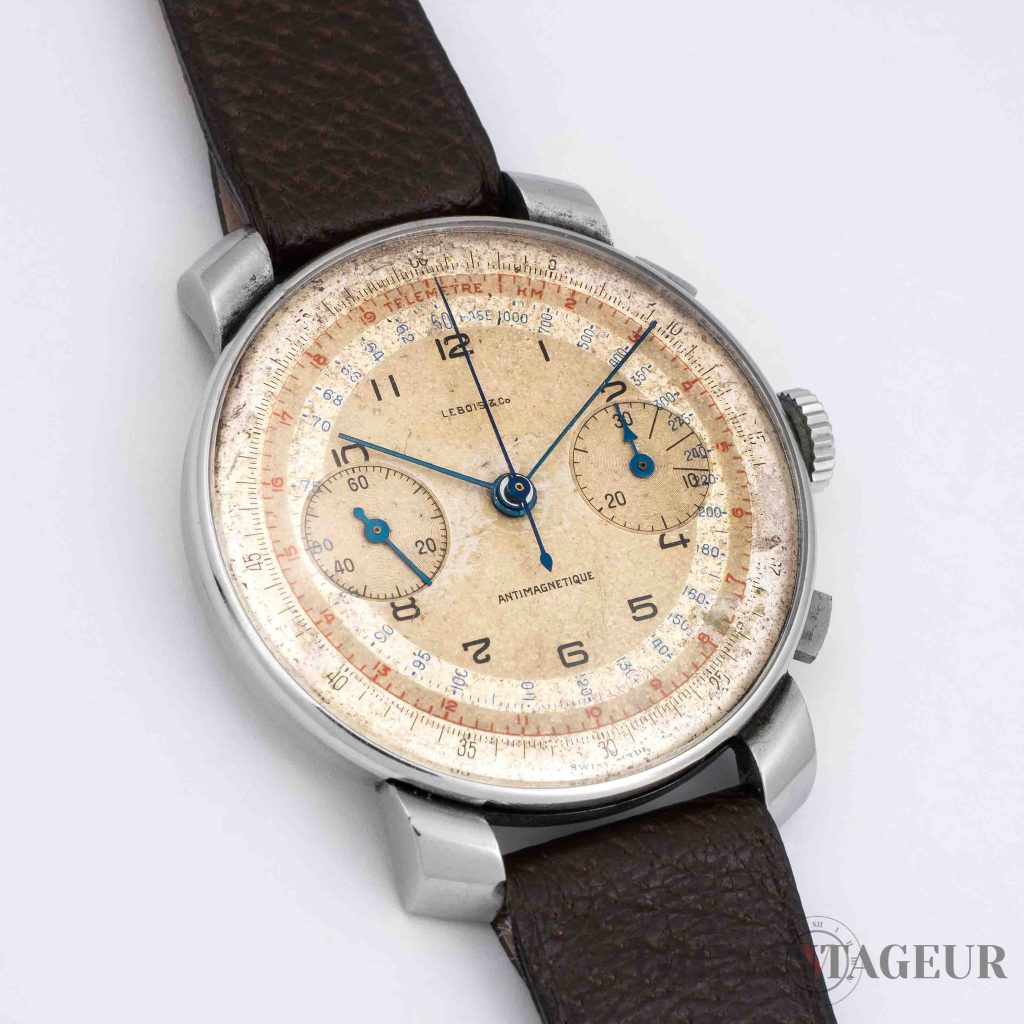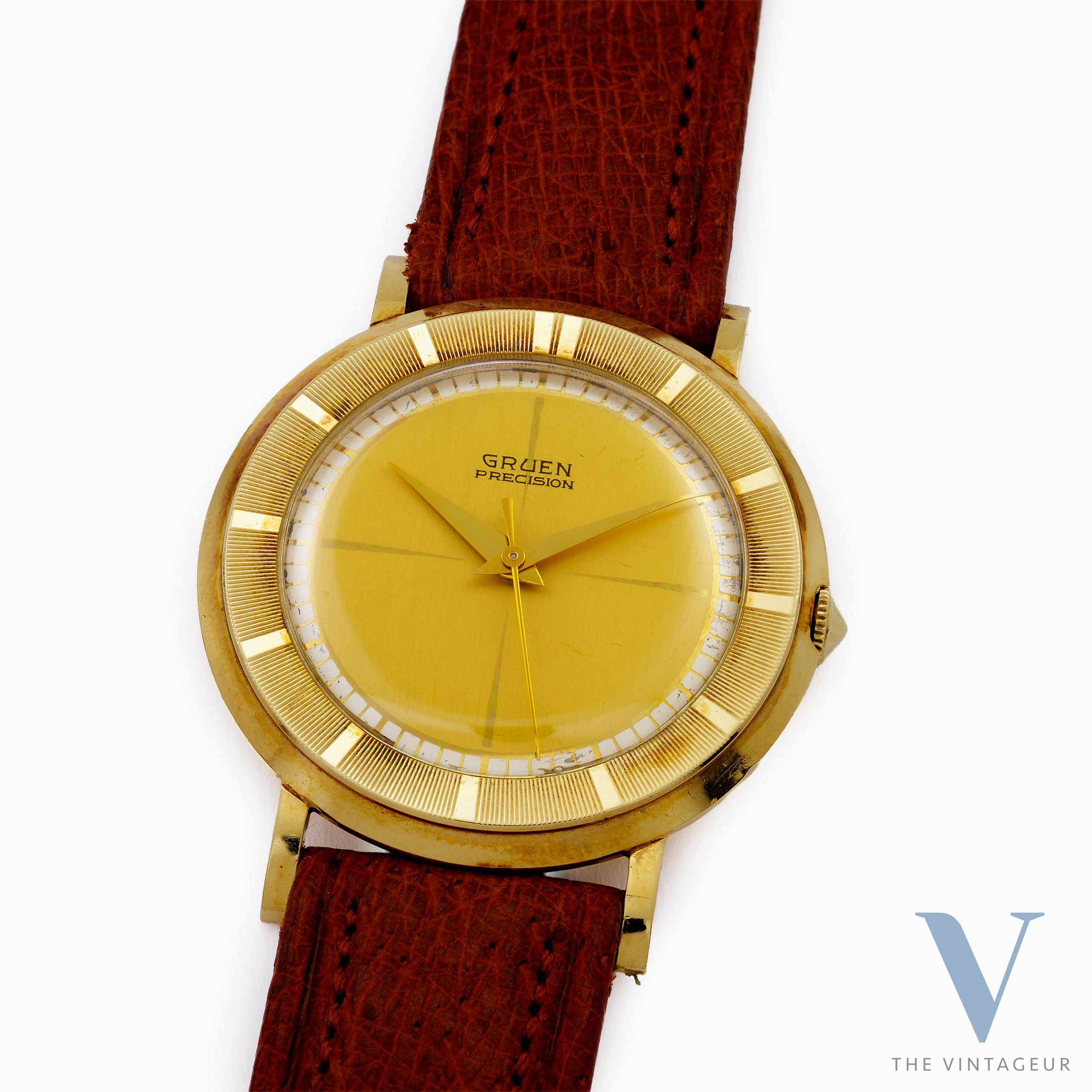
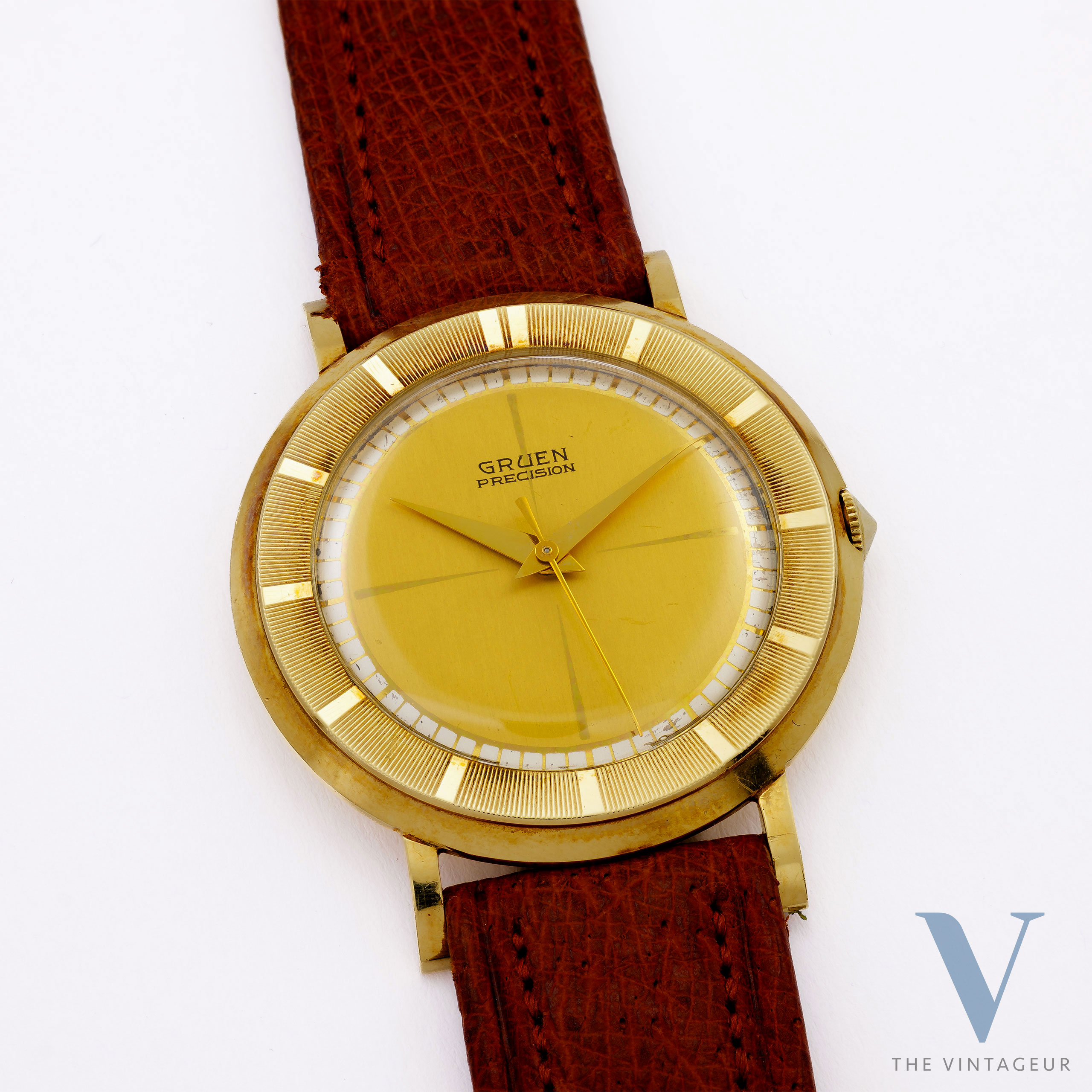
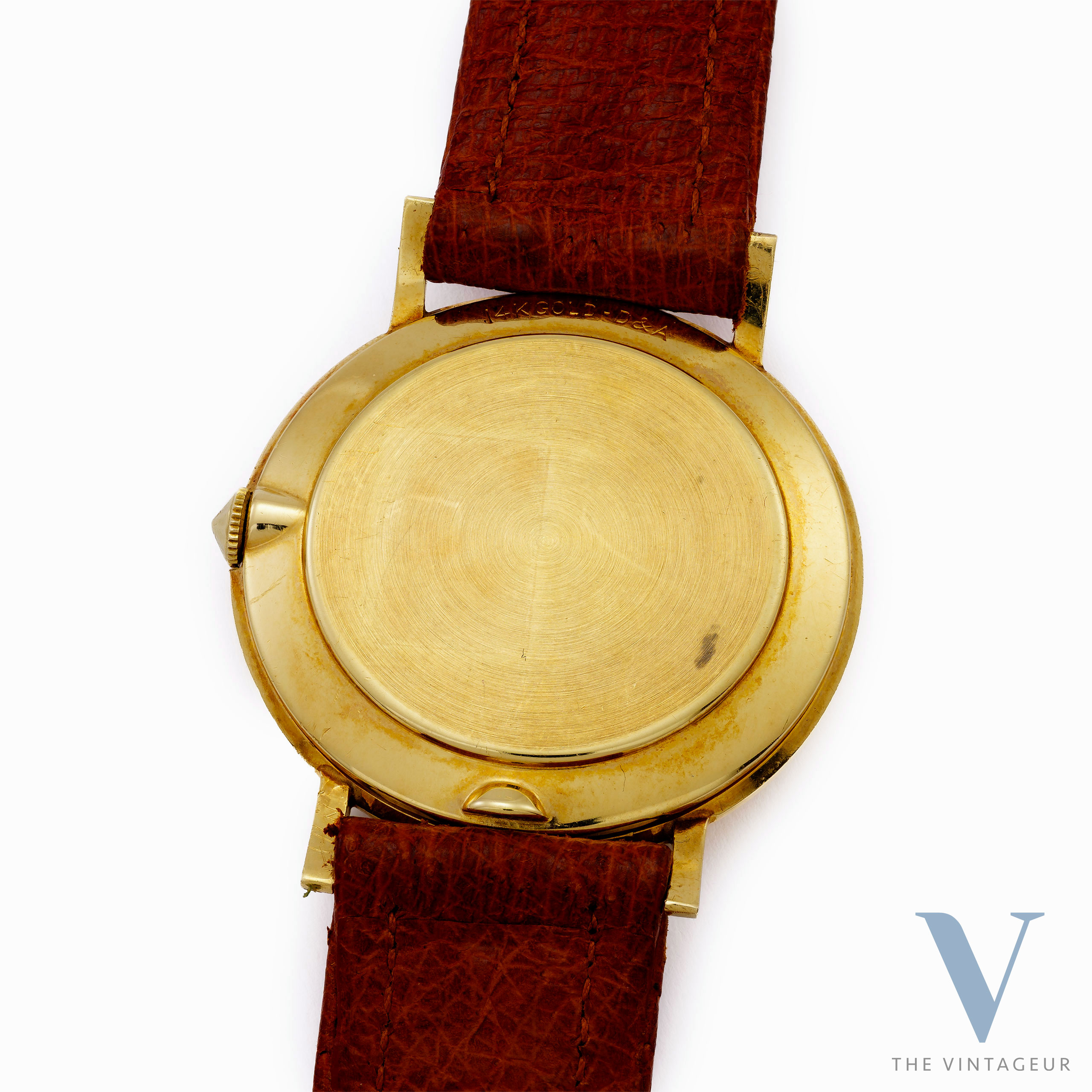
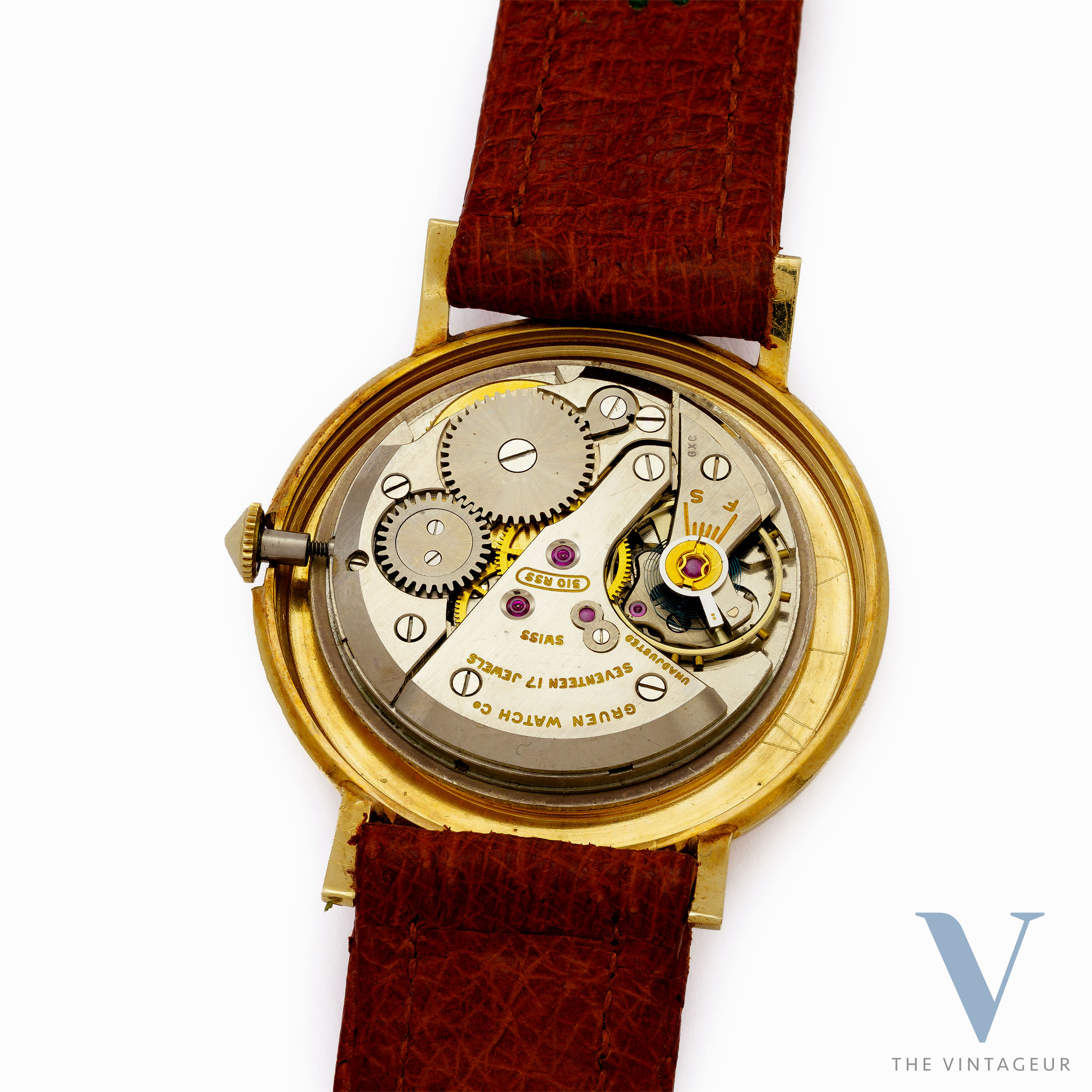
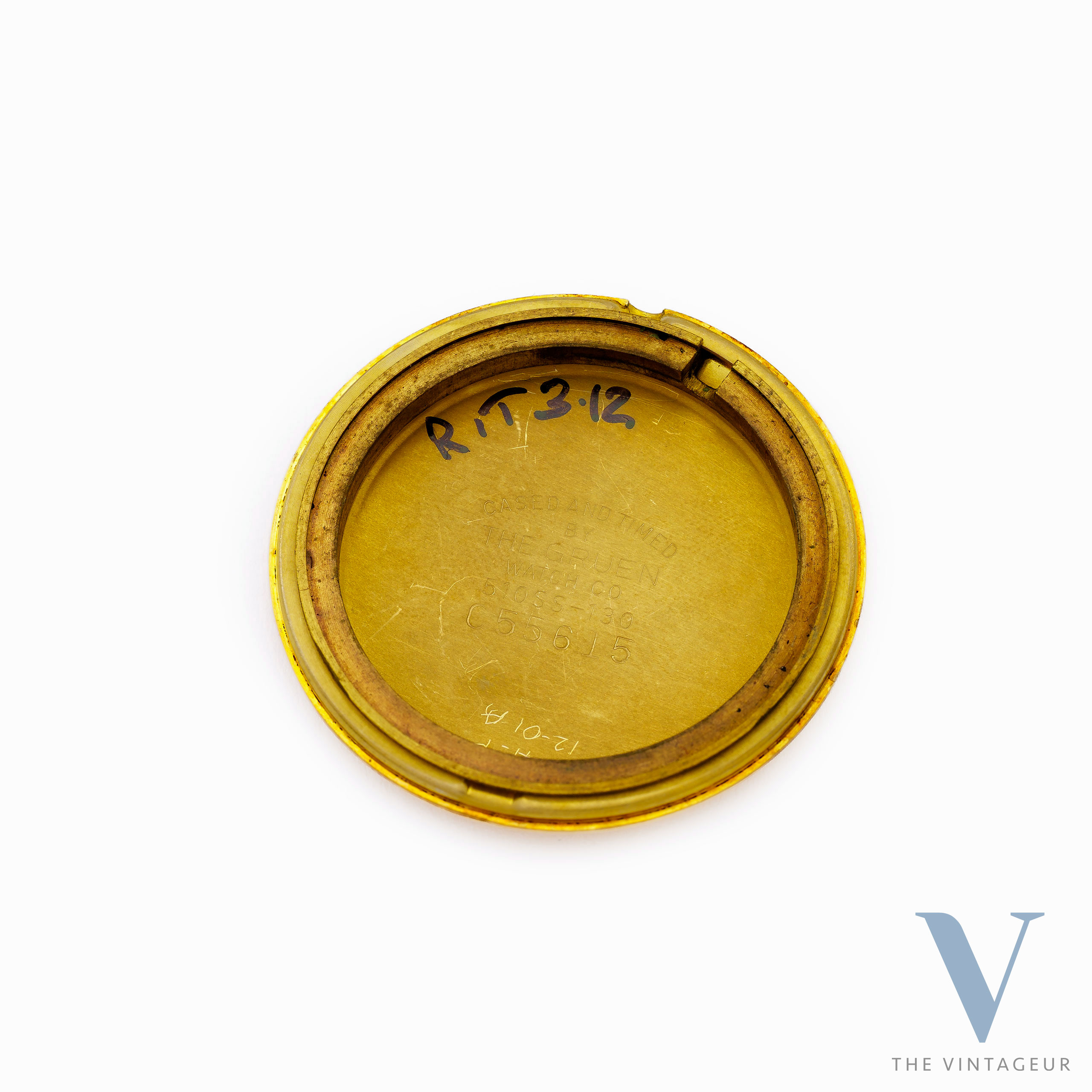
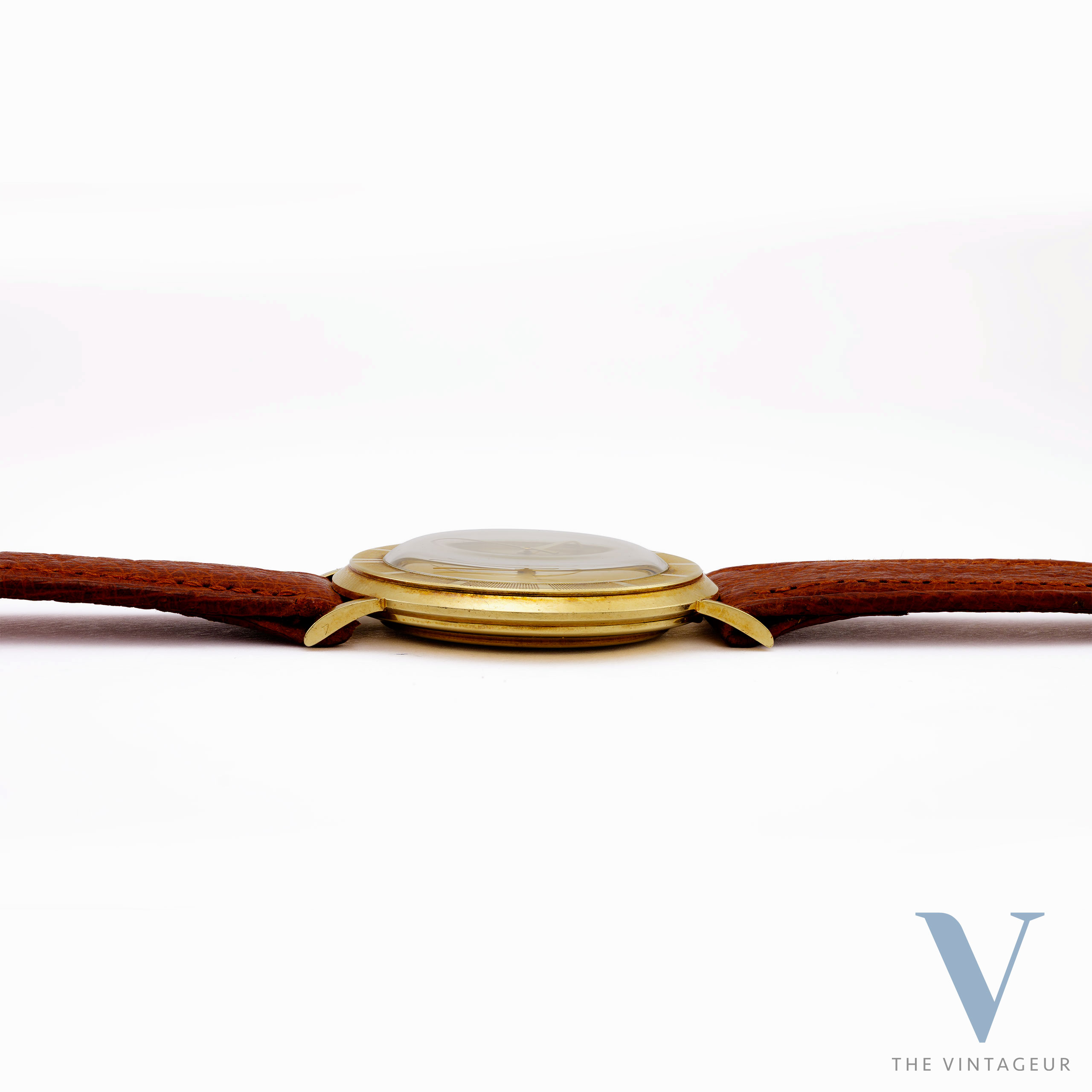
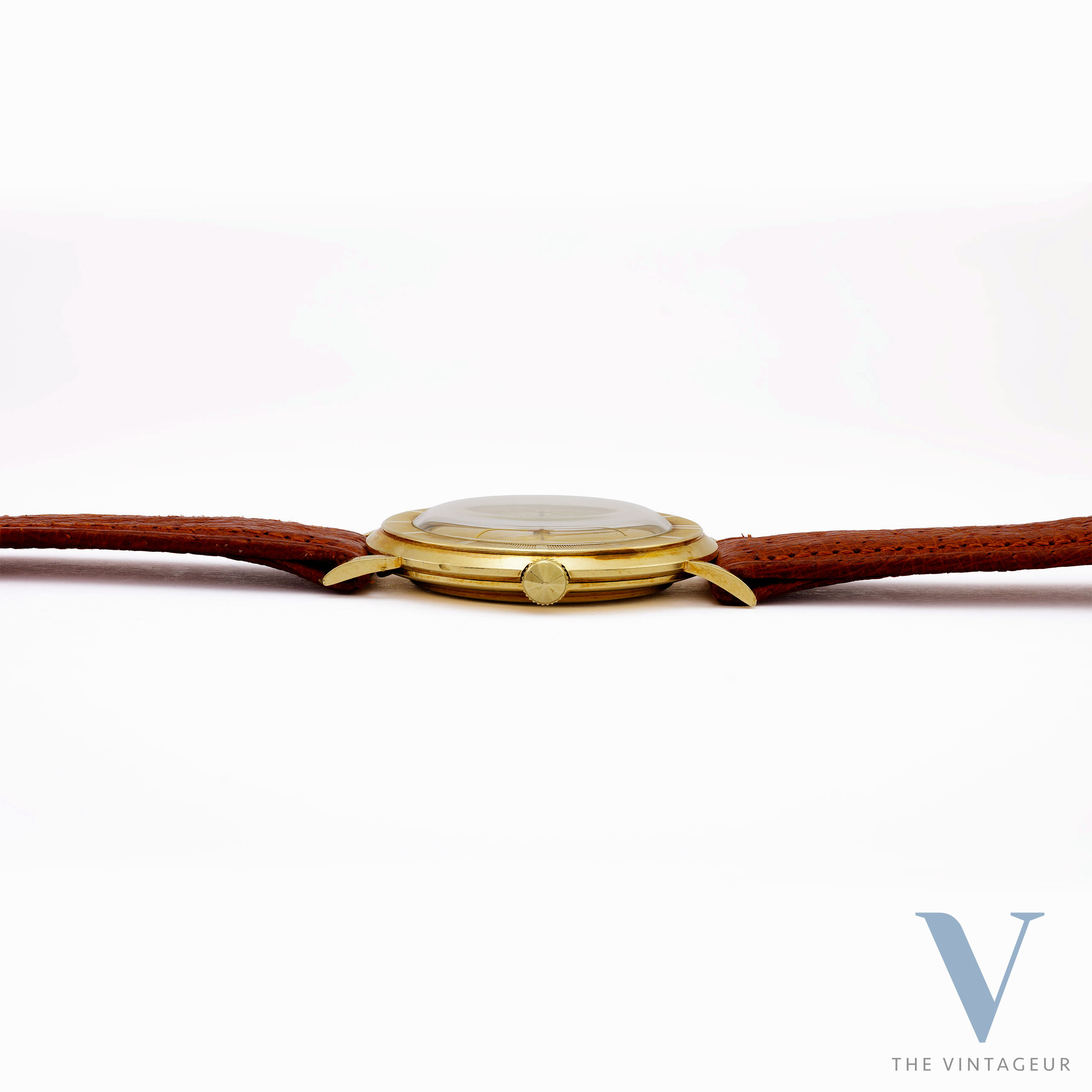
Beautiful Gruen Precision with sector-cross dial, ultra-thin 14KT yellow gold case, Gruen 510 hand-wound movement inside, from the 1950s.
SPECIFICHE
14KT yellow gold case measuring 34mm
Lug-to-lug measuring 39mm
Cristallo originale
Corona originale
Gruen 510 hand-wound movement inside
ANALISI
Before settling down overseas, Dietrich Grun – who would later become “Gruen” – had already honed his watchmaking skills in German and Swiss workshops. Once in the United States, he founded the Columbus Watch Company in 1882 in Columbus, Ohio, and over time passed on his passion for timekeeping to his sons. At the dawn of the twentieth century, the company changed its name to Gruen & Sons and moved to Cincinnati, where it began producing watches powered by Swiss movements. The American public welcomed them enthusiastically. Between the 1920s and 1960s, alongside giants such as Elgin, Hamilton, and Waltham, the Gruen Watch Company did more than simply manufacture watches: it helped shape entire chapters of American society and traditions.
Although American manufacturers – unlike their Swiss counterparts – were able to achieve enormous volumes of large-scale wristwatch production, especially from the 1910s onward, they faced challenges in ensuring the thinness and precision of the mechanisms. The Swiss were highly critical of the Americans regarding the thinness and the precision of the movements. This critical attitude can be seen in this passage from a Swiss newspaper from 1910:
“[…] In America, it was the Gruen Company that first created the demand for flat watches, demonstrating that this type of timepiece could be truly practical and easily repaired. In the United States, semi-flat watches are successfully produced, but I doubt it will ever be possible to make a completely flat watch there, due to the shortage of skilled labor. Machines easily produce normal-sized watches; when it comes to flat watches, the matter is entirely different, as the work of the machines must be supplemented by skilled watchmakers. Only in Switzerland are flat watches made for women. On average, they meet the generally accepted requirements for women’s watches; however, precision is somewhat sacrificed for aesthetics. It is true that such precision can be achieved, but it requires a highly skilled watchmaker, and retailers who market them are advised not to overemphasize this quality and to guarantee better results than they are accustomed to.” […] (Excerpt from an article from the Revue internationale de l’horlogerie, 1910)
In particular on the topic of watch precision, American manufacturers lagged behind their Swiss counterparts, and numerous advertisements for experienced Regulating Watchmakers appeared on public noticeboards and in the American trade press.
Gruen therefore chose to adopt an innovative strategy: designing the cases in-house but using high-quality Swiss movements. The manufacture thus exemplified the transatlantic hybridization of the time: American design, distribution, and marketing combined with Swiss manufacturing technology. Thus, Gruen, in addition to expanding from Cincinnati to New York and Totonto, established strategic bases in Biel, Geneva, St.-Imier, and Madretsch. In these Swiss production centers for high-quality calibers, the American company successfully carved out its own space, quickly becoming a major player by the 1910s. He began to fit Aegler, ETA, Felsa and FHF ebauche calibers into his watches, renaming them and signing them on the bridges and plates. It was during this period that he filed countless patents and trademarks, including “Gruen Verithin”, “Verithin” and “Ultrathin” – which referred to thinness – and “Gruen Precision”, “Precision” and “Gruen Precision Verithin” – which instead echoed precision as well as the thinness of the movements. The “Precision” name was filed in October 1912, and was registered under number 32122 by Gruen Watch Mfg. Co. (where “Mfg.” indicates the American term “Manifacturing”). From the 1910s to the 1970s, the “Precision” signature on the dials of Gruen watches was a standard that indicated higher-end models, such as thin and well-finished Swiss mechanical movements, which allowed the American company to affix the “Swiss Made” inscription to their dials.