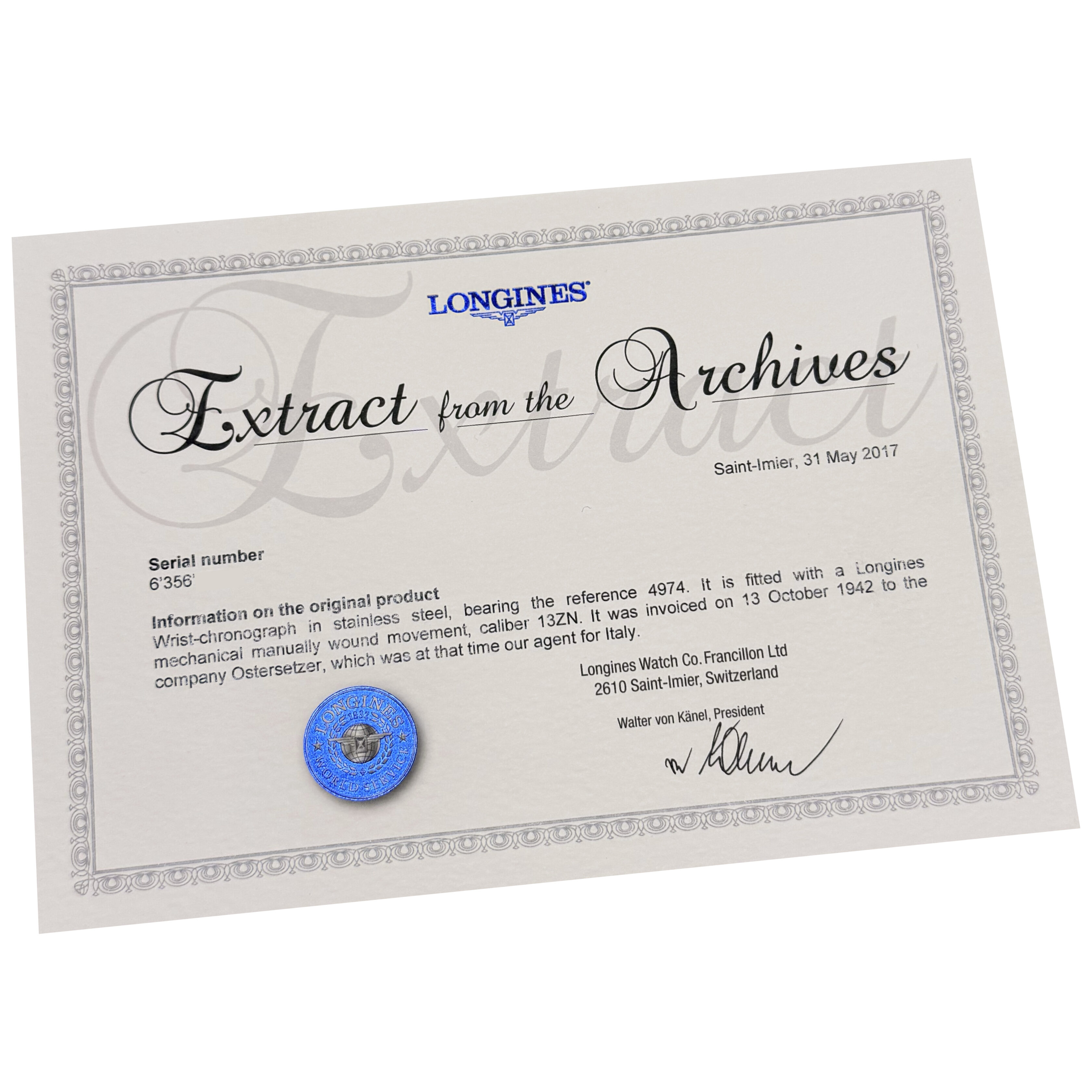
Exceptional Longines reference 4974 “Tre Tacche” flyback chronograph, with an incredible black gilt dial double signed “Mobec Watch Zurich”, monobloc steel case, in-house 13ZN manual-winding chronograph movement, from 1942
SPECIFICHE
Cassa in acciaio di 37,5 mm
Spingitori d'urto originali
Corona originale
Original handset
Cristallo di plastica
Longine 13ZN manual-winding chronograph movement inside
ANALISI
The combination of the 13ZN caliber and the “Tre Tacche” case of reference 4974 constitutes a One of the most successful synthesises of technical rigor, constructional solidity, and formal balance in the panorama of wrist chronographs of the 1940s. The 4974 crystallizes the moment when Longines – already in possession of one of the finest bi-push chronograph calibers of its time -could pair it with a waterproof case of complex industrial genesis, yet instantly recognizable thanks to the three notches on the caseback that have marked its collector’s success in our time. Its absolute rarity – perhaps just over a hundred pieces produced over the course of three years (1940 > 1943) – combined with the exceptional variety of dials by Stern Frères and Flueckiger & Cie (“ZJ”), and completed by a chronograph caliber of rare beauty and precision, make this chronograph one of the most beloved and coveted objects today.
Reference 4974 is part of a broader case waterproofing strategy pioneered by Longines between the late 1930s and early 1940s. Although water resistance had already been extensively explored on time-only watches, Swiss watchmakers were struggling to solve the dilemma of waterproofing chronographs, which had the perennial problem of water infiltration through the chronograph buttons. Against this backdrop, Longines embarked on a technical (and aesthetic) journey that would lead to the first release of reference 4270, with its famous “mushroom pushers,” in 1938, followed by reference 4813, from which the 4974 inherited its crown and pushers.
The 37.5mm steel case is a testament to robustness. It is crafted entirely from a solid block of steel by hand-turning and finishing, and features a thick, finely satin-finished profile that blends beautifully with a clean-cut stepped bezel. A raised shoulder on the opposite side accommodates the screw-down case back, which, together with a rubber gasket between the case back and the central case, ensures the watertightness of the entire assembly. It is characterized by three notches (hence the affectionate Italian nickname “Tre Tacche”) used for tightening with a special key. As for the manufacture of this iconic case, although internal Longines documentation does not explicitly name an external supplier, some analyses and studies by enthusiasts indicate that it was produced by the renowned “La Centrale” manufacture.
Inside this monolithic case is the infamous 13ZN manually wound chronograph caliber with flyback function. This marvelous machine measures 29.80 mm in diameter and 6.05 mm thick. The movement has eighteen jewels and adopts the noble column-wheel architecture with lateral clutch. The regulator is a monometallic screw balance that oscillates at 18,000 vibrations per hour; the Erismann-Schniz (“Scock-Resist”) shock absorber was introduced only in 1938, and earlier models did not have it. The movement is secured to the case not by a ring but by a screw clamp that exerts pressure on a groove machined inside the medium case. The finishing of this caliber is also spectacular: galvanic gold plating envelops the bridges and plates, revealing the beauty of the chamfering performed on all the steel levers of the chronograph section. The 13ZN also featured the flyback device – patented between 1934 and 1935 and sometimes referred to as the Taylor function – which allows the chronograph hand to be instantly reset and restarted without first stopping. This system was present on almost all production models, with the sole exception of the single-pusher models and a few examples on which the function was deliberately deactivated by modifying the hammer.
The “Tre Tacche” dial is, for many enthusiasts, the beating heart of the entire reference. Its supply was entrusted exclusively to two manufacturers of absolute excellence: Flueckiger & Cie S.A. of Saint-Imier, recognizable by the “ZJ” mark (the initials of founder Zélim Jacot) and linked to Longines by a collaboration dating back to 1872, and Stern Frères of Geneva, identifiable by the characteristic star mark. This unique double-signed dial represents the pinnacle of Stern’s mastery. A splendid, deep black galvanized surface, from which the clear graphics with the open 6 and the signatures “Longines” and “Mobec Watch Zurich” emerge, typically created using pad printing. The double signature is extremely rare on the dial of a “Tre Tacche” watch, and in this case it is even more so because, until now, literature on the Zurich-based “Mobec Watch” has been almost nonexistent and watches signed on the dial by this retailer are very sporadic. It is therefore necessary to open a brief digression on the history of this almost entirely forgotten or never fully explained Swiss retailer.
HISTORY OF “MOBEC WATCH”
It all began when Moritz Beckermus appeared on the watchmaking scene in the 1920s. His origins were likely Jewish. The surname Beckermus, in fact, is a Yiddish and Ashkenazi variant of the German surname Becker (or Beckermann), meaning “baker.” This surname, of professional origin, indicates that the family’s ancestors most likely worked as bakers in the Jewish communities of Central and Eastern Europe. His family must have been involved in the migration to Switzerland, which involved many Jews from Germany and Austria, as well as from Alsace. As early as the 17th century, due to severe restrictions limiting the number of families authorized to reside in many localities, Jews from these areas were forced to seek their fortunes elsewhere. The situation improved only after 1860, when Switzerland granted Jews the right to settle freely (1866) and Austria guaranteed equal rights with the new constitution of 1867. This led to a further wave of immigration, with the emergence of new communities, including families from Austria and Germany.
Moritz Beckermus, along with his direct ancestors, must have been part of this scenario. He was first recorded in the Swiss commercial register in 1927 as a watch, gold, and silver merchant at Badenerstrasse 123 in Zurich, and was a resident of Unterengstringen, a small suburb bordering the prosperous and wealthy cantonal capital. In 1934, sources report that his business was still operating from the same store as a company called “Moritz Beckermus.” However, the following year, on May 28, 1935, the company changed its business name to “Mobec,” an acronym derived from the initials of its founder’s first and last name (“Mo-Bec”). Three years later, Moritz Beckermus stepped down from the company’s board of directors to make way for his son Sigmund, who became sole director. During these years, Mobec traded in various items in addition to watches. Sources (telephone directories and advertisements) between the mid-1930s and the first half of the 1940s describe a multifaceted company that sold gold and silver jewelry, precious stones, costume jewelry, cutlery, optical products, silverware, and nickel silver.
In 1946, a Marvin Watch poster listed “Mobec Uhren A.G.” among its Zurich retailers, alongside Turler and Beyer, not only referring to the historic location at 123 Badenerstrasse, but also to a new store located at Bahnhofstrasse 78 (a new business location officially registered only in January 1949). This street was already becoming what it is today: Zurich’s most iconic and expensive shopping street. Sources therefore reveal an enterprising commercial expansion of Mobec’s operations in the wealthy city in the first half of the 1940s, along with its preeminence as a retailer of luxury watches and jewelry from the finest brands.
On September 14, 1948, the company name was also published in French and English: “Montres Mobec Société Anonyme Zurich” and “Mobec Watch Limited Zurich,” also testifying to a desire to expand beyond Switzerland’s borders.
But Mobec’s fortunes seemed to come to an abrupt end less than a month later, when the jewelry store became the subject of a complex news story. The newspaper Observatoire Suisse along with other newspapers, reported a theft that occurred on October 10, 1948, involving several jewelry stores on the same street. Quote: “For the third time in a month, thieves broke into jewelry stores on Bahnhofstrasse in Zurich. On the 10th of this month, the company “Mobec-Watches”, at number 78 Bahnhofstrasse, was targeted and items worth 75,000 francs were stolen”.
Exactly one year later, on October 3, 1949, the newspaper Neue Zürcher Nachrichten reported a sensational arrest (excerpt): “Arrest of a dangerous thief: the person responsible for the robberies at the Kofmehl and Mobec jewelry stores in Zurich was captured in Milan on October 2. Giovanni Perotti, a forty-year-old thief originally from Voiron, France, was arrested by the Milanese police. In September 1948, he was responsible for the robbery at the Emil Kofmehl jewelry store in Zurich, stealing jewelry worth 110,200 Swiss francs. He was also responsible for a robbery at the Mobec jewelry store, also in Zurich, where he stole jewelry worth 75,000 Swiss francs. Despite being identified, he managed to escape to Italy, presumably with the stolen goods or the proceeds. He was imprisoned in Milan pending extradition”. Further research revealed that the thief’s real name was Maurice Chaumette and that he was using a dual identity to travel between France, Switzerland, and Italy with a second passport bearing the personal details of Giovanni Perotti. He was sentenced to three years in prison by a Milanese judge in February 1951.
Beyond the dramatic news story that was covered by all European newspapers, this theft represented a severe financial blow for Mobec. 75,000 francs in 1948 was a considerable sum of money, which today could be around €400,000 in due proportion. The financial damage was therefore almost terminal, but Mobec survived. The jewelry store also withstood another theft, this time in 1965. The thieves, who had broken in with firearms through the windows, were caught a few hours after the event by the police, and the stolen goods – approximately 9,000 francs in watches – were recovered and returned.
Over time, from the late 1930s until the late 1960s, Mobec continued to operate, placing its signature on the dials of watchmakers from the big Maison. In advertisements from the 1940s, it was associated with brands such as Lemania, Marvin and Longines; between the 1950s and 1960s, Mobec was also an official retailer for Cyma, Zodiac, Movado, and Heuer.
On August 4, 1970, Mobec Uhren Aktiengesellschaft Zürich (Montres Mobee Societé Anonyme Zurich) (Mobec Wateh Limited Zurich) was still active and was listed in the Zurich commercial register with a new office at Ottikerstrasse 14, at the residence (or legal office) of Samuel Beckermus, likely the son of Sigmund and grandson of founder Moritz. From this point on, sources remain silent, and Mobec seems to have lapsed into anonymity, irreversibly fading into oblivion (at least until today…).