


HISTORY AND DEVELOPMENT OF ONE OF THE LONGEST-LIVED AND MOST CREATIVE SWISS MAISON
INTRODUCTION
The 1940s were a period of great creative fervor and enormous advances in watchmaking techniques and technology. Between the late 1930s and early 1940s, Swiss watchmakers raced against time to submit new patents for case and dial designs, as well as movements (particularly self-winding and bi-push chronographs). I anticipated the design innovation aspect of Juvenia with the “Mystère” launched in 1942 in Part I of the Juvenia story, but at the same time, the watchmaker was also producing more technical watches: let’s meet Juvenia in the field of applied science.

PART IIII. JUVENIA: FROM “ARITHMO” TO “EPHEMERIS” (1940)
The path that led the great Swiss watchmaker Juvenia to consider designing and mass-producing the Arithmo model is a kind of fairy tale, full of characters whose stories intersect and sometimes diverge.
In the first half of the 1940s, the development of wristwatches for practical and professional use began to attract strong interest from watchmakers. It was still an embryonic market outside of the diver’s watch and chronograph landscape. It was in this context that the “Arithmo” model was born, a wristwatch that allowed complex mathematical calculations using a slide rule mounted on a circumference of just a few millimeters.
On February 8, 1944, Juvenia registered its name with registration number 106366 (later renewed in 1964).

(Registration document of the name “Arithmo” n°106366, Juvenia. 1944. Credit by E-periodica.org)
The Juvenia Arithmo was born from a 1944 patent for a table clock designed to perform complex arithmetic calculations. Professionals such as architects and engineers could perform calculations and measurements using a bezel with a logarithmic slide rule that moved bidirectionally. Indeed, before the advent of the electronic calculator, the slide rule was one of the most valuable and useful accessories a person could own: using the slide rule, it was possible to calculate complicated equations applied to engineering and trigonometry.
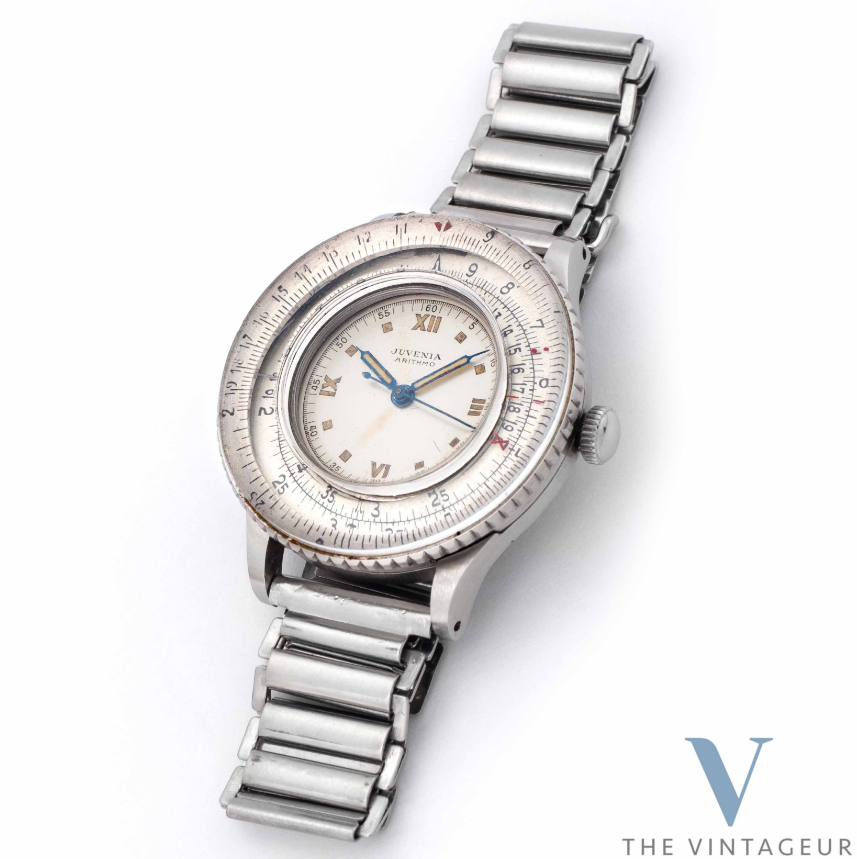
(Juvenia “Arithmo” Radio dial, 1950s. Credit by Thevintageur.com)
This model had a variant with a sliding metal bezel, but its main distinguishing feature is a unique patented crystal. The Arithmo’s crystal is special and is technically called “Refrascope”: the main dial is covered by a crystal portion separate from the curved bezel of the rotating peripheral slide rule. When the wearer rotates the bezel, the outer portion with its crystal rotates with it, while the inner portion, above the central dial, remains fixed. The appearance is truly unlike any other watch with a similar system and allows a clear and enhanced view of the slide rule from any angle.
The Arithmo was originally equipped with a hand-wound caliber (AS 1180 movement) and was soon joined by a variant with a self-winding hammer-type caliber (AS 1250 movement).
In the same year as the launch of the Arithmo (1944), Juvenia deposited its logo to be stamped on the cases of internal production: an octagonal frame with an indication of the name and territorial origin in French and English.

(Document from the Juvenia hallmark deposit, 1944. Credit by E-periodica.ch)
*[NB. There will soon be a dedicated monographic section on Wristory on the “Arithmo” model, which will recount its historical genesis and evolution. We refer you to that in-depth article. Coming soon.]
Of course, wristwatch production in these years wasn’t limited to the “Mystère” and the “Arithmo.” These two models represent the pinnacle of style and innovation between the 1940s and 1950s, but Juvenia also successfully expanded into men’s wristwatches, including time-only watches, calendar watches, and chronographs, with the same stylistic and technical quality.
The movements selected for the chronographs of this period are those supplied by Venus, sometimes with a high-quality finish: the levers are chamfered and finely brushed on the upper surfaces.

(Juvenia chronograph, Venus 175 movement, 1940s. Credit by Stucktheoyster.com)
Alongside the steel-cased, water- and dust-resistant models with two or three sub-counters (Venus 178 movement), the catalogue also featured gold cornographs with fancy lugs, snap-on case backs and very refined rectangular or “bump” pushers with exceptional formal balance.

(Juvenia chronograph, Venus 178 movement, 1950s. Credit by Pandolfini.it)
Very rare is the version with a split-seconds complication, which featured the sought-after Venus 179. A model that is highly sought-after by collectors of the Maison (also due to its generous 38mm dimensions) and the specific complication combined with the chronograph.

(Juvenia split-seconds chronograph, Venus 179 movement, 1950s. Credit: Antiquorum.swiss)
As part of this rich production, Juvenia developed and introduced in 1950 a triple-calendar watch with moon phases and a self-winding movement (AS 1250). It was named “Ephemeris“, romantically inspired by the document or table reporting astronomical positions or specific data on celestial events, which could be used to make predictions.
It was a complicated watch, available in both steel and gold cases and measuring 36 mm in diameter. It was an immediate success, despite the high costs of the time.

(First advertisement for the launch of the Juvenia “Ephemeris” model, 1950. Credit: Watchlibrary.org)

(Affiche, Juvenia “Ephemeris”, 1951. Credit by Watchlibrary.org)
This extraordinary watch is characterized by the elevated position of the calendar setting buttons on the right and left sides of the case, and had a screw-down case back that protected the movement from dust and moisture. The “Ephemeris” in rose gold cases with fancy lugs and a dial with applied indexes are particularly valuable.

(Juvenia “Ephemeris” rose gold case, 1950s. Credit by Montresmania.com)
In the complicated watch platform, Juvenia – like many other Maisons in the mid-1950s – also offers a chronograph with a date display powered by the inevitable Valjoux 72 base, but this production must have been very limited as today it is very difficult to even see one in good general condition.
The bulk of the production, namely time-only watches, was released in a wide variety of shapes and technical features between the 1940s and 1950s.
Of particular note is a three-hand watch from the “Sport” line with an automatic “bumper” caliber in a waterproof steel case, marking an important milestone for the Swiss watchmaker.
Initially, in the late 1930s, Juvenia created a 31mm Hermetic case that rivaled that of the Mido Multifort made by Taubert & Fils (aka “FB” from its distinctive hallmark). These contained manually wound movements. But while Mido introduced the hammer-operated automatic movement in 1935, Juvenia delayed it by about four or five years. The movement used was initially the newly developed 11.5″ Felsa 279, 17 jewels and incabloc, which Juvenia renamed the “Autostrap”.

(Deposit document for the name “Autostrap,” 1939. Credit by Watchlibrary.org)

(Felsa 279 bumper caliber signed “Juvenia Autostrap,” 1941/1942. Credit by Relojes-especiales.com)
As market demand for these brand-new automatic calibers grew, Juvenia also adopted “bumper” movements designed by A.Schild SA (AS 1049 and derivatives). These calibers powered 33mm steel watches, which were shockproof, antimagnetic, and dustproof, and featured a screw-down case back with a contoured profile to facilitate hermetic tightening, making them waterproof.

(Juvenia “Sport”, first half of the 1940s. Credit: Swissvintagewatches.com)

(Juvenia “Sport”, first half of the 1940s. Credit: Swissvintagewatches.com)

(Juvenia “Sport”, first half of the 1940s. Credit: Swissvintagewatches.com)
PART V. JUVENIA: THE ECCENTRICITY OF PURE DESIGN (1950 – 1960)
By the late 1940s, Juvenia had already explored extremes in case and dial design for its time-only watches. Following the success of the “Mystère” model, the brand worked on new aesthetic concepts and designed the “Sextant” model. Although the project dates back to the late 1940s, it was not officially presented to the public and subsequently launched on the market until the 1956 Baselworld Fair.

(Presentation of the “Sextant” at the Basel Fair in 1956. Credit by Watchlibrary.org)

(Presentation of the “Sextant” at the Basel Fair in 1956. Credit by Watchlibrary.org)
The watch is obviously inspired by the sextant, a fundamental instrument for navigation on the open sea, which allows for the precise measurement of the angle between a celestial body—such as the Sun, the Moon, a bright star, or a planet—and the horizon. Thanks to this angular measurement, navigators can calculate their latitude with great accuracy. When combined with a marine clock (nautical chronometer) and astronomical tables, the sextant also allows for determining longitude, making it an indispensable tool for orientation.

(Juvenia “Sextant”, circa 1960. Credit by Bulangandsons.eu)
The understated 33/34mm gold or steel case frames a dial with a set of very elaborate hands: the hour hand is formed by a semicircular structure reminiscent of a protractor; the minute hand appears like a ruler ending in an arrowhead; and the seconds hand resembles a compass pointer (it has a painted groove to help the observer identify the direction of the seconds reading).

(Juvenia “Sextant”, detail of the hands, circa 1960. Credit by Bulangandsons.eu)
This model was relaunched by the brand in the 2000s in two variations (encouraged by the visibility of actor Johnny Depp, who regularly wore it); a third variation of the Sextant, this time with a larger 40mm case, is known as the “Architect” due to its highly technical aesthetic, which featured a dial with small squares inspired by graph paper.
The 1950s and 1960s thus represent Juvenia’s creative pinnacle, anticipating the trends and tastes of an emancipated and revitalized society after the tragic events of the previous years.
It is on this ground that two other highly successful models for the Maison took shape: the “Trigone” and the “Planète”.

(Juvenia, affiche, mid-1950s. Credit by Timeperiodwatches.com)
Both models can be considered “mysterious” watches, even if they aren’t strictly speaking. The “Trigone” – presented in 1955 in Basel – takes its name from the scientific Latin “Trygon,” which referred to flat-bodied fish from the “dasyatidae” family (e.g., stingray). It features a dial with two large, equally sized hour and minute hands, shaped like a broad triangle resembling fish, but in two different colors to distinguish the hours from the minutes for easy reading. Catalogs and advertisements from the period provide a schematic overview of its operation and how to read the time: the hour hand is the one below; the minute hand is above it and bears the brand’s signature.

(Juvenia “Trigone”, affiche, 1957. Credit by Watchlibrary.org)
A table model of this model was produced with an alarm function, eight-day power reserve, and in which – along with the characteristic triangular hour and minute hands – there is an index for setting the alarm.

(Juvenia “Trigone” alarm, early 1960s. Credit by Jewelry.ha.com)
The other model that often appears in advertisements alongside the “Trigone” is the “Planète”. This watch is also a bit unintuitive to use, but it’s decidedly simpler than the “Trigone.” Its dial features three discs of different diameters and colors that function as the hours, minutes, and seconds hands.

(Juvenia “Planète”, 1960s. Credit by Sothebys.com)
The name easily suggests the inspiration behind the design of this extravagant watch, which, with the rotation of its hands, was meant to evoke the eccentric motion of the planets and stars, as if it were a miniature solar system worn on the wrist. It first appeared in vintage advertisements in 1958 (below, next to a bizarre “Mystère” model with a rhomboid case).

(Juvenia “Planète”, 1958 catalogue. Credit by Watchlibrary.org)
Alongside this highly creative and imaginative production, Juvenia launched the “Slim Collection”, which – in contrast – is very understated, with a clean, elegant, and essential design. It was released in 1957 in three versions (the names of which were officially registered): a men’s model, a women’s model, and one with an ultra-thin self-winding movement.

(“Slim Collection” name registration document, 1957. Credit By Watchlibray.org)

(Affiche, Juvenia “Slim”, 1959. Credit by Hifi-archiv.info)
To develop this collection of ultra-thin watches, Juvenia initially used the hand-wound Aurore-Villeret caliber 423, which was called the Juvenia 602 movement. It is 23.3mm wide (10.5″ lignes) and only 2.8mm thin. Shortly thereafter, the even thinner A. Schild 1758 movement was used as the basis, which was redefined as the Juvenia caliber 975. This thinness of the movement allowed for the engineering of cases up to 35mm wide but very slender on the wrist, to which wonderful integrated and semi-integrated bracelets could be applied, to unify the design towards absolute lightness.

(Juvenia “Slim”, circa 1960. Credit by Lumeville.com)
All these features would become a must-have for the Maison throughout its historical journey up to the present day, and again between the 1970s and 1980s this collection evolved and was embellished with round and square cases in steel or gold, also set with precious stones; dials in colored hard stone; and integrated bracelets of wonderful workmanship.
PART VI. JUVENIA: THE FAILURE OF “HEUROPLAN” AND THE SUBSEQUENT “GOLDEN MOMENT” (1960 – 1970)
The continued ownership of Juvenia, held firmly by Jacques Didisheim’s sons, Albert, Charles, and, above all, Bernard, allowed the Maison to survive almost entirely unscathed through the dangerous and turbulent twenty years that led to a general decline in Swiss production from the 1960s to the late 1970s. One of the first triggers of this depression coincided with the growth of the European Common Market, which catalyzed unprecedented direct competition among Swiss Maisons. In this bleak landscape, several companies, in order to remain viable and competitive on the market, had to organize together to avoid being isolated.
At the beginning of the 1960s – specifically, on November 19, 1959 – the “Heuroplan” consortium group was founded.

(“Heuroplan”, registration document from 1959. Credit by E-Periodica.ch)
“Heuroplan” is the result of the joining forces of four Swiss watch manufacturers and one French company. They are Cyma, Movado, Eska, Juvenia, and the French company Nappey of Besançon. The idea is to develop a common strategy to maintain a strong business in the French market by implementing shared sales and marketing network policies.
A 1959 photograph taken at the editorial office of a newspaper in La Chaux-de-Fonds illustrates the agreement reached between the parties. From left to right, the following are: M.M. (Journalist), Pierre Schowb (Cyma), Leopold Ditesheim (Heuroplan), Jacques Didisheim (center) (Juvenia), Sylvain Kocher (standing) (Eska), Bertin Ditesheim (Movado), and Marcel Germon (Heuroplan).

(“Heuroplan”, Photographic document from 1959. Credit by Watchlibrary.org)
The consortium was formed as a sort of joint brand, but its intention was not to launch a joint production line: the companies that produce the watches distributed in France by Heuroplan remain completely independent of one another. From the source: “The first step was to pool the resources of the five original organizations to launch a broad joint advertising campaign. The promoters believed it would not only encourage potential customers to purchase a watch from one of Heuroplan’s five brands, but also rehabilitate the high-quality watch in the public’s mind and transform it into a fashion item.”
And that’s exactly what happened. Heuroplan targets a medium-to-high-end customer base with a single brand that encompasses five others.

(“Heuroplan” display, 1959. Credit by Watchlibrary.org)
The catalogs, between 1959 and 1960, featured similar collections from those offered individually by the five manufacturers. The advertising model was designed to standardize the offerings for the public.

(“Heuroplan”, 1959 catalog. Cxredit by Ebay.fr)
Consistency is key to managing even individual posters. The same layout and graphic design are used to produce posters and flyers.

(Juvenia for “Heuroplan”, affiche, 1960. Credit by Hprints.com)

(Eska for “Heuroplan”, poster, 1960. Credits by Nappey.co)

(Cyma for “Heuroplan”, affiche, 1960. Credit by Alamy.com)
This consortium experience did not last long. Between 1959 and the end of 1960, the five manufacturers realized the danger of losing the individuality they had built, in some cases, over 100 years of history. The foundation upon which the centuries-old history of Swiss watchmaking rests – heritage, tradition, and brand recognition – was beginning to erode, and Heuroplan dissolved only two years after its inception.
After this fruitless interlude, Juvenia continued its solo journey. Meanwhile, 1960 marked the centenary of the Maison’s founding (1860). Several local and national newspapers celebrated Juvenia’s remarkable centenary history with numerous articles.

(Article on Juvenia’s 100th anniversary, 1960. Credit by Watchlibrary.org)
Production during these years remained of the highest quality. In particular, the catalog offered a wide variety of watches with a classic, essential design derived from the “Slim” collection. The “Slimatic” and the “Miss-Slimatic” – launched in the late 1950s – are the two versions with self-winding calibers and central seconds, powered by the Juvenia 662 caliber in the larger version (derived from the ETA 2450/2451). An improved model is the one with the accompanying date complication at 3 o’clock in the men’s versions (automatic Juvenia 1015 movement derived from the ETA 2600), which enjoyed great success in the mid-1960s and up until the 1980s with few variations.
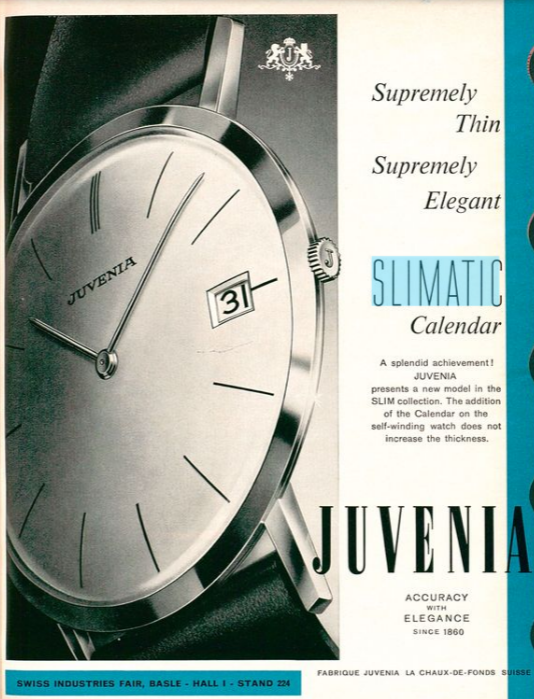
(Affiche, Juvenia “Slimatic Calendar”, 1959. Credit by Watchlibrary.org)
These refined watches, despite their apparent simplicity, display great attention to detail. The crown is now branded with a “J” at its top, and the top of the watch features leather straps, and especially integrated and semi-integrated bracelets of exquisite workmanship, a hallmark of this successful and long-running line.

(Juvenia “Slimatic Calendar”, 1960s. Credit by Timeperiodwatches.com)
The “Miss-Slimatic” women’s models reach heights of grace and beauty – particularly in the high craftsmanship of the bracelets – that very few other fashion houses have achieved in recent years.

(Juvenia “Miss-Slimatic”, 1960s. Credit by 100ways.com)
Thinner women’s wristwatches with hand-wound movements allowed goldsmiths to design elaborate cases with attached bracelets, generating compact aesthetic solutions in which the watch and its bracelet are one and the same.

(Affiche, Juvenia, 1968. Credit by Hifi-archiv.info)
The inspirations are drawn from natural themes. The plant world, with its soft, sinuous forms, is interpreted through almost abstract interweavings and intersections of elements, giving rise to small works of art.

(Juvenia women’s watch in 18K yellow gold, ca. 1973. Credit: Luxurybrandjewellery.com.au)
The design – in some spectacular cases – is taken to extremes in a quest for uniqueness that leads to hiding the watch face to give greater freedom of “language” to fabulous bracelets with clear naturalistic-vegetal or marine inspiration.

(Juvenia women’s 18K yellow gold watch, 1970s. Credit: The-saleroom.com)
Particularly successful are three women’s wristwatch models created in the early 1970s, whose production continued throughout the following decade. This time, Juvenia did not assign specific names to them. This practice seemed to disappear by the early 1970s: from this point on, Juvenia no longer registered the names of its models for at least a full decade.
The first of these three watches is characterized by the square shape of its small case, which features a “bark-treated” dial, as does its beautiful integrated bracelet.
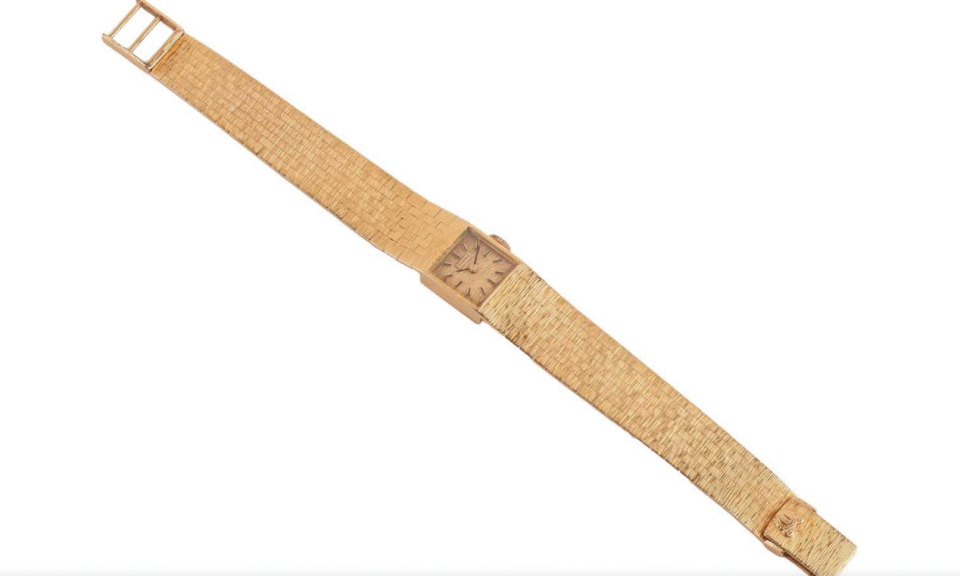
(Juvenia 18Kt gold women’s watch, 1970s. Credits: The-saleroom.com)
This model can be seen in many advertisements of the time at least until the early 1980s.

(Affiche, Juvenia, 1970. Credit by Hifi-archiv.info)
Juvenia’s second women’s watch, a highly successful commercial success (and inappropriately called the “Cocktail” by some), has a long, narrow rectangular case featuring a micro-lattice finish, which is also present on the dial (which can be clear or black) and the integrated bracelet. The model was launched on the market in 1964, but its widespread distribution, with further modifications, occurred in the mid-1970s.

(18Kt gold Juvenia women’s watch, 1970s. Credit: Bobswatches.com)

(Affiche, Juvenia, 1964. Credit by Hifi-archiv.info)

(Affiche, Juvenia, 1972. Credit by Hifi-archiv.info)
The third and final women’s watch with enormous commercial success is actually a bracelet with a built-in watch. Its structure is slender, very sinuous, and fluid. Vintage advertisements depict it in various shapes – intertwined, spiral, or scroll-like – but the inspiration is the same.
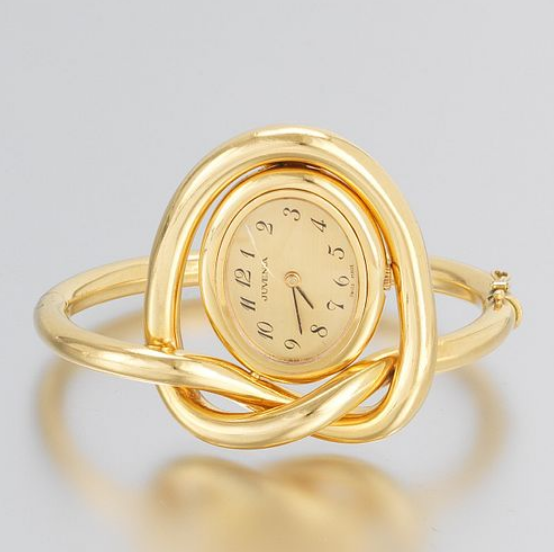
(Juvenia 18Kt gold bracelet watch, 1970s. Credit by Bidsquare.com)

(Affiche, Juvenia, early 1970s. Credit bu Hifi-archiv.info)
In what could be described as a “golden age” for Juvenia – considering the massive production of watches with integrated bracelets in precious metal – a men’s model also appeared that mirrored the style and design of the women’s models described so far.
This model is known as the “Macho”, although this term is never found in reference to Juvenia in any source. This massive, all-18K gold watch features a square case enhanced and complemented by a wide variety of integrated bracelets of varying designs and construction. It was produced from around 1964 through the 1970s and featured either a self-winding movement or a self-winding movement with a date display.

(18Kt yellow gold Juvenia men’s watch, 1970s. Credit: Ragoart.com)

(18Kt yellow gold Juvenia men’s watch, 1970s. Credit: Ragoart.com)

(Affiche, Juvenia, 1964. Credit by Hifi-archiv.info)
COMING SOON: THE GREAT HISTORY OF JUVENIA PART III (1970 – PRESENT)