


HISTORY AND DEVELOPMENT OF ONE OF THE LONGEST-LIVED AND MOST CREATIVE SWISS MAISON
INTRODUCTION
The 1970s were fertile ground for watch designers. Creative freedom reigned supreme in Switzerland and beyond. The widespread adoption of quartz movements led manufacturers’ creative departments to rethink case thicknesses, diameters, and lines. There were no longer many limits to creative imagination; there were no barriers to what a designer’s pencil could achieve in the field of watchmaking. Alongside a significant portion of quartz watch production, some watchmakers continued to produce watches with high-quality mechanical movements. Juvenia, as we have already seen, was naturally a key player in this era. Indeed, it was one of the most enterprising watchmakers, riding this new wave despite the challenging domestic economic climate. Despite serious financial difficulties, and to address these, Juvenia relied on its most successful collections, relaunching them with significant upgrades.

PART VII. JUVENIA: BETWEEN “FUTURISM” AND “SPACE-AGE” (1970–1980)
The “Mystère” collection continued to dominate the market from the late 1960s through the 1970s. New shapes and colors were added to the model’s standard technical setup. Powered by hand-wound mechanical movements of various sizes, Juvenia introduced a wide range of mystery watches with diverse shapes, leveraging the idea of a single U-shaped lug, almost detached from the case body. This allowed the watch’s head to be conceived independently in terms of shape and design. Circular, ovoid, rhomboid, and octagonal cases were added to the catalog; along with this, new colors and more adventurous color combinations with straps were experimented with.

(Juvenia “Mystère”, 1970s. Credit by Carlo Biagioli, private collection)
The “Slim” collection also expanded significantly with new models.
In the “Slim” version, but still with hand-wound calibers—first the Juvenia 975 (based on the AS 1758) and then, in the late 1970s, the Juvenia 1115 (derived from the Zenith 2320)—watches with even bolder designs were released, embracing the “futuristic” and “space-age” taste of that decade.
This advertisement for a “Slim” model, dubbed the “Trapeze” due to the bold trapezoidal shape of the case design, dates back to 1970. Each model variant, from one collection to the next, featured both a strap and an integrated or semi-integrated bracelet known as a “Milanese mesh” bracelet.

(Affiche, Juvenia “Trapeze”, 1970. Credit by Hifi-archiv.info)
This model was accompanied by another, more popular model, which had an ovoid case shape. The design of this case could be either horizontal or vertical. The surface of the dials (often silver or blue) could be smooth or finished with a “hammered” treatment, reminiscent of tree bark, which gave the entire composition a three-dimensional feel.

(Catalog excerpt, 1970s. Credit by Juvenia.ch)
Juvenia’s designers were among the best in the entire watchmaking scene during these years, playing with the shape of the cases – bending, stretching, and tightening – to create aesthetic concepts that were precursors to the tastes that would become so prevalent in the 1970s and 1980s.
The dials retained a clean layout, with “intellectually elementary” graphics, but their surfaces were crafted with techniques that recall the interwoven design of the integrated “Milanese mesh” bracelets.

(Juvenia “Slim” with ovoid case, 1970s. Credit by Ebay.com)

(Juvenia with quadrancular case, 1970s. Credit by Jeosephbonnie.com)
In some rare models, the dial surface emerges as the undisputed protagonist, with its own unique character. The aesthetic solutions adopted are aimed at achieving a richness of detail, as in this beautiful watch with a “blue waves” dial finish.
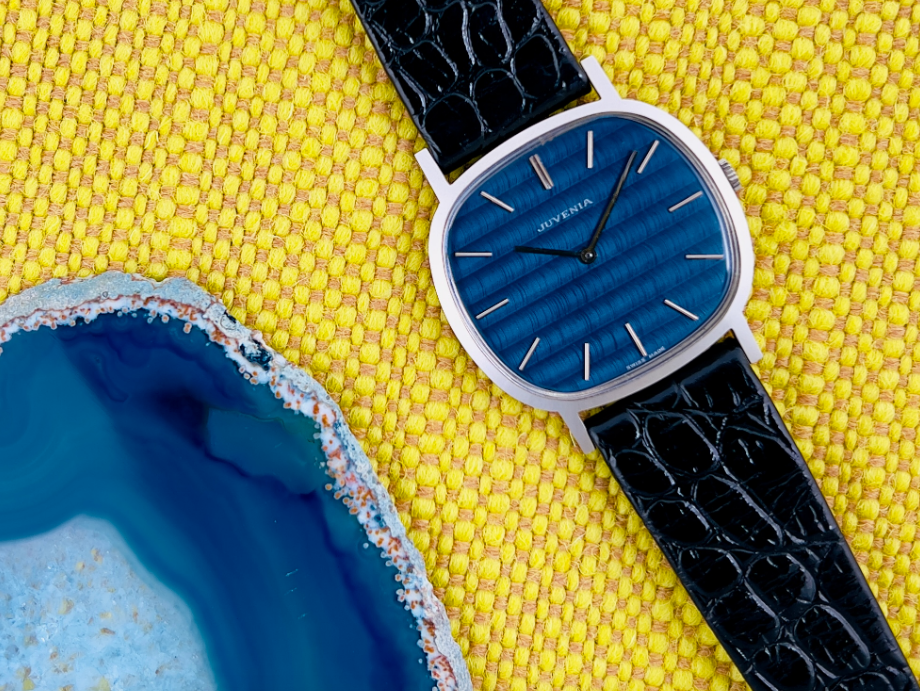
(Juvenia “Blue Waves” dial, 1970s. Credit by Ecygallery.com)
Dial production during this period is also characterized by the use of precious hard stones, particularly lapis lazuli. Cases during this period reached a high level of complexity, based on designs pioneered a decade earlier, and the more ductile silver was used alongside gold and steel.
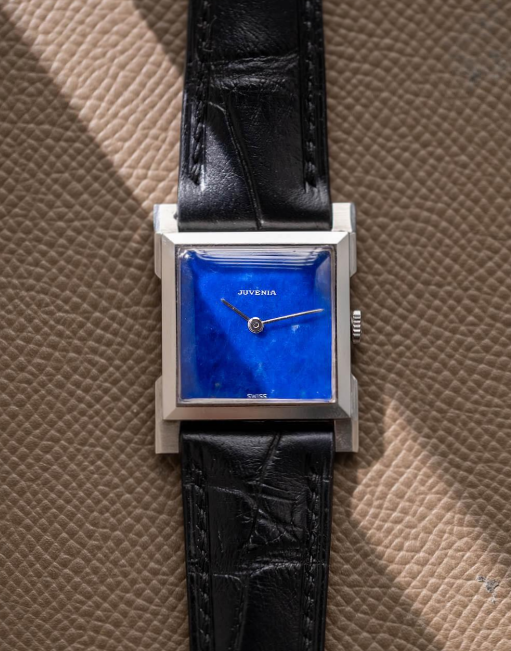
(Juvenia in steel case with lapis lazuli dial, 1970s. Credit by Spacetime.vintagewatches on IG)

(Juvenia in 18K white gold case and green malachite dial, 1970s. Credit by Capitoliumart.com)

(Juvenia in silver case and stone dial, 1970s. Credit by Ecygallery.com)
Alongside the highly complex case design and the use of semiprecious stone for the dials, Juvenia creates watches with a simple yet avant-garde aesthetic, inspired by the “Space-Age” movement, which began in the late 1950s but reached its peak in the transition from the 1960s to the 1970s.

(Juvenia time-only watch with “TV” case, 1970s. Credit by Watchesonstraps on IG)
These models (called “TV”) began appearing in period advertisements as early as the mid-1960s, together with the Maison’s “best-buy” references.

(Affiche, Juvenia, late 1960s. Credit by Hifi-archiv.info)
Even more futuristic in aesthetics are some watches with square, distinctly three-dimensional cases, evoking a taste for science fiction but also for the technological evolution of personal computers and space missions.

(Juvenia time only, 1970s. Credit by Empress.cc)
Alongside these models, Juvenia continued to offer more technical watches. In the second half of the 1960s, it began producing chronographs powered by the highly prized Valjoux 72 movement. This was not the product for which Juvenia was known and sought after by its customers, and production must have been very limited in terms of the number of pieces distributed to the market. However, the brand maintained its overall level of quality at an extremely high level, producing water-resistant chronographs with bidirectional Bakelite bezels and inserts, and tritium dials.

(Juvenia chronograph with Valjoux 72, second half of the 1960s. Credit by Romainrea.com)
In the mid-1970s, the designs took on the typical style of this period. The cornograph cases are cushion-shaped with a finely satin-finished surface, and the dials are characterized by the use of contrasting colors.

(Juvenia chronograph with Valjoux 72, 1970s. Credit by Chronocentric.com)
The chronograph in the picture, which has a strong sporty character, was also released on the market with a dial with inverted colors (aka “panda” and “reverse-panda”).

(Juvenia, cornograph dial, 1970s. Credit by Joseph-watches.com)
PART VIII. JUVENIA: THE ACQUISITION BY EBEL AND THEN TO CHINA (1980–1990)
In the late 1970s, Juvenia – like many other Swiss manufacturers – began to feel the brunt of the so-called “quartz crisis,” and in the early 1980s, it was absorbed into Ebel, the watchmaker founded by Eugène Blum and Alice Lévy in La Chaux-de-Fonds in 1911. Newspapers of the time made no explicit mention of Juvenia’s financial difficulties, which were nevertheless significant. Due to a series of succession issues, the Didisheims lost control of the company and the brand. From 1980 until at least April 1981, the company was managed by its own employees before Ebel acquired it.
Below is an article from the “Impartial”, a newspaper from La Chaux-de-Fonds, which tells almost live this “fusion” between Ebel and Juvenia.
L’impartial, April 25, 1981
“Ebel” Absorbs “Juvenia”
“Should we call it a natural merger? We could take a risk in the case of “Juvenia,” which yesterday, at 3 p.m., merged with the “Ebel” group. Thus, the fifth-largest Swiss watchmaking group, after Asuag, SSIH, Rolex, and Complication, merged in La Chaux-de-Fonds. A natural merger because these are two healthy companies that are not rushing into their marriage, but rather joining forces as young people, after a long trial period. This will be a departure from what we have seen all too often in the past decade: unions for the worse after having conquered the best. Here, the risks were measured unambiguously and from an industrial perspective: a long collaboration between “Ebel” and “Juvénia” led to the conclusion that they could complement each other. Elsewhere, companies have been merged, pocketed, and left to sink financially. Here, risks have been measured and assessed coldly. In a situation of effective complementarity, risk-taking fosters dynamism. Ultimately, Ebel will bring together the most efficient resources under two roofs. However, the sales departments and product ranges of the two brands will remain separate to avoid any confusion. The identity of each brand will be preserved. All opportunities for streamlining administration and production will be exploited. A joint policy has been defined to strengthen existing positions. Ebel competes effectively in the Swiss market, in Italy, Germany, and the United States, and is making significant progress in the Far East. Juvenia holds leading positions in Switzerland, the United States, Hong Kong, and the Far East, as well as in Europe. It is obviously no coincidence that the agreement by which Ebel acquires the entire share capital of Juvenia was signed yesterday, on the eve of the opening of the Basel Fair. For ten days, the two brands will be able to present their intentions to customers. This expansion of the Ebel watchmaking group is not surprising, given the vehemence of manager Pierre-Alain Blum, who intends only to respect the limits he sets for himself. He increased Ebel’s workforce to 220, and the brand maintains its preeminence in precision watchmaking. Then it absorbed the Cristalor case factory (180 jobs) and, yesterday, Juvenia, which now employs a total of 52 people. It seems obvious that in a situation of duplication, the best will prevail. The rule is not permissive, but in this case it allows Ebel to advance where others complain and lag behind. The complementarity also extends to their locations; the two companies are separated from each other by only a block of three houses on Rue de la Paix. Good luck!”
Despite the proclamations and hopes, the entire 1980s were a dark period for the Juvenia brand, which literally disappeared from every source. There was no news of new models and no advertisements for its watches, but it was certain that production and distribution – especially in the Far East – of the best-buy models from the “Mystère” and “Slim” lines, but with quartz movements, continued.
Production during this period was very limited for an item designed in the 1960s but apparently produced on a larger scale during the height of Ebel’s control of the brand. It was a “Coin Watch”, which first appeared in a 1972 advertisement.

(“Coin Watch” Juvenia, Affiche, 1972. Credit by Hifi-archiv.info)

(Juvenia US$10 18Kt yellow gold “Coin Watch”, 1985. Credit by Christies.com)
It’s a watch disguised as a gold coin with an elegant integrated Milanese mesh bracelet, typical of Juvenia production from the previous period. (Juvenia “Monet Watch” $10 in 18K yellow gold, 1985. Credit: Christies.com)
The circular central body in 18K yellow gold has the obverse and reverse of a coin (an American one in this case) embossed, and the continuous edge is also worked with a “thousand-line” pattern to simulate a real coin.

(Juvenia US$10 18Kt yellow gold “Coin Watch”, 1985. Credit by Christies.com)
Inside is the gold cylinder that houses the hand-wound movement and the clear dial, which stands on a pivot at 6 o’clock and can be extracted via a button at 3 o’clock on the case.

(Juvenia US$10 18Kt yellow gold “Coin Watch”, 1985. Credit by Christies.com)
This watch is still part of Juvenia’s tradition, but it doesn’t take long for Ebel to leave its mark on the newly acquired Maison. In 1982, a collection called “Number One” was born, which immediately featured rectangular cases (as opposed to Ebel’s round, softer ones), integrated bracelets, the use of dual-material steel and gold, and quartz crystal movements.

(Juvenia “Number One”, mid-1980s. Credit by Atxwatches.com)

(Juvenia “Number One,” mid-1980s. Credit: Allbids.com.au)
Ebel’s investments in research and development within Juvenia were very limited. Pierre-Alain Blum, who had led Ebel since the mid-1970s with great success, concentrated all his financial efforts on lavish marketing campaigns for his brand and the launch of new Ebel models, leaving little funding to keep Juvenia afloat. In 1988, after just six years, Juvenia was spun off.
The brand was acquired by Asia Commercial, a Hong Kong holding company led by President and Executive Director Eav Yin (who died at 80 on September 4, 2020), who fully embraced Juvenia as a watch enthusiast called “neo-vintage.”
The first attempts to revitalize Juvenia were immediate. At the 1988 Baselworld, a collection of watches called “Biarritz” was presented. The name – derived from the renowned and elegant coastal city in southwestern France – immediately evokes the soul of this sumptuous and exclusive collection.

(Juvenia “Barritz”, 1988 document. Credit by Watchlibrary.org)
Rectangular and round watches for men and women in solid gold, with bezels and/or dials set with precious stones (diamonds are always present), an integrated bracelet built on five linked modules with a soft, rounded design, and a quartz movement.

(Juvenia “Barritz” in 18Kt yellow gold and diamonds, early 1990s. Credit by Morningstarsjewelers.com)

(Affiche, Juvenia “Barritz”, 1990. Credit by Ebay.com)

(Juvenia “Barritz” in 18Kt yellow gold, diamonds and rubies, early 1990s. Credit by Ebay.fr)

(Affiche, Juvenia “Barritz”, 1990. Credit by Watchlibrary.org)
Around the first two years of the 1990s, Juvenia once again radically redesigned the “Mystère” collection. These new pieces with their distinctive integrated bracelets were no longer models for everyone; they were exclusive products in solid gold and diamonds. The success and widespread commercial diffusion of the “Mystère” model, which had lasted over thirty years, was destined to end.

(Juvenia “Mystère”, Affiche, 1991. Credit by Watchlibrary.org)
In 1992, Asia Commercial Holding appointed a man with extensive experience and professional depth in the watchmaking industry to lead Juvenia: Francois Thiébaud. He led Juvenia in La Chaux-de-Fonds from its historic headquarters on Rue de la Paix, and upon appointment as CEO, he declared: “I didn’t know Juvenia,” he admitted. “I collected documents and information about Juvenia and decided to accept this challenge. Today, I know I can only do it: I have an extraordinary brand, a cohesive and well-prepared team. […] We are recreating a Juvenia family.” (Excerpt from an article in L’Express, a Neuchâtel newspaper, 1994. From Watchlibrary.org). Indeed, Thiébaud immediately dedicated his energy and creativity to the brand, first relaunching the “Mystère” collection (which he called “New Mystère”) with ten new models.
Watches bearing the name “Mystère” lose their significance as true “mystery watches” because they leave the hour and minute hands clearly visible on the circular dial (for this reason I call them “New Mystère”). They leave only the periphery of the dial transparent, the central section of which is secured to the case band at four anchor points (this feature is also seen in the limited and slightly later production of the skeletonized models).
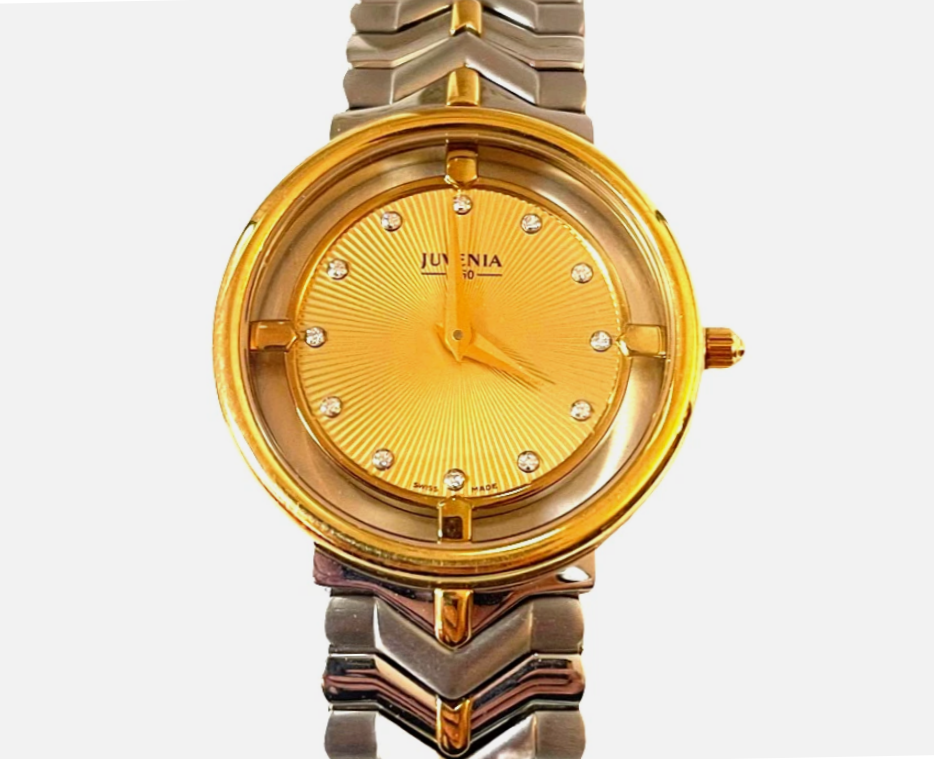
(Juvenia “Mystère” or “New Mystère”, 1992. Credit by Ebay.com)

(Juvenia “Mystère” or “New Mystère”, Affiche, 1992. Credit by Watchlibrary.org)

(Juvenia “Mystère” or “New Mystère”, Affiche, 1992. Credit by Watchlibrary.org)
Among this production, items of high stylistic and technical value stand out, such as a series of squelette (or “skeleton”) watches of notable value (also due to the use of diamonds and other precious stones) which were presented at the Basel fair in 1994.

(Juvenia “Mystère Squelette”, 1994. Credit by Watchlibrary.org)

(Juvenia “Mystère Squelette”, 1994. Credit by Watchlibrary.org)
An innovative design breakthrough came in 1993, when the team led by Thiébaud worked on a brand new series of streamlined models within the “Golden Age” collection. The first pieces were presented at the 1993 Baselworld and featured a completely original design, drawing no inspiration from the Maison’s historic and successful models.
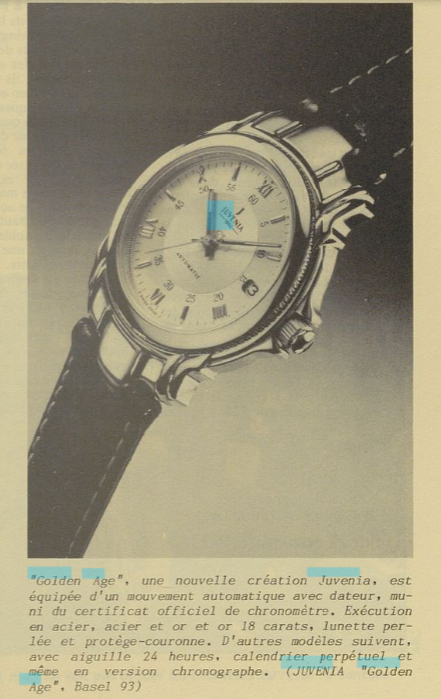
(Juvenia “Golden Age” presented in Basel, 1993. Credit by Watchlibrary.org)

(Juvenia “Golden Age”, 1990s. Credit by Juvenia.ch)
Generally, these are self-winding, waterproof watches with a date display (ETA 2892-A2 movement), produced in both men’s and women’s sizes in steel or gold, which revive and declare Juvenia’s heritage on the dial, featuring the company’s founding date (“1860”) and the stylized crown counterweighting the minute hand. The style is typical of the early 1990s, with a “muscular” design built on fluid, flowing lines. Variations of this model include a semi-integrated leather strap (in which the lugs are attached by a steel and gold or full gold link) or a fully integrated bracelet, which gives the timepiece a sportier feel (also thanks to a bezel that mimics a tool watch’s bezel).

(Juvenia “Golden Age”, 1993. Credit by Violity.com)
The following year, the “Golden Age” collection presented a variant with a GMT complication, again at the Baselworld. The lines remained unchanged, but the overall look of the watch appeared weighted due to its significant thickness. The model nevertheless enjoyed considerable commercial success.

(Juvenia “Golden Age” GMT presented in Basel, 1994. Credit by Watchlibrary.org)

(Affiche, Juvenia “Golden Age” GMT, 1995. Credit by Watchlibrary.org)

(Affiche, Juvenia “Golden Age” GMT, 1995. Credit by Watchlibrary.org)
The “Golden Age” collection is enriched with other models with new complications, such as complete calendars and automatic chronographs with date (ETA 7750 movement).
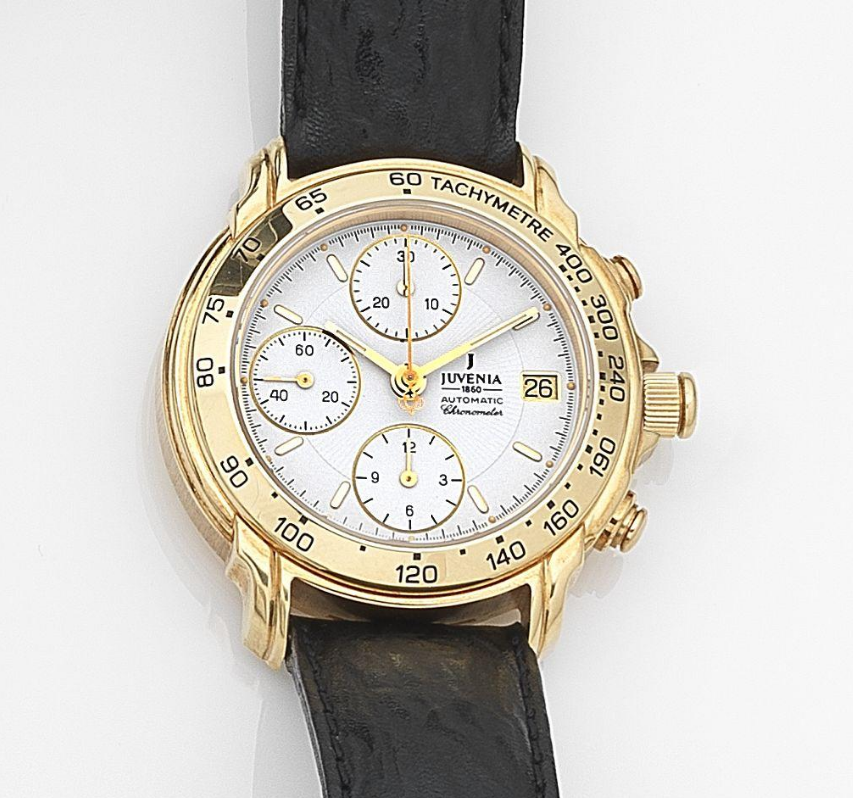
(Juvenia “Golden Age” Chronograph, mid-1990s. Credit: Bonhams.com)
Much rarer is a version featuring a sub-dial for a dual time and, at 6 o’clock, a section with a power reserve indicator.

(Poster, Juvenia “Golden Age” Dual-Time Chronograph and Power Reserve, 1995. Credit by Watchlibrary.org)
Alongside the “Golden Age” collection, at the 1994 Baselworld, Juvenia presented the “Aurelia” model, with elegant and slender cases, also in platinum, reminiscent of the “Mystère” references of the 1970s, and, along with it, a new, completely redesigned “Planet” line.

(Juvenia “Planet” top left and “Aurelia” top right. Credit: Watchlibrary.org)
The pursuit of quality construction and exquisite materials remains a focus for Juvenia. Dials, cases, and bracelets are the result of a rethinking of the Maison’s historic aesthetic canons. They are reinterpreted and manipulated to create new shapes and contemporary “decorative” concepts. These watches exude the spirit of the 1990s, but they’re already far from the quality of the “Pre-Planet” models of the 1950s.

(Juvenia “Pre-Planet” full 18Kt rose gold, early 1950s. Credit by Thevintageur.com)

(Juvenia “Pre-Planet” full 18Kt rose gold, early 1950s. Credit by Thevintageur.com)
In 1996, Francois Thiébaud left Juvenia. He was called by Nicolas Hayek to lead Tissot’s management for the Swatch Group. He would work for the brand for 24 years, renewing it year after year and leading it to success.
With the new millennium, Juvenia’s “vintage era” ended. The Maison looked to modernity and contemporaneity with hope and optimism.
Amidst a swarm of large and small brands that rise and fall every day, Juvenia is still there; it’s still where it belongs…since 1860.

COMING SOON: THE GREAT HISTORY OF JUVENIA – PART IIII – A MONOGRAPHIC SECTION DEDICATED TO THE “ARITHMO” MODEL