GENERAL CATALOGUE 1994 AND MONOGRAPHIC CATALOGUE “PASHA” 1995
INTRODUCTION
There is a special magic in the history of Cartier, something that goes beyond the simple story of an entrepreneurial success. It is the story of a man who transformed his passion into a universal language, able to speak in the same way to tsars and actresses, to maharajas and modern women, and to arrive with the same strength until today.

(Photo depicting Louis-François Cartier. Credit: Wikipedia.org)
In the heart of 1847 Paris, a young craftsman named Louis-François Cartier gave life to a dream. At just 28, he took over the workshop of his mentor, Adolphe Picard, on rue Montorgueil, and on 17 April of that year had already registered his personal trademark: a lozenge with a heart in the centre, flanked by the initials “LC“. That symbol, simple but full of meaning, would represent for more than a century and a half the passion and love that Cartier poured into his creations.

(Trademark “LC”. Credit: TheCartiers.com)
For Cartier, goldsmith’s art was not just a craft, but a sublime form of expression, where every detail, precious material and design nuance blended into works of unparalleled quality.
The success of Cartier developed with these premises through the most prestigious districts of Paris: from the Palais Royal to the Boulevard des Italiens, where a refined and cosmopolitan clientele – including influential Russian patrons – discovered not only jewels, but also art objects, creations of high silverware, pocket watches and, starting in 1888, the first wristwatches decorated as jewelry. Among the favorite materials of the time was platinum, then considered a novelty with extraordinary potential, already used to embellish the buttons of men’s clothes.
PART I. LOIUS CARTIER: INTERNATIONAL EXPANSION AND INNOVATIVE STYLE
High-design watchmaking and the pursuit of innovation was the favorite field of action of Louis Cartier, grandson of the founder.
In 1872, Louis-François brought his son Alfred into the business and two years later he took over the house. In turn, Alfred trained his son Louis in the art of jewellery, giving birth to the third generation of Cartier at the helm, which had its base in the new boutique on rue de la Paix.
Louis, together with his brother Pierre and Jacques, took Cartier to new horizons. In 1902 they opened a London branch on New Burlington Street (later moved to New Bond Street in 1909), while in 1907 Pierre inaugurated the New York office on Fifth Avenue.

(Photo from 1922 depicting from left to right: Pierre, Louis, Alfred and Jacques Cartier. Credit: Paperjam.lu)
Under the guidance of Louis, Cartier reached unprecedented heights of creativity. An avid jeweler, Louis revolutionized design with his platinum and diamond “garland” sets, an elegant reinterpretation of the Louis XVI style that contrasted with frivolous Art Nouveau trends. Direct rival of Fabergé, both in Paris and St Petersburg, Cartier dared to experiment with polychrome enamels and bold chromatic contrasts, anticipating what would be called Art Deco in 1925. Black and white, green and black, and above all blue and green, combinations inspired by the peacock’s feathers and the iridescent shades of the kingfisher, are used to renew the enamelled dials of watches. The culmination of this chromatic explosion was reached with the polychromy of emeralds and sapphires, joined to leaves inlaid with rubies in the style “Tutti Frutti”, which has become a timeless icon inspired by Jacques’s frequent trips to India.

(“Tutti Frutti” bracelet. Credit: Sothebys.com)
At the same time, Cartier jewelry gradually abandoned elaborate shapes in favor of sharper and cleaner geometric lines: circles, squares, contrasts between full and empty, were at the service of pure design. This breakthrough is recorded in parallel in the production of watches, first in pocket and table watches, then in wrist watches, of which Cartier was an absolute precursor.
PART II. CARTIER: WATCHMAKING AS AN ART
In the world of watchmaking, Cartier has always pursued an ambitious goal: to merge aesthetic elegance and technical precision.
Although the first watches are attested in archives since 1853 (pocket watches and small wristwatches for women much more similar to bracelets), it is at the beginning of the 20th century that a significant turning point occurs through the fruitful and long association with the Parisian master watchmaker Edmond Jaeger.
The refined designs developed by the house during the twentieth century, together with the mechanical excellence guaranteed by the talent of Jaeger, have won over the most demanding enthusiasts and collectors from the very first examples. It was a collaboration destined to leave its mark. Together, they presented timeless icons such as the “Panther”, the “Tonneau” and the “Santos”, the first wristwatch designed for men at the request of Brazilian aviator Alberto Santos-Dumont (conceived in 1904 and launched on the market in 1911).

(One of the earliest drawings of the Santos model kept in the Cartier archives, 1911. Credit: Watchlibrary.org)
But Cartier’s innovation does not stop there. “The Mysterious Watch”, a true masterpiece of ingenuity, represents another milestone. Designed from 1913 with the “Modèle A” in collaboration with Maurice Couet, these watches are inspired by the inventions of the famous illusionist Robert-Houdin. Over the years, Mystery Watches have undergone an extraordinary evolution, proving to be among the most fascinating and technically daring creations in the history of watchmaking.
Another fascinating chapter in the history of Cartier is represented by the “Tank”, introduced in 1919. A few months after the “Tortue” model, with its square case inspired by World War I tanks, it soon became the star of the prestigious boutique on Rue de la Paix and beyond. Symbol of timeless sophistication, this model has become a cult object for collectors also in its subsequent style evolutions: the “Cintrée”, the “L.C.” (Louis Cartier) and the “Chinoise”.

(Rare Cartier Tank Normal London and Cartier Tank New York. Credit: thevintageur.com)
Cartier and Jaeger together are a hotbed of technical as well as aesthetic developments. Already in 1909, Jaeger patented the first deployant clasp exclusively for Cartier, which was much more practical and safe than the characteristic barbell clasp that had hitherto been typical of watches with a leather strap. But it has been since the mid-1920s and throughout the 1930s that this close collaboration has brought the most striking results in terms of innovation. In 1925 from the manufacture Jaeger was born a movement that is the exaltation of micromechanics in the field of watchmaking: the “Duo-plan”. This “baguette-shaped” gauge is designed with a completely new two-level superimposed structure, which allows to maintain precision by means of a wide balance and to preserve a general reduction in volumes. This movement allows Cartier to redefine the design of women’s wristwatches by focusing on extreme miniaturization with unprecedented and avant-garde aesthetic solutions.

(Rare 1930’s Cartier Duo-plan. Former Biagioli collection. Credit: Finarte.it)
Between 1932 and 1933, Cartier launched two more style innovations on the market, working with Jaeger on the morphology of two emblematic cases: the “Reversible Basculante” and the model “Vendome”, designed on a single central “T” shape lug.
PART III. CARTIER: AN INCREASINGLY BOLD DESIGN
Between the 50s and 60s, Cartier still evolves its style and it is from the London branch that the most interesting and successful design ideas come, with the birth of models with egg-shaped cases such as the “Oval”, the “Maxi Oval” and up to the bizarre “Crash Watch”. The idea of the curvature of the shape of the Tank (“Cintrée”) worked out in three different dimensions and the birth of other models with a bold design such as the “Double Strap”, the “Asymmetric” and the “Pebble”.

(Rare Cartier Baignoire Allongèe Maxi Oval, 1979. Credit: Collectorsquare.com)
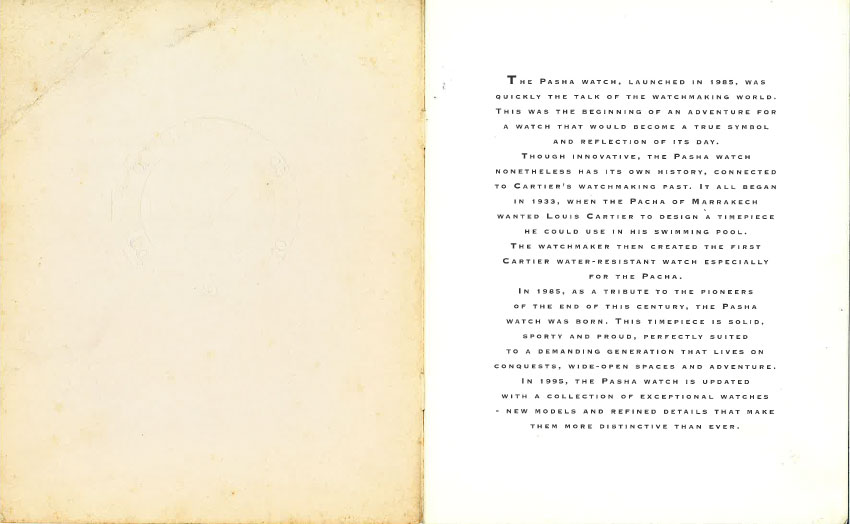
The first half of the 1980s was marked by another milestone for Cartier and his watchmaking inspiration: the “Pasha” model.
The iconic name “Pasha” originates from the myth of a legendary figure: Thami El Glaoui (1879-1956), the powerful Pasha of Marrakech, who in the 1930s personally turned to the prestigious Cartier boutique on Rue de la Paix to order a revolutionary watch, that it had to withstand water during its frequent swimming in the pool, without compromising its elegance.
It is said that to meet this need, the master watchmakers Cartier developed an innovative system of crown waterproofing, initially applied to a model Tank. Legend or not, it is a fact that at the height of World War II, Cartier returned to water-resistant watches, this time inspired by military models. The result was a timepiece with a round and massive case, characterized by a protective grid with four crossed bars to protect the glass-plastic and an oversize screw crown fixed with a mini-catenella to the carrure. Technical solutions also designed to have a strong impact on style and make the watch instantly recognizable.
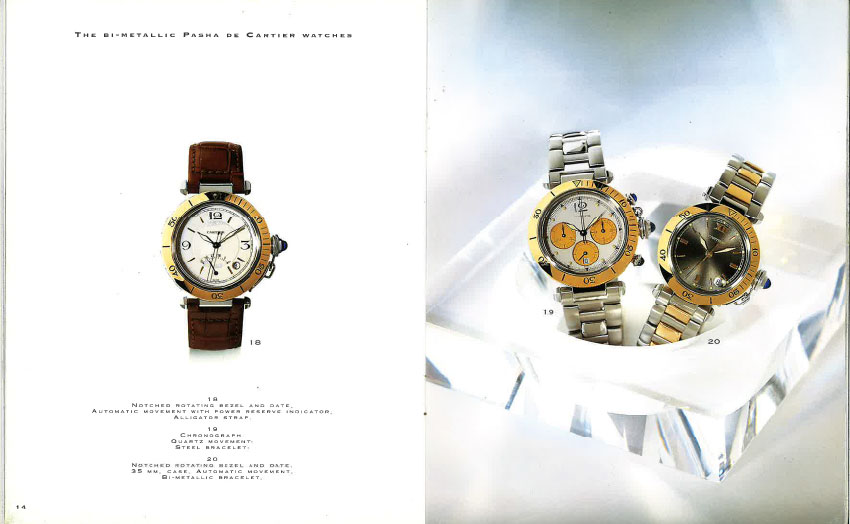
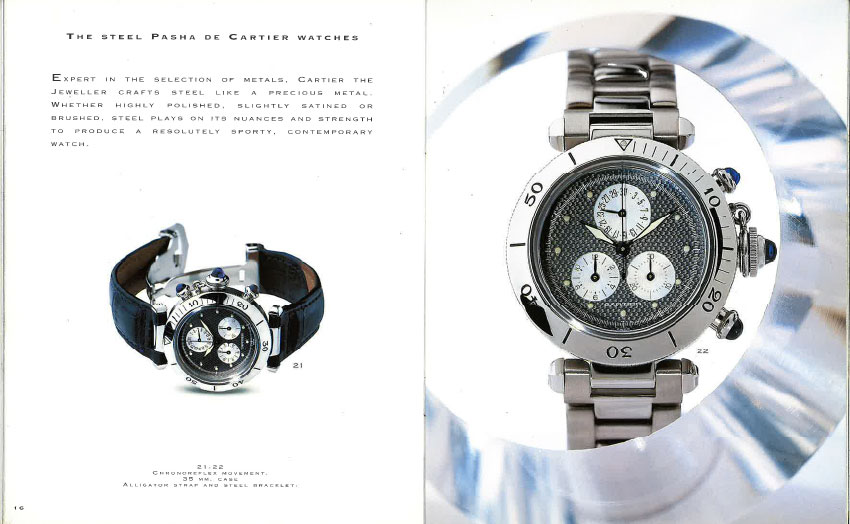
But it was in 1985 that this model was relaunched in style by Cartier, quickly becoming another Maison icon. This watch lent itself (like no other product on the market so far) to the addition of complications: from the simple date display, the chronograph, up to the perpetual calendar. This versatility has allowed the model to enter with many variations in a stable layout within the Cartier catalogues from the 80s until today.

(Cartier Pasha Minute Repeater Ref. W30012, 1989. Credit: thewatchboutique.com)
The relaunch of Pasha in 1985 also corresponds to a kind of revitalization of the entire Maison. Between the end of the 1960s and the beginning of the 1970s, following the sale of Cartier Paris to a group of investors led by Joseph Kanoui, one does not feel the same creative impulse as in the previous period. In 1972, the line-concept “Les Must de Cartier” was conceived and piloted by the duo of Robert Kocq and Alain Dominique Perrin. It is only with the Pasha that we find the vital energy needed to give a boost to high-end watches, which is completed by the launch of the “Tank Américaine” (1989), the “Diabolo” (1991) and the “Tank Française” (1996).

(Cartier Diabolo Ref.1470/1, 1993. Credit: Awco.nl)
PART IV. CARTIER: 1994 GENERAL CATALOGUE
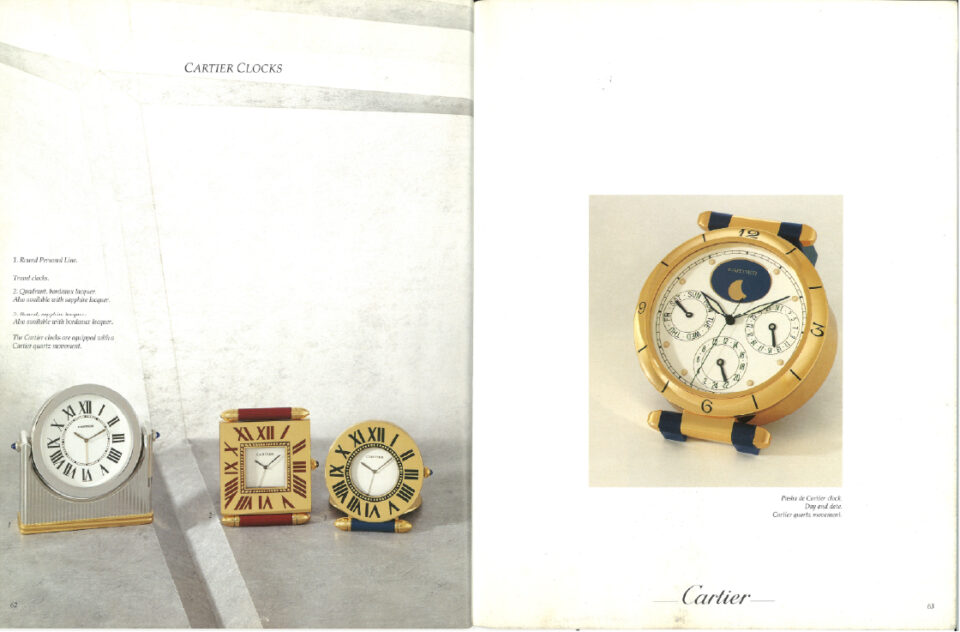
This brief foreword and exploration of the history of Cartier and its most representative models does not have an ambition for completeness. It is, however, useful to make the most of the two wonderful catalogues that The Vintageur puts at the disposal of fans and collectors of the brand from all over the world.
Through the pages rich in polychrome tables you can retrace the epic of one of the most illustrious brands in the history of watchmaking. From its foundation to the present day, Cartier has remained true to itself, to its enormous tradition and unique heritage, adapting to the evolution of techniques and technologies related to watchmaking without ever losing its unequalled style.
Have a good time.



PART V. CARTIER: MONOGRAPHIC CATALOGUE OF THE “PASHA” MODEL 1995